

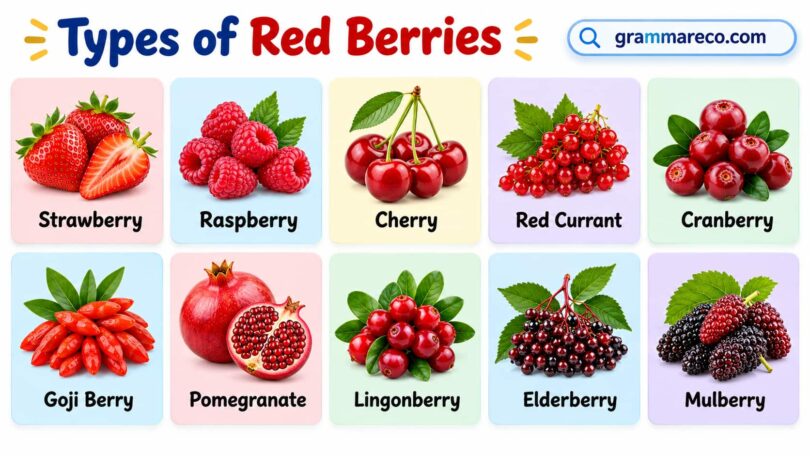
Red berries grow on trees, shrubs, vines, and low-growing plants in gardens, forests, and fields. Some are popular fruits used in desserts, jams, and drinks, while others provide food for birds and other wildlife. Common examples include strawberries, raspberries, cranberries, lingonberries, and red currants. Learning about the different types of red berries helps you recognize their shapes, colors, growing habits, and main characteristics. However, not every red berry is safe to eat, so correct identification is essential before picking wild fruit.
What Are Red Berries With Names and Examples?
Red berries are small, fleshy fruits that develop on many kinds of plants. Botanically, some familiar fruits called berries are not true berries, while other red fruits belong to different fruit types. Their shapes, flavors, leaves, and growing habits vary by species. The term red berries therefore describes a broad group of fruits rather than one botanical family.
Common red berry names include strawberries, raspberries, cranberries, red currants, lingonberries, and salmonberries. Some grow on cultivated plants, while others grow naturally in forests, wetlands, and mountain areas.
List of Types of Red Berries
Red berries differ in size, flavor, habitat, and plant structure. Some grow in hanging clusters, while others develop individually or in groups of tiny fruit sections. The following list includes familiar edible berries and selected wild or ornamental species.
- Strawberries
- Red Raspberries
- Cranberries
- Red Currants
- Salmonberries
- Lingonberries
- Red Huckleberries
- Thimbleberries
- Wineberries
- Red Gooseberries
- Bearberries
- Bunchberries
- Red Elderberries
- Red Baneberries
- Red Chokeberries
- Hawthorn Berries
- Dogwood Berries
- Pyracantha Berries
- Red Beautyberries
- Cloudberries
- Red Mulberries
- Dewberries
- Red Barberries
- Autumn Olive Berries
- Serviceberries, which may appear red before ripening
- Rose Hips
- Pin Cherries
- Red Cherries
- Red Grapes
Types of Red Berries With Names
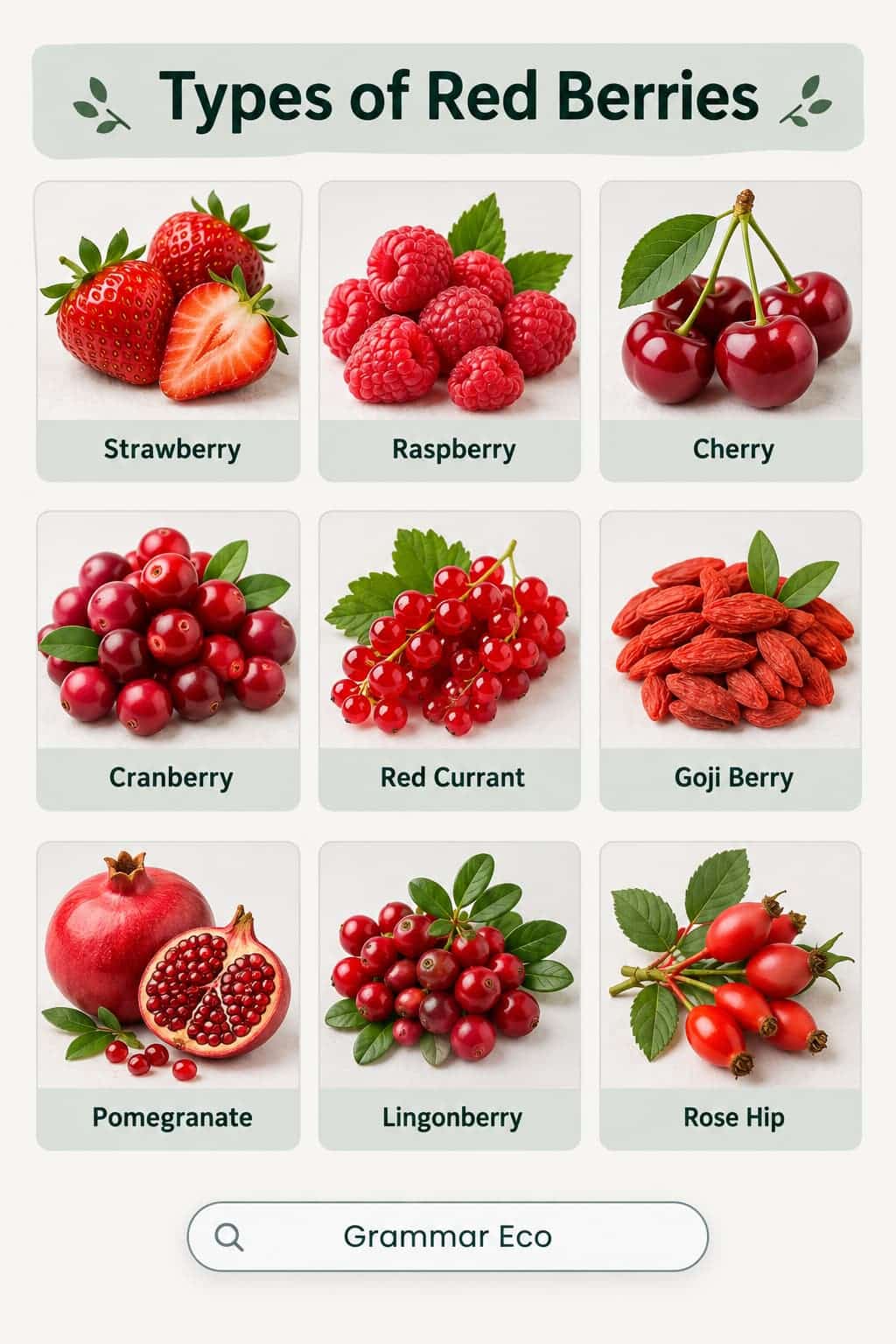
Types of Red berries include cultivated fruits, native wild species, and ornamental fruits that should not be eaten without reliable identification. Their leaves, stems, growth patterns, and fruit clusters help distinguish one species from another.
Strawberry
Strawberries (Fragaria × ananassa) are familiar red fruits with juicy flesh and tiny seeds across their outer surface. The plants grow close to the ground and produce runners that form new plants. Their sweet flavor suits fresh fruit salads, smoothies, desserts, jams, and breakfast dishes. Wild strawberries are usually smaller than cultivated garden varieties.
Red Raspberry
Red raspberries (Rubus idaeus and related cultivated varieties) consist of many small, rounded sections. A ripe raspberry usually separates from its central core, leaving a hollow center. The plants grow on woody canes, often with small prickles. Their sweet, slightly tart fruit is eaten fresh or used in pies, jams, yogurt, and sauces.
Cranberry
Cranberries (Vaccinium macrocarpon) are round, firm fruits produced by low-growing, trailing plants. They grow naturally in wetlands and are commercially cultivated in bogs. Their strong tart flavor makes them popular in juice, dried fruit, sauces, and baked goods. In the United States, cranberry sauce is especially associated with Thanksgiving meals.
Red Currant
Red currants (Ribes rubrum) are small, glossy fruits that hang in long strings from deciduous shrubs. Their thin, translucent skin allows the tiny seeds inside to be visible. The berries taste tart with a mild sweetness when ripe. People use them in jellies, sauces, fruit desserts, and preserves.
Salmonberry
Salmonberries (Rubus spectabilis) grow on shrubs in moist forests and streamside areas of northwestern North America. Their fruits resemble raspberries and range from yellow-orange to reddish orange. The flavor varies with ripeness and growing conditions. Properly identified salmonberries are edible and can be eaten fresh or used in preserves.
Lingonberry
Lingonberries (Vaccinium vitis-idaea) are small, round, bright red fruits produced by low evergreen shrubs. They grow in cool northern forests and open, acidic habitats. Their firm flesh has a sharp, tart taste, so they are often cooked with sugar. Lingonberries are popular in Scandinavian preserves, sauces, and dishes served with meat.
Red Huckleberry
Red huckleberries (Vaccinium parvifolium) grow on woody shrubs in moist forests of the Pacific Northwest. Their small, bright red fruits are often translucent and have a tart flavor. The plants may grow on decaying logs or forest soil. Properly identified fruits are edible, although their delicate texture and small size make harvesting slow.
Thimbleberry
Thimbleberries (Rubus parviflorus) produce soft red fruits shaped like tiny, open thimbles. The shrubs have broad, maple-like leaves and usually lack the sharp prickles found on many raspberry canes. They grow in woodland clearings and along trails across parts of western North America. The delicate berries are edible but bruise easily and do not store well.
Wineberry
Wineberries (Rubus phoenicolasius) are reddish orange to deep red fruits surrounded by a distinctive hairy, red calyx before ripening. The arching canes have fine reddish hairs and prickles. Native to East Asia, wineberry has become naturalized in parts of eastern North America. The ripe fruit is edible, but the plant can spread aggressively and is considered invasive in some areas.
Red Gooseberry
Red gooseberries are varieties of gooseberry (Ribes uva-crispa) that develop red or reddish purple fruit when ripe. The berries are round or oval, with thin skin and juicy flesh. Many plants have sharp thorns along their branches. Depending on the variety and ripeness, gooseberries taste tart or sweet. They are commonly used in pies, jams, sauces, and desserts.
Bearberry
Bearberry (Arctostaphylos uva-ursi) is a low-growing evergreen plant with leathery leaves and small red fruits. It grows in sandy soils, rocky areas, and cool open habitats across parts of North America. The berries are mealy and not usually eaten as a common fresh fruit. Plant identification matters because other red-fruited groundcovers may look similar.
Bunchberry
Bunchberry (Cornus canadensis) is a low woodland plant that produces a cluster of bright red fruits. Its leaves usually form a ring near the top of the stem, making it easier to recognize. It grows in cool forests across northern North America. Because its fruits are not commonly eaten, verify the plant’s identity and edibility before considering them for food.
Red Elderberry
Red elderberry (Sambucus racemosa) produces dense clusters of small red fruits on woody shrubs. It grows in forests, woodland edges, and streamside habitats across parts of North America. The plant can be confused with other elderberry species, so correct identification is essential. Raw red elderberries and other plant parts may cause illness. Do not eat them unless a reliable regional authority confirms safe preparation.
Red Baneberry
Red baneberry (Actaea rubra) is a woodland plant with clusters of shiny red berries and divided leaves. It grows in cool forests across parts of North America. Its fruit can look attractive, but the plant is poisonous to humans. Never eat red baneberries. Their appearance may resemble edible currants or other wild fruits, making careful plant identification essential.
Red Chokeberry
Red chokeberry (Aronia arbutifolia) is a deciduous shrub that produces clusters of small, red, apple-like fruits. Its leaves turn red in autumn, adding to its ornamental appeal. The fruit is edible but strongly astringent when fresh. It is sometimes used in jams, juices, and cooked preparations. Red chokeberry is native to eastern North America.
Hawthorn Berries
Hawthorn trees and shrubs (Crataegus species) produce small red fruits often called haws. The fruits may have one or several hard seeds, depending on the species. Hawthorns grow in woodlands, hedgerows, and landscaped areas. Some species have edible fruits used in jellies and cooked foods, but identification is necessary because the genus contains many different species.
Dogwood Berries
Some dogwood species produce bright red fruits in late summer or fall. Flowering dogwood (Cornus florida) and other dogwoods can be recognized by their woody growth and distinctive leaves. Edibility differs among species, and many dogwood fruits are not commonly eaten by people. Do not assume that red dogwood berries are safe simply because birds eat them.
Pyracantha Berries
Pyracantha, commonly called firethorn, is an ornamental shrub with sharp thorns and dense clusters of orange-red to red fruits. It is frequently planted along fences and garden walls. Although the berries attract birds, they are not recommended as a casual food because large amounts may cause stomach upset. Avoid eating ornamental berries unless their identity and safe use are confirmed.
Red Beautyberry
Some plants called beautyberry produce red fruits, including coralberry (Ardisia crenata), an ornamental evergreen shrub in warm regions. Its bright clusters can remain on the plant after flowering. The name beautyberry covers different plants, and their fruits do not all have the same edibility. Treat unfamiliar ornamental red berries as unsafe unless a trusted botanical source confirms the species.
Cloudberry
Cloudberry (Rubus chamaemorus) is a low-growing plant of northern bogs and cool, wet habitats. Its ripe fruit is usually amber or golden orange rather than red, while unripe fruit may appear reddish. It is sometimes mistaken for a red berry during early development. Only properly identified, ripe cloudberries should be used as food.
Red Mulberry
Red mulberry (Morus rubra) is a North American tree that produces elongated clusters of small fruit sections. The fruits may be red before turning dark purple when fully ripe. Mature mulberries are juicy and sweet, while less ripe fruits can taste tart. The fruit is commonly eaten fresh or used in jams, pies, and other desserts.
Dewberry
Dewberries are trailing bramble plants related to blackberries and raspberries. Their fruit may look red before ripening to a darker color, depending on the species. They grow along field edges, roadsides, and open woodland areas. Properly identified ripe dewberries are edible and can be used in pies, preserves, and sauces.
Red Barberry
Barberry shrubs (Berberis species) produce small oval fruits that may be red, orange-red, or dark red. Many species have thorny branches and small leaves. Some barberry species have edible fruit used in particular regional cuisines, but the name refers to many different plants. Do not eat ornamental barberries without confirming the species and checking a reliable food-safety source.
Autumn Olive Berries
Autumn olive (Elaeagnus umbellata) is a shrub that produces small red fruits with silvery speckles. It grows in fields, roadsides, and disturbed areas across parts of North America. The ripe fruits are edible, tart, and often used in jams. However, the shrub is invasive in many regions, so harvesting or planting it may be discouraged locally.
Rose Hips
Rose hips are the red or reddish orange fruits of rose plants (Rosa species). They usually develop after the flowers fade and may remain on the plant into fall or winter. Rose hips contain seeds surrounded by fleshy tissue. Some species are used in teas, jams, and syrups, but the seeds and irritating hairs should be removed during preparation.
Pin Cherries
Pin cherries (Prunus pensylvanica) are small, bright red fruits that grow in clusters on trees native to northern North America. The fruit has a thin skin, juicy flesh, and a hard central pit. The ripe flesh can be used in cooked foods, but the pits should not be crushed or eaten.
Red Cherries
Many cultivated cherry varieties produce red fruit, including sweet cherries (Prunus avium) and sour cherries (Prunus cerasus). The fruits have smooth skin, juicy flesh, and one hard pit. Sweet cherries are often eaten fresh, while sour cherries are popular in pies, preserves, and sauces. Avoid eating the pits.
Red Grapes
Red grapes (Vitis vinifera and other grape species) grow in clusters on woody vines. Their smooth skins range from pinkish red to deep red or purple. Table grapes are usually eaten fresh, while some varieties are used for juice, raisins, and wine. Grapes are botanically true berries, unlike strawberries.
Red Juniper Cones
Some juniper species produce fleshy, berry-like cones that may be red before maturity or blue when ripe. Their appearance depends on the species. Juniper cones are not ordinary berries, and not every species is suitable for food. Never consume them without confirming the exact plant and checking a reliable botanical source.
Wild Red Berries Names
Wild red berries grow naturally in forests, wetlands, meadows, mountain areas, and along streams. Some are edible native fruits, while others are poisonous or belong to invasive plants. The following names include species encountered in parts of North America.
- Wild Strawberry
- American Red Raspberry
- Salmonberry
- Red Huckleberry
- Thimbleberry
- Lingonberry
- Bearberry
- Bunchberry
- Red Elderberry
- Red Baneberry
- Red Chokeberry
- Red Mulberry
- Dewberry
- Red Hawthorn
- Red Gooseberry
- Wineberry
- Cloudberry
- Red Currant
- Cranberry
- Autumn Olive
- Rose Hips
- Pin Cherry
- Red Barberry
Safety note: Never identify a wild berry by color alone. Check the plant’s leaves, stem, fruit arrangement, and habitat using a reliable regional identification resource. Some poisonous berries closely resemble edible fruits, and a photograph alone may not be enough to identify a plant safely.
Red Berries That Grow on Bushes
Many red berries grow on shrubs with woody stems, although some berry-producing plants spread along the ground or climb over other plants. Bush height, leaf shape, thorns, and fruit clusters help distinguish the species.
| Berry Name | Plant Type | Typical Fruit Appearance |
|---|---|---|
| Red Currant | Deciduous shrub | Small, translucent red clusters |
| Red Gooseberry | Thorny shrub | Round or oval red fruits |
| Red Raspberry | Woody cane shrub | Soft, hollow-centered red fruits |
| Salmonberry | Deciduous shrub | Red to orange raspberry-like fruits |
| Red Huckleberry | Woodland shrub | Small, bright red fruits |
| Lingonberry | Low evergreen shrub | Small, firm red fruits |
| Red Chokeberry | Deciduous shrub | Dense clusters of red fruits |
| Red Elderberry | Woody shrub | Clusters of small red fruits |
| Wineberry | Arching cane shrub | Hairy, red-orange fruits |
| Autumn Olive | Deciduous shrub | Speckled red fruits |
| Hawthorn | Shrub or small tree | Small red fruits with hard seeds |
| Pyracantha | Thorny ornamental shrub | Dense orange-red fruit clusters |
| Barberry | Thorny shrub | Small oval red fruits |
| Bearberry | Low evergreen shrub | Round red fruits |
| Thimbleberry | Deciduous shrub | Soft, thimble-shaped red fruits |
Not every shrub produces edible fruit, and some plants have poisonous parts. Always verify the botanical identity before eating berries from a garden, roadside, or forest.
Red Berries Found in North America
North America has many native and cultivated plants that produce red fruits. Their habitats range from wet cranberry bogs in the Northeast to Pacific coastal forests and woodland edges. Some species also grow in gardens and farms throughout the United States.
| Red Berry Name | Where It Grows | Key Characteristic |
|---|---|---|
| American Cranberry | Northeastern United States and Canada | Firm, tart fruits from wetland plants |
| American Red Raspberry | Much of North America | Soft, red fruits on woody canes |
| Salmonberry | Pacific Northwest and Alaska | Raspberry-like orange-red fruits |
| Red Huckleberry | Pacific Northwest | Bright red woodland fruits |
| Thimbleberry | Western and northern regions | Soft fruits with broad-leaved plants |
| Wild Strawberry | Many regions | Small, sweet fruits close to the ground |
| Red Currant | Cultivated gardens and some naturalized areas | Translucent berries in hanging clusters |
| Red Gooseberry | Cultivated gardens and selected wild areas | Round fruits on often thorny shrubs |
| Red Elderberry | Northern and western regions, among other areas | Dense red fruit clusters |
| Red Baneberry | Woodlands in northern and eastern regions | Shiny red fruits that are poisonous |
| Red Chokeberry | Eastern North America | Astringent fruits on deciduous shrubs |
| Red Mulberry | Eastern and central regions | Elongated fruit that darkens when ripe |
| Dewberry | Eastern and central regions | Low, trailing bramble growth |
| Hawthorn | Many regions | Small red fruits on thorny trees or shrubs |
| Bunchberry | Northern forests | Red fruit clusters on low woodland plants |
| Bearberry | Northern and western regions | Low evergreen groundcover |
| Autumn Olive | Naturalized across many areas | Speckled red fruit on an invasive shrub |
| Wineberry | Parts of eastern North America | Red-orange fruits surrounded by hairy calyxes |
Which Red Berries Are Edible?
Many red berries are edible and can be enjoyed fresh, cooked, or dried. Common edible red berries include strawberries, raspberries, red currants, cranberries, lingonberries, and red gooseberries. Some wild berries, such as salmonberries and thimbleberries, are also edible when correctly identified. However, not every red berry is safe to eat. Certain poisonous berries look similar to edible varieties, so never eat wild berries based on color alone. Always confirm the plant’s identity using reliable botanical information before consuming it.
Benefits of Red Berries at a Glance
Edible red berries provide nutrients that vary by species and serving size. Many contain fiber, vitamin C, and plant compounds such as anthocyanins and other polyphenols. Eating a variety of whole fruits can contribute to a balanced diet, but no single berry prevents or cures disease.
| Red Berry | Nutritional Features | Common Food Uses |
|---|---|---|
| Strawberries | Vitamin C, fiber, and folate | Fresh fruit, smoothies, salads |
| Red Raspberries | Fiber, vitamin C, and polyphenols | Oatmeal, yogurt, jams |
| Cranberries | Polyphenols and vitamin C | Sauces, juice, dried fruit |
| Red Currants | Vitamin C and fiber | Jellies, sauces, desserts |
| Lingonberries | Fiber and plant polyphenols | Preserves, sauces |
| Salmonberries | Vitamin C and fiber | Fresh fruit, cooked preserves |
| Red Huckleberries | Fiber and various plant compounds | Sauces, baked foods |
| Thimbleberries | Vitamin C and fiber | Fresh fruit, jams |
| Red Gooseberries | Vitamin C and fiber | Pies, cooked desserts |
| Red Mulberries | Vitamin C, fiber, and plant pigments | Smoothies, pies, preserves |
| Red Chokeberries | Polyphenols and anthocyanins | Cooked sauces and juices |
| Red Hawthorn Fruits | Fiber and plant compounds that vary by species | Jellies and cooked preparations |
Nutrient levels depend on the variety, ripeness, storage, and preparation method. Sweetened juices, jams, and dried berries may contain added sugar, so check the product label when comparing foods. These benefits apply to edible, correctly identified fruit, not to every plant with red berries.
FAQs About Types of Red Berries
Common red berries include strawberries, raspberries, cranberries, red currants, lingonberries, salmonberries, and red gooseberries. Availability varies by region.
Strawberries, raspberries, cranberries, and red currants are familiar edible fruits. Wild berries require reliable identification before consumption.
Wild strawberries, salmonberries, red huckleberries, thimbleberries, cranberries, and some currants grow naturally in suitable habitats across North America.
No. Many red berries are edible, but others, including red baneberries, are poisonous. Never judge edibility by color alone.
Many edible red berries provide vitamin C, fiber, and plant compounds. Their nutritional content varies by species, serving size, and preparation.
Key Takeaway
Red berries include familiar edible fruits, such as strawberries and raspberries, as well as wild and ornamental species. Their colors and shapes can look similar, but their safety differs. Learn the berry names, compare identifying features, and verify edibility before consuming any unfamiliar fruit.
Read more