
Ever wondered why you can’t count words like water or sugar? Mass noun examples help you understand uncountable things in English grammar. These include liquids, substances, and abstract materials used daily.
Learning them improves sentence accuracy and fluency. Ready to master uncountable nouns easily? Let’s explore them step by step.
What Are Mass Nouns and Examples?
Mass noun examples are uncountable nouns that represent substances, materials, or concepts that cannot be counted individually. They are used with quantities rather than numbers. Let’s explore simple examples to build clarity.
- Water:
- A liquid essential for life
- Rice:
- A grain eaten as food
- Sugar:
- A sweet substance used in food
- Air:
- The invisible gas we breathe
- Sand:
- Fine particles found on beaches
List of Mass Noun Examples in Sentences
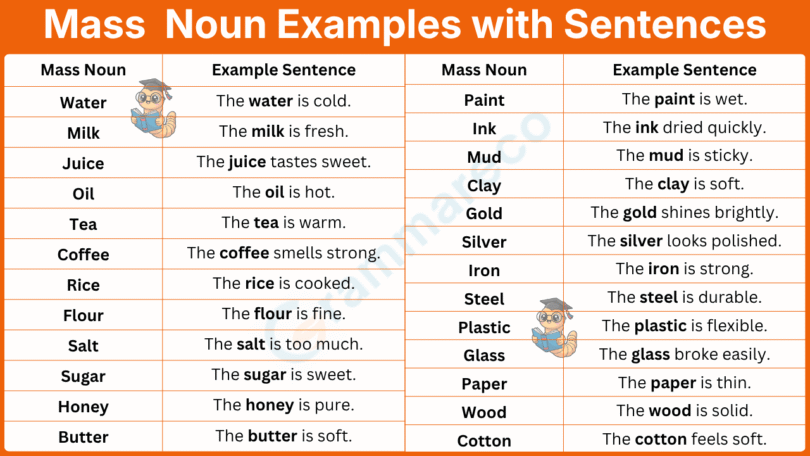
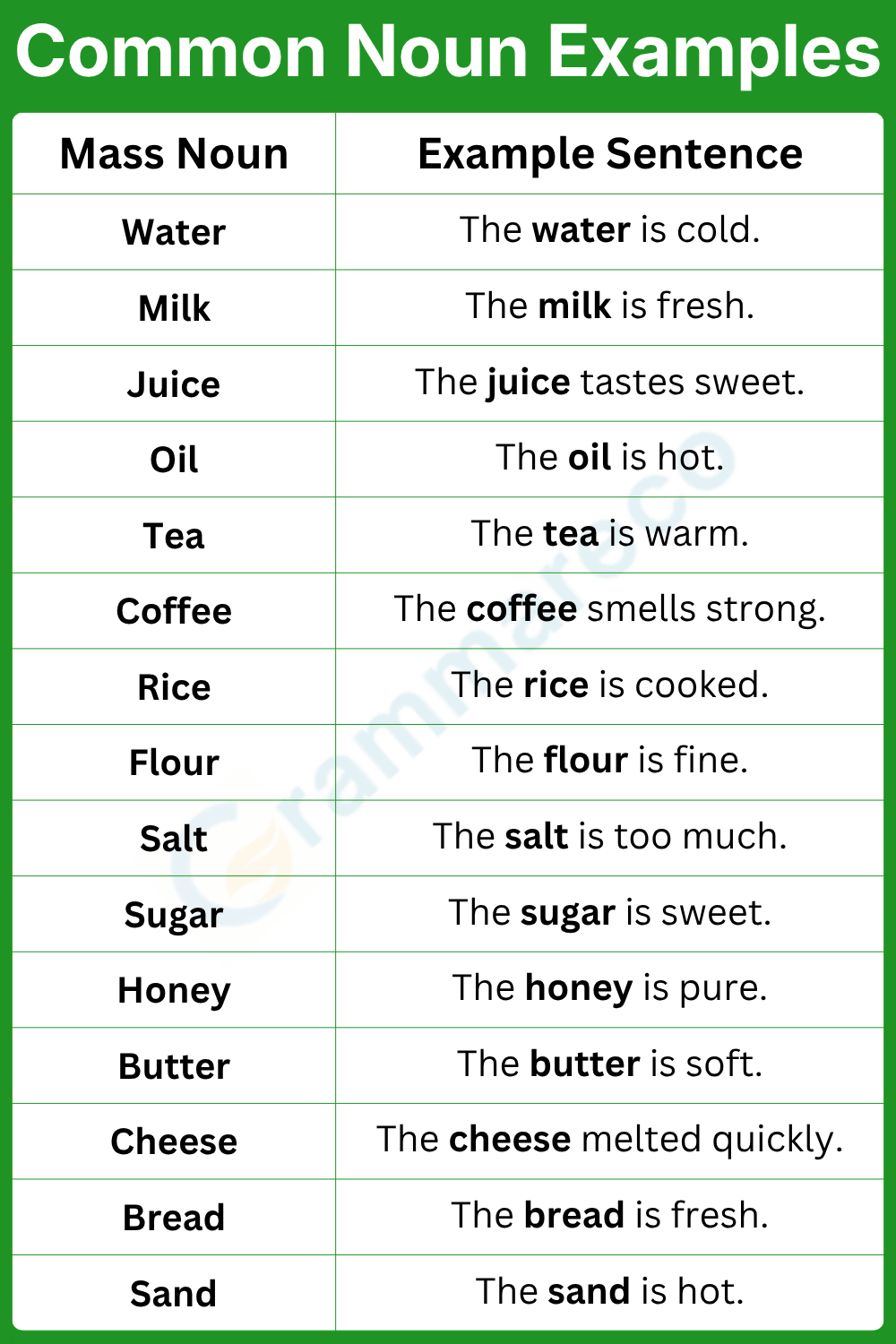
Mass noun examples are used to describe uncountable things in sentences. These nouns usually do not have plural forms and are measured instead of counted.
| Mass Noun | Example Sentence |
|---|---|
| Water | The water is cold. |
| Milk | The milk is fresh. |
| Juice | The juice tastes sweet. |
| Oil | The oil is hot. |
| Tea | The tea is warm. |
| Coffee | The coffee smells strong. |
| Rice | The rice is cooked. |
| Flour | The flour is fine. |
| Salt | The salt is too much. |
| Sugar | The sugar is sweet. |
| Honey | The honey is pure. |
| Butter | The butter is soft. |
| Cheese | The cheese melted quickly. |
| Bread | The bread is fresh. |
| Sand | The sand is hot. |
| Dust | The dust covered the table. |
| Smoke | The smoke filled the air. |
| Steam | The steam rose quickly. |
| Air | The air feels fresh. |
| Fog | The fog reduced visibility. |
Examples Common Mass Nouns with Pictures
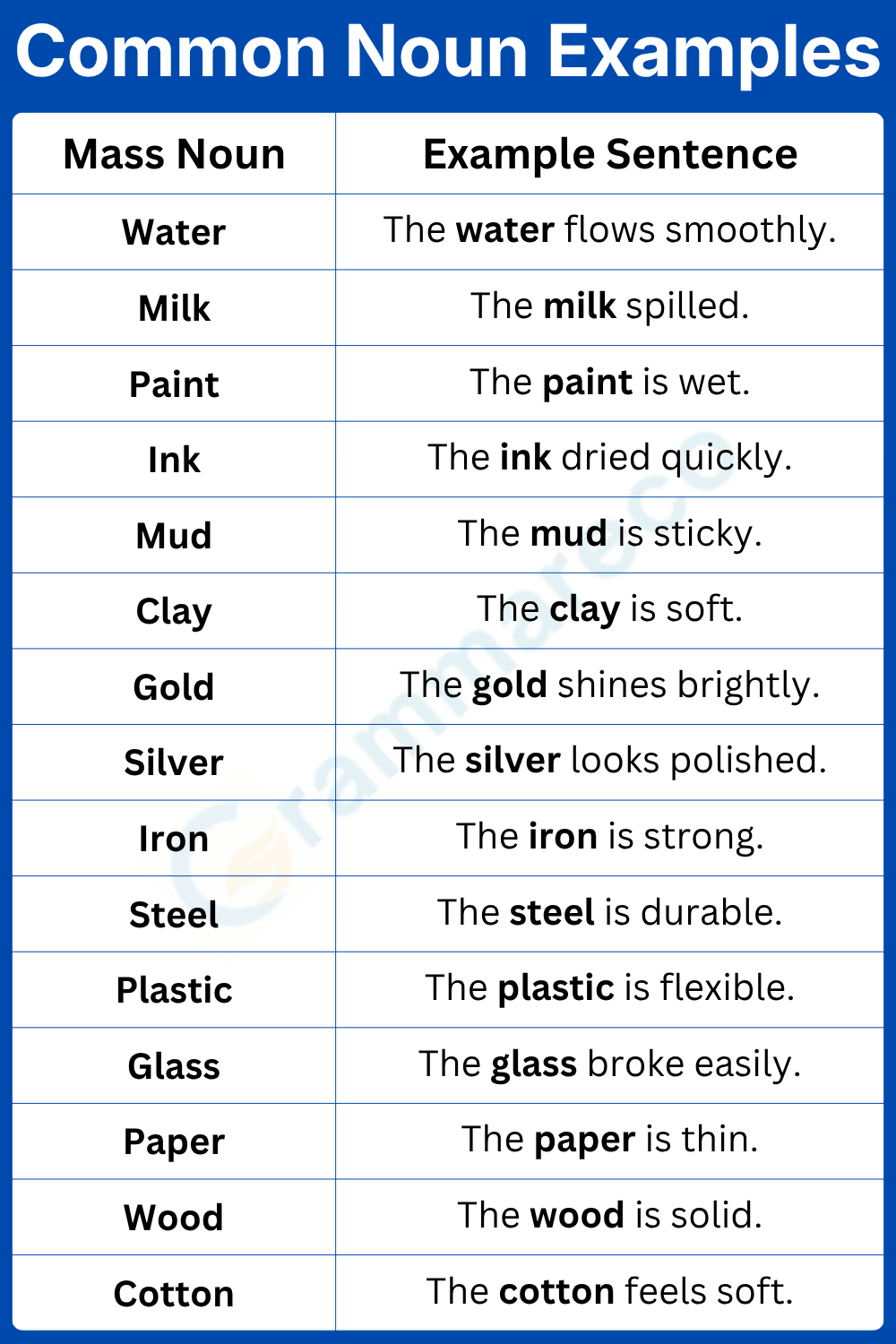
Mass noun examples represent substances you can see or imagine as a whole, not as separate units. These examples help visualize uncountable nouns clearly.
| Mass Noun | Example Sentence |
|---|---|
| Water | The water flows smoothly. |
| Milk | The milk spilled. |
| Paint | The paint is wet. |
| Ink | The ink dried quickly. |
| Mud | The mud is sticky. |
| Clay | The clay is soft. |
| Gold | The gold shines brightly. |
| Silver | The silver looks polished. |
| Iron | The iron is strong. |
| Steel | The steel is durable. |
| Plastic | The plastic is flexible. |
| Glass | The glass broke easily. |
| Paper | The paper is thin. |
| Wood | The wood is solid. |
| Cotton | The cotton feels soft. |
| Wool | The wool is warm. |
| Leather | The leather is durable. |
| Rubber | The rubber stretches easily. |
| Soil | The soil is fertile. |
| Ice | The ice melted quickly. |
Mass Nouns Examples for Liquid, Substances and more
Mass noun examples often include liquids, materials, gases, and food substances. These categories help learners understand how uncountable nouns are used in real contexts.
- Liquids: Water, Milk, Oil, Juice, Tea
- Food Substances: Rice, Flour, Sugar, Salt, Butter
- Materials: Wood, Glass, Steel, Plastic, Cotton
- Natural Elements: Air, Sand, Soil, Smoke, Fog
These categories make it easier to identify and use mass noun examples correctly in sentences.
Countable vs Mass Nouns Examples (Easy Comparison)
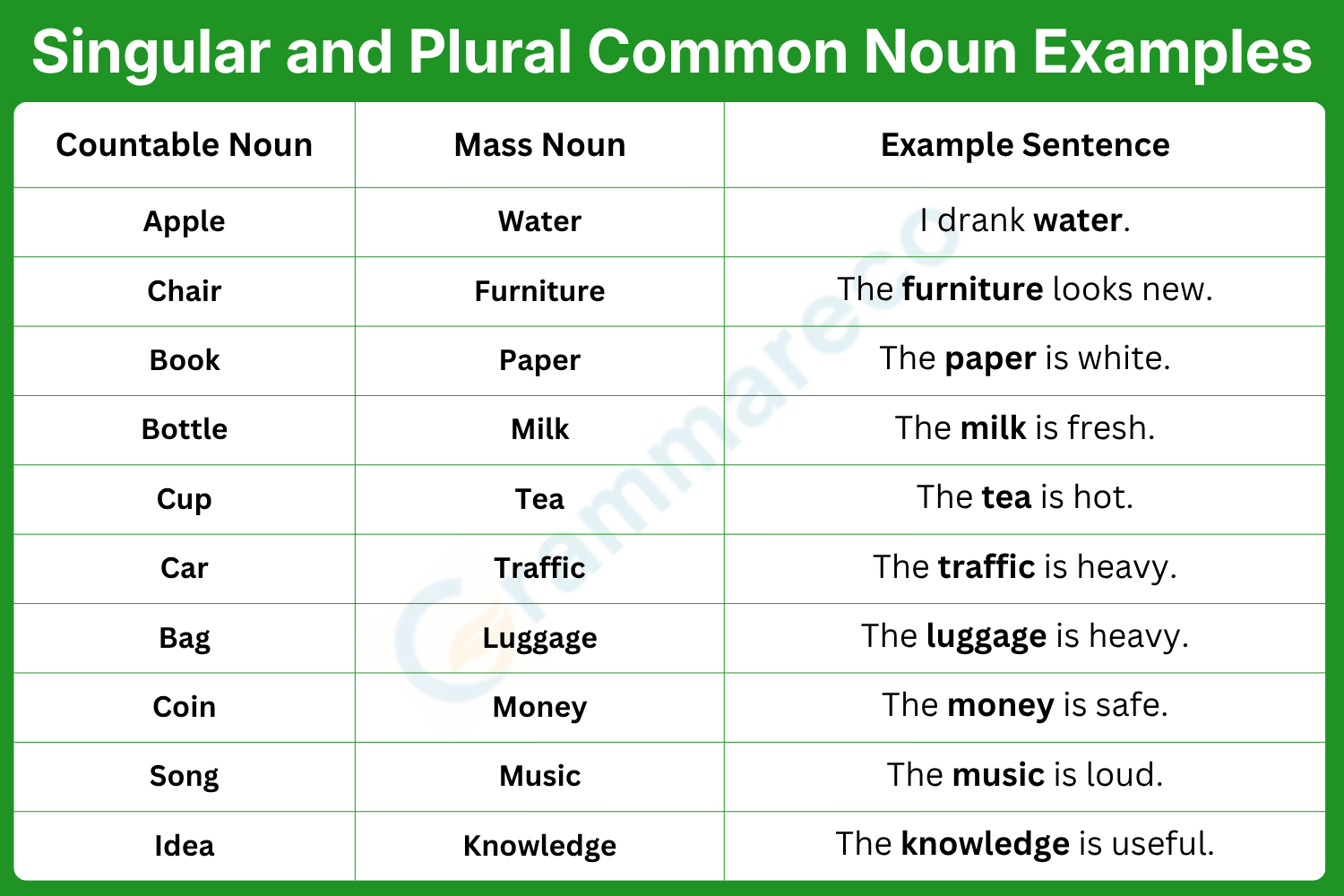
Mass noun examples differ from countable nouns because they cannot be counted individually. This comparison helps clarify usage and grammar rules effectively.
| Countable Noun | Mass Noun | Example Sentence |
|---|---|---|
| Apple | Water | I drank water. |
| Chair | Furniture | The furniture looks new. |
| Book | Paper | The paper is white. |
| Bottle | Milk | The milk is fresh. |
| Cup | Tea | The tea is hot. |
| Car | Traffic | The traffic is heavy. |
| Bag | Luggage | The luggage is heavy. |
| Coin | Money | The money is safe. |
| Song | Music | The music is loud. |
| Idea | Knowledge | The knowledge is useful. |
FAQs about Mass Nouns Examples
Mass nouns are uncountable nouns that cannot be counted individually, like water, rice, or sugar.
Examples include water, milk, sand, air, and rice.
No, most mass nouns do not have plural forms because they are uncountable.
Yes, liquids like water, milk, and oil are mass nouns.
Read more