
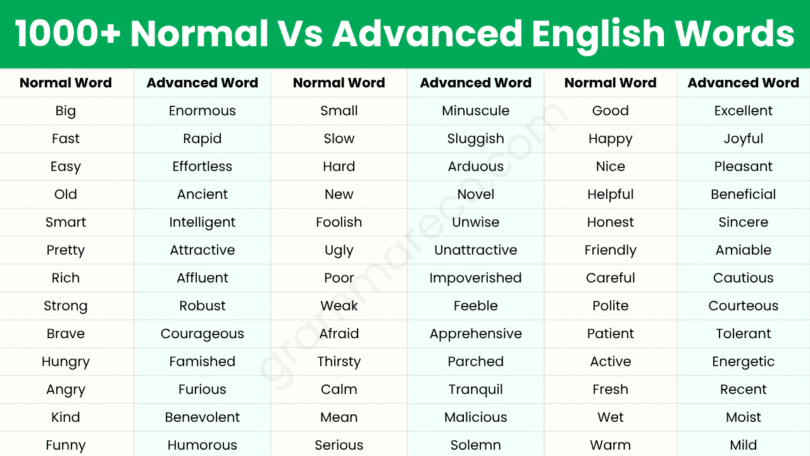
Normal English words are common words used in everyday conversations, while advanced English words are often more formal, precise, or less common. Normal vs advanced English words can differ in tone, strength, and context, so learners should understand how each alternative works before replacing one word with another. The right choice depends on the situation, audience, and meaning intended.
This article covers everyday alternatives, positive and negative terms, difficult vocabulary, five-letter words, meanings, and sentence examples. Learning these normal and advanced English words can help learners choose suitable language for school, work, conversations, and formal communication.
What Are Normal and Advanced English Words?
Normal English usually uses familiar words that people hear often in everyday communication. Advanced English uses less common, more precise, academic, or formal words when the situation requires a different level of expression.
For example, “help” is common, while “assist” is more formal. “Buy” is normal, while “purchase” often sounds more formal.
Advanced does not always mean better. A common word can be the best choice when it communicates an idea naturally.
How to Go From Basic to Advanced English Vocabulary
Learning common words first gives you a strong base for understanding more formal alternatives. Instead of memorizing isolated synonyms, connect each advanced word with its meaning, context, and sentence pattern.
Use small groups of related words and review them regularly. Reading short articles, writing sentences, and learning words through pictures can also help you recognize how normal and advanced terms differ.
When Should You Use Advanced English Words?
Advanced words work best when their meaning fits the situation and audience. Formal vocabulary can suit school assignments, reports, academic writing, presentations, and professional communication.
Everyday conversations usually sound more natural with common words. Avoid replacing every simple word with a difficult synonym because advanced vocabulary can sometimes sound unnatural or change the intended meaning.
Easy Normal Vs Advanced English Words for Everyday
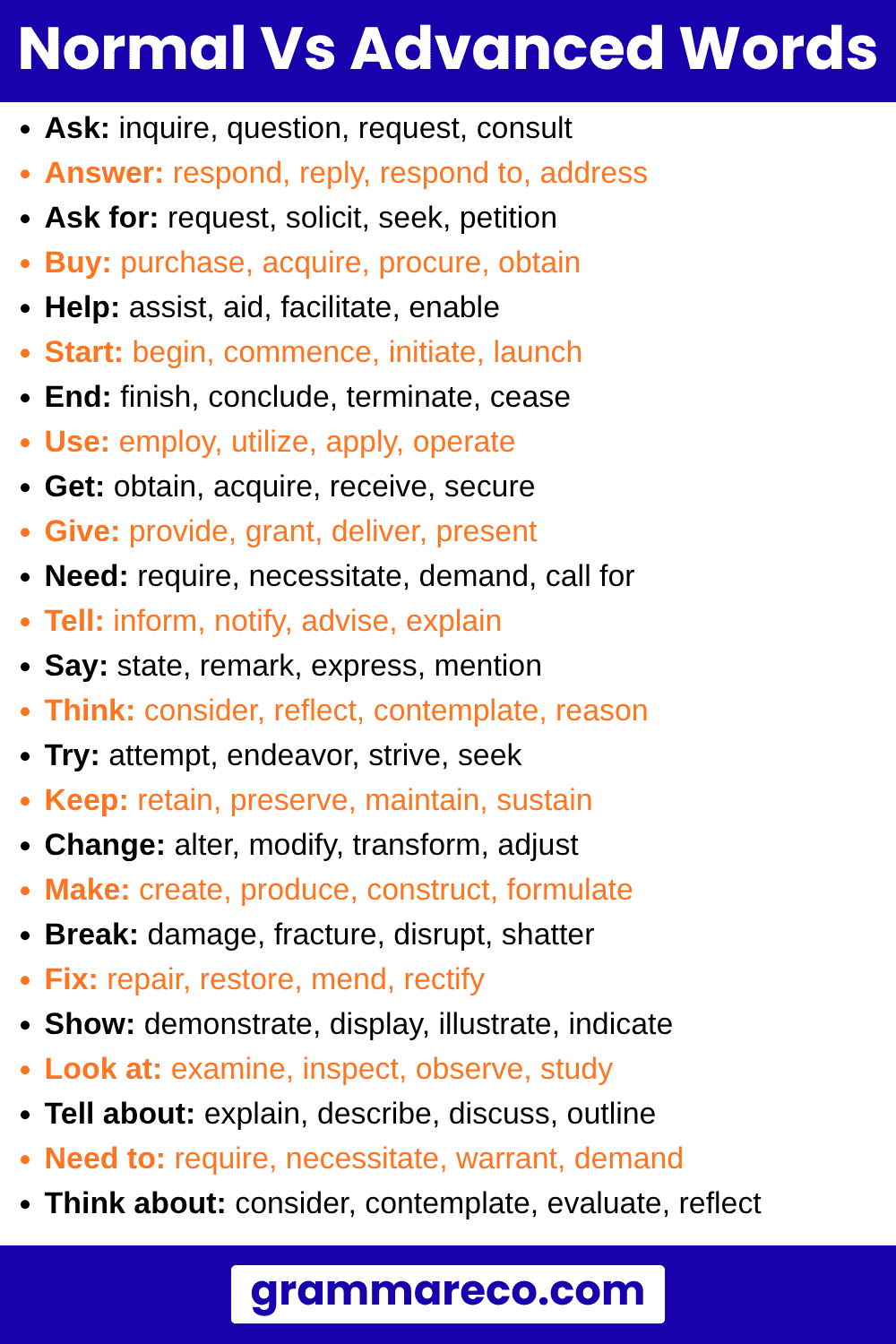
- Ask: inquire, question, request, consult
- Answer: respond, reply, respond to, address
- Ask for: request, solicit, seek, petition
- Buy: purchase, acquire, procure, obtain
- Help: assist, aid, facilitate, enable
- Start: begin, commence, initiate, launch
- End: finish, conclude, terminate, cease
- Use: employ, utilize, apply, operate
- Get: obtain, acquire, receive, secure
- Give: provide, grant, deliver, present
- Need: require, necessitate, demand, call for
- Tell: inform, notify, advise, explain
- Say: state, remark, express, mention
- Think: consider, reflect, contemplate, reason
- Try: attempt, endeavor, strive, seek
- Keep: retain, preserve, maintain, sustain
- Change: alter, modify, transform, adjust
- Make: create, produce, construct, formulate
- Break: damage, fracture, disrupt, shatter
- Fix: repair, restore, mend, rectify
- Show: demonstrate, display, illustrate, indicate
- Look at: examine, inspect, observe, study
- Tell about: explain, describe, discuss, outline
- Need to: require, necessitate, warrant, demand
- Think about: consider, contemplate, evaluate, reflect
- Help with: assist, facilitate, contribute to, aid
- Go up: increase, rise, ascend, escalate
- Go down: decrease, decline, descend, diminish
- Give back: return, restore, repay, reimburse
- Leave: depart, exit, withdraw, vacate
- Live: reside, dwell, inhabit, remain
- Work: labor, operate, function, perform
- Use up: consume, exhaust, deplete, expend
- Look for: seek, search, pursue, investigate
- Deal with: handle, manage, address, resolve
- Talk about: discuss, address, examine, consider
- Think deeply: contemplate, deliberate, ponder, reflect
- Make better: improve, enhance, strengthen, refine
- Make worse: worsen, aggravate, intensify, deteriorate
Normal Vs Advanced English Words for Everyday
Everyday vocabulary contains many short words that can be replaced by more formal alternatives in suitable contexts. The pairs below focus on common actions, qualities, and situations without repeating vocabulary used in the later sections.
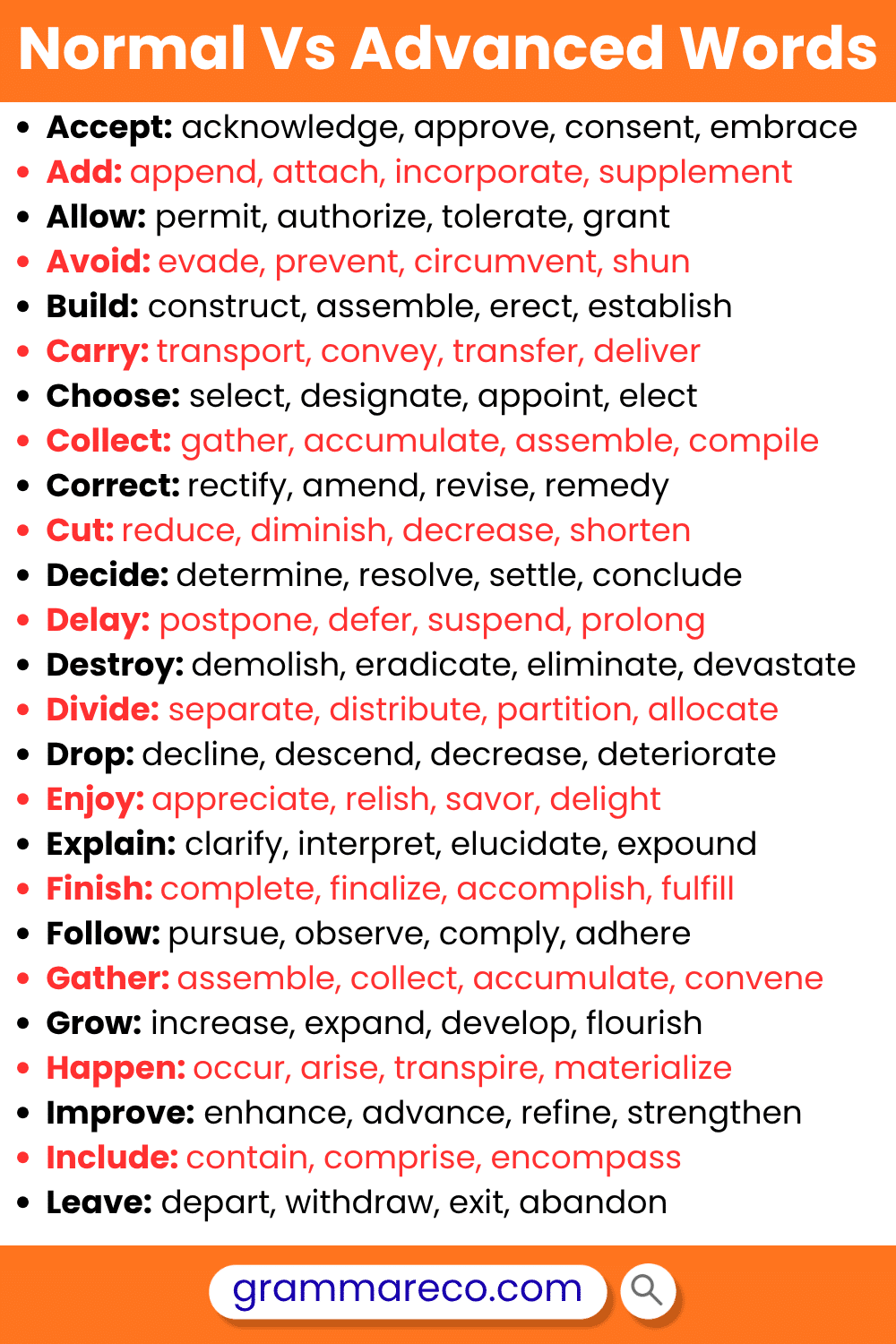
- Accept: acknowledge, approve, consent, embrace
- Add: append, attach, incorporate, supplement
- Allow: permit, authorize, tolerate, grant
- Avoid: evade, prevent, circumvent, shun
- Build: construct, assemble, erect, establish
- Carry: transport, convey, transfer, deliver
- Choose: select, designate, appoint, elect
- Collect: gather, accumulate, assemble, compile
- Correct: rectify, amend, revise, remedy
- Cut: reduce, diminish, decrease, shorten
- Decide: determine, resolve, settle, conclude
- Delay: postpone, defer, suspend, prolong
- Destroy: demolish, eradicate, eliminate, devastate
- Divide: separate, distribute, partition, allocate
- Drop: decline, descend, decrease, deteriorate
- Enjoy: appreciate, relish, savor, delight
- Explain: clarify, interpret, elucidate, expound
- Finish: complete, finalize, accomplish, fulfill
- Follow: pursue, observe, comply, adhere
- Gather: assemble, collect, accumulate, convene
- Grow: increase, expand, develop, flourish
- Happen: occur, arise, transpire, materialize
- Improve: enhance, advance, refine, strengthen
- Include: contain, comprise, encompass, incorporate
- Leave: depart, withdraw, exit, abandon
- Mention: state, note, cite, reference
- Offer: propose, present, provide, extend
- Organize: arrange, coordinate, structure, systematize
- Prepare: arrange, formulate, organize, ready
- Receive: obtain, accept, acquire, collect
- Reduce: lessen, minimize, decrease, curtail
- Remove: eliminate, extract, detach, eradicate
- Repair: restore, mend, renovate, refurbish
- Return: restore, repay, revert, reciprocate
- Save: conserve, preserve, reserve, economize
- Send: transmit, dispatch, forward, deliver
- Start: initiate, launch, inaugurate, originate
- Stop: cease, halt, discontinue, terminate
- Suggest: propose, recommend, advise, advocate
- Understand: comprehend, grasp, perceive, apprehend
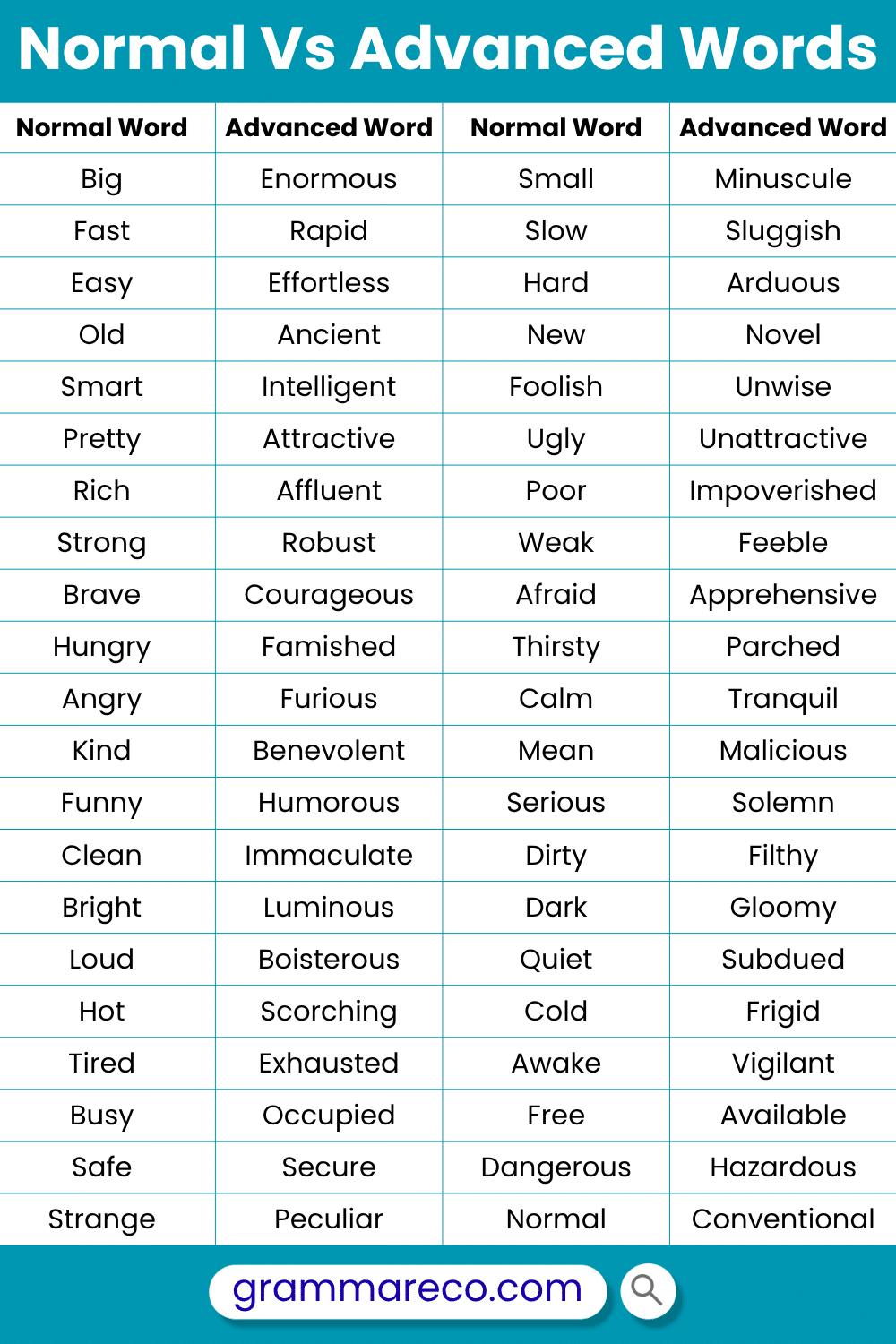
Normal Vs Advanced English Vocabulary Words
| Normal Word | Advanced Word | Normal Word | Advanced Word |
|---|---|---|---|
| Big | Enormous | Small | Minuscule |
| Fast | Rapid | Slow | Sluggish |
| Easy | Effortless | Hard | Arduous |
| Old | Ancient | New | Novel |
| Smart | Intelligent | Foolish | Unwise |
| Pretty | Attractive | Ugly | Unattractive |
| Rich | Affluent | Poor | Impoverished |
| Strong | Robust | Weak | Feeble |
| Brave | Courageous | Afraid | Apprehensive |
| Hungry | Famished | Thirsty | Parched |
| Angry | Furious | Calm | Tranquil |
| Kind | Benevolent | Mean | Malicious |
| Funny | Humorous | Serious | Solemn |
| Clean | Immaculate | Dirty | Filthy |
| Bright | Luminous | Dark | Gloomy |
| Loud | Boisterous | Quiet | Subdued |
| Hot | Scorching | Cold | Frigid |
| Tired | Exhausted | Awake | Vigilant |
| Busy | Occupied | Free | Available |
| Safe | Secure | Dangerous | Hazardous |
| Strange | Peculiar | Normal | Conventional |
| Quick | Swift | Late | Delayed |
| Near | Adjacent | Far | Remote |
| Empty | Vacant | Full | Saturated |
| Cheap | Inexpensive | Costly | Expensive |
| Thin | Slender | Thick | Dense |
| Young | Juvenile | Mature | Adult |
| Famous | Renowned | Unknown | Obscure |
| Beautiful | Gorgeous | Plain | Unremarkable |
| Useful | Practical | Useless | Futile |
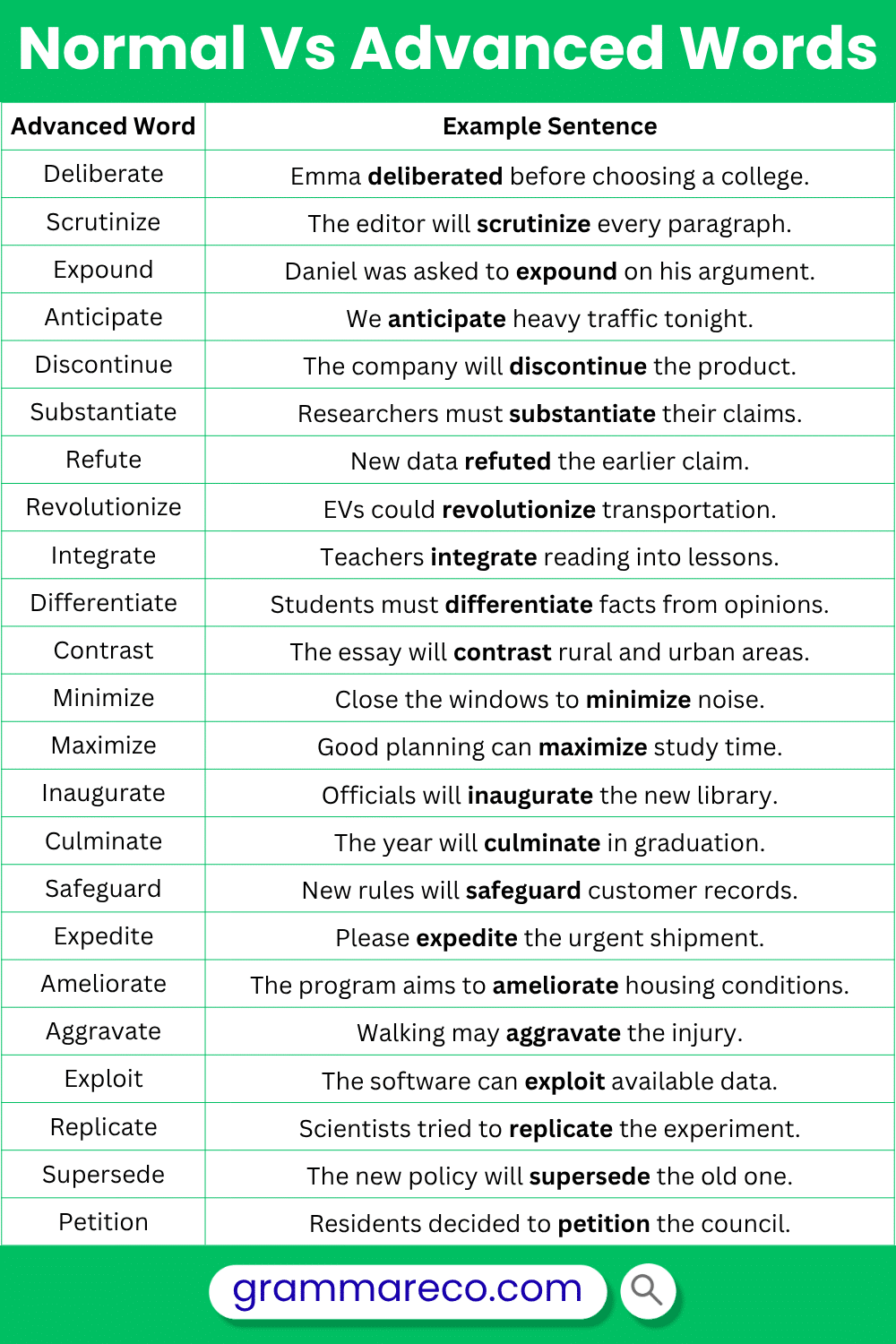
Advanced English Words With Example Sentences
| Advanced Word | Short Example Sentence |
|---|---|
| Deliberate | Emma deliberated before choosing a college. |
| Scrutinize | The editor will scrutinize every paragraph. |
| Expound | Daniel was asked to expound on his argument. |
| Anticipate | We anticipate heavy traffic tonight. |
| Discontinue | The company will discontinue the product. |
| Substantiate | Researchers must substantiate their claims. |
| Refute | New data refuted the earlier claim. |
| Revolutionize | EVs could revolutionize transportation. |
| Integrate | Teachers integrate reading into lessons. |
| Differentiate | Students must differentiate facts from opinions. |
| Contrast | The essay will contrast rural and urban areas. |
| Minimize | Close the windows to minimize noise. |
| Maximize | Good planning can maximize study time. |
| Inaugurate | Officials will inaugurate the new library. |
| Culminate | The year will culminate in graduation. |
| Safeguard | New rules will safeguard customer records. |
| Expedite | Please expedite the urgent shipment. |
| Ameliorate | The program aims to ameliorate housing conditions. |
| Aggravate | Walking may aggravate the injury. |
| Exploit | The software can exploit available data. |
| Replicate | Scientists tried to replicate the experiment. |
| Supersede | The new policy will supersede the old one. |
| Petition | Residents decided to petition the council. |
| Concur | Researchers concur with the conclusion. |
| Dissent | One member chose to dissent from the decision. |
| Participate | Students should participate in discussions. |
| Resign | The director decided to resign. |
| Persist | If you persist, you will improve. |
| Disseminate | The organization will disseminate the findings. |
| Consolidate | The company will consolidate several departments. |
| Abolish | The organization voted to abolish the rule. |
| Compress | The program can compress large files. |
| Disclose | The report must disclose financial information. |
| Emerge | New patterns began to emerge. |
| Recur | Similar problems may recur. |
| Proffer | The lawyer proffered additional evidence. |
| Prohibit | School rules prohibit entry here. |
| Neglect | Do not neglect small problems. |
| Persevere | Sarah persevered despite difficulties. |
| Hesitate | Do not hesitate to ask questions. |
Explore Basic Vs Advanced Words in English
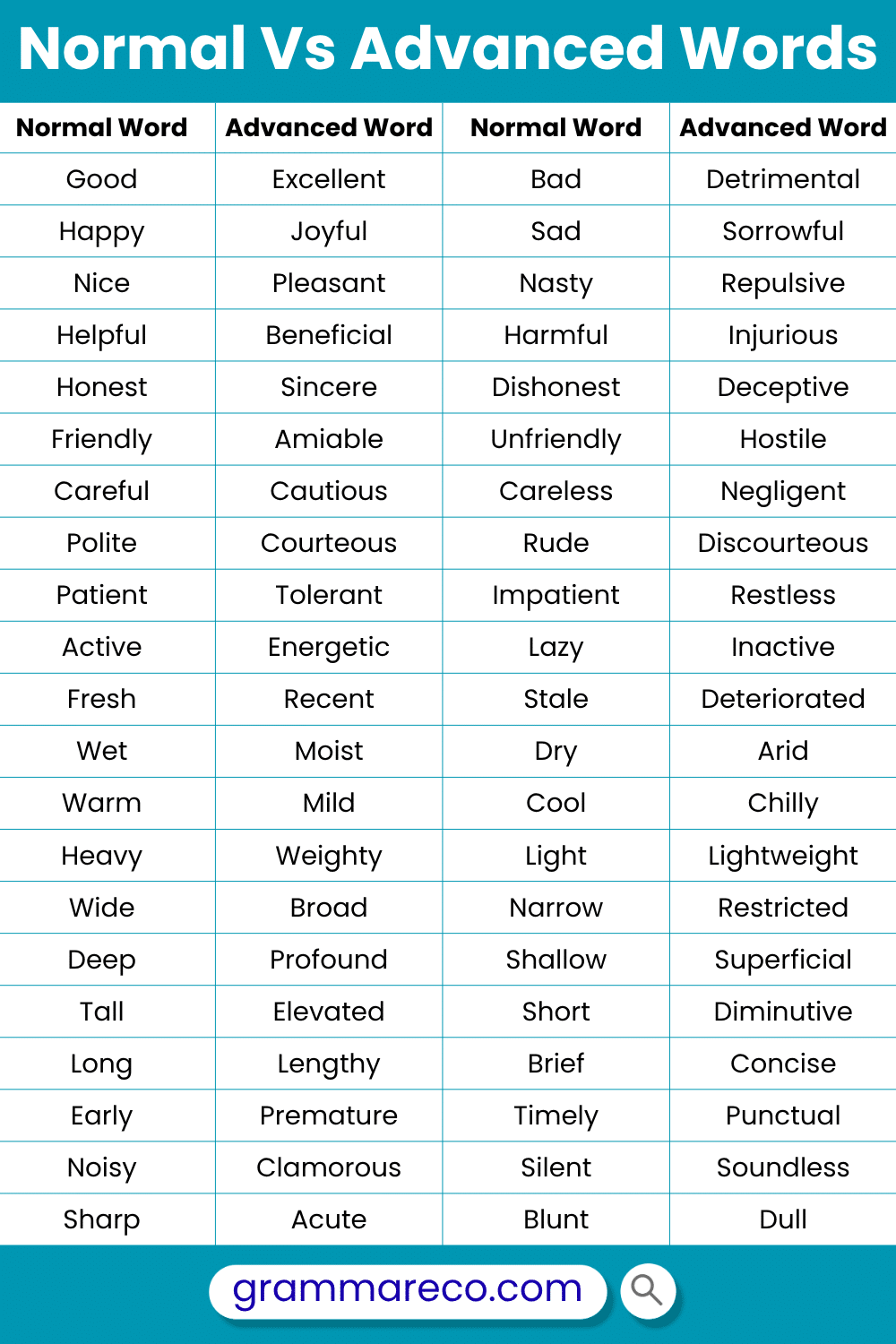
Basic vocabulary vs advanced vocabulary becomes more useful when learners understand how stronger alternatives differ in tone. Below are the basic words and their advanced alternative are given:
| Normal Word | Advanced Word | Normal Word | Advanced Word |
|---|---|---|---|
| Good | Excellent | Bad | Detrimental |
| Happy | Joyful | Sad | Sorrowful |
| Nice | Pleasant | Nasty | Repulsive |
| Helpful | Beneficial | Harmful | Injurious |
| Honest | Sincere | Dishonest | Deceptive |
| Friendly | Amiable | Unfriendly | Hostile |
| Careful | Cautious | Careless | Negligent |
| Polite | Courteous | Rude | Discourteous |
| Patient | Tolerant | Impatient | Restless |
| Active | Energetic | Lazy | Inactive |
| Fresh | Recent | Stale | Deteriorated |
| Wet | Moist | Dry | Arid |
| Warm | Mild | Cool | Chilly |
| Heavy | Weighty | Light | Lightweight |
| Wide | Broad | Narrow | Restricted |
| Deep | Profound | Shallow | Superficial |
| Tall | Elevated | Short | Diminutive |
| Long | Lengthy | Brief | Concise |
| Early | Premature | Timely | Punctual |
| Noisy | Clamorous | Silent | Soundless |
| Strong-smelling | Pungent | Mild-smelling | Faint |
| Sharp | Acute | Blunt | Dull |
| Smooth | Polished | Rough | Coarse |
| Soft | Tender | Hard | Rigid |
| Flexible | Adaptable | Stiff | Inflexible |
| Simple | Uncomplicated | Complex | Intricate |
| Certain | Definite | Unsure | Uncertain |
| Correct | Accurate | Wrong | Erroneous |
| Important | Significant | Minor | Insignificant |
| Common | Prevalent | Rare | Scarce |
Positive Normal Vs Advanced English Vocabulary Words
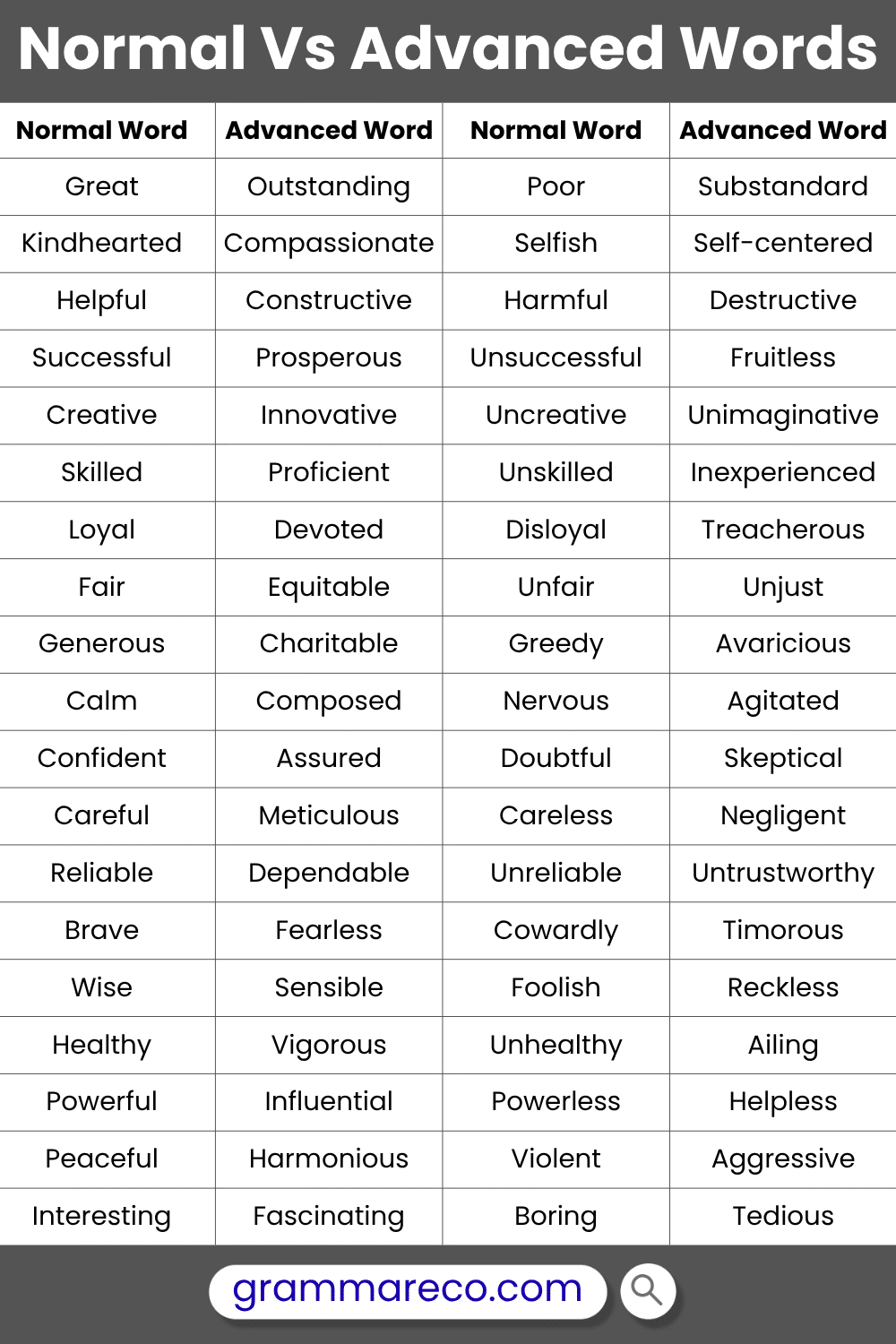
Positive vocabulary describes favorable qualities, pleasant feelings, useful actions, or successful results.
| Normal Word | Advanced Word | Normal Word | Advanced Word |
|---|---|---|---|
| Great | Outstanding | Poor | Substandard |
| Kindhearted | Compassionate | Selfish | Self-centered |
| Helpful | Constructive | Harmful | Destructive |
| Successful | Prosperous | Unsuccessful | Fruitless |
| Creative | Innovative | Uncreative | Unimaginative |
| Skilled | Proficient | Unskilled | Inexperienced |
| Loyal | Devoted | Disloyal | Treacherous |
| Fair | Equitable | Unfair | Unjust |
| Generous | Charitable | Greedy | Avaricious |
| Calm | Composed | Nervous | Agitated |
| Confident | Assured | Doubtful | Skeptical |
| Careful | Meticulous | Careless | Negligent |
| Reliable | Dependable | Unreliable | Untrustworthy |
| Brave | Fearless | Cowardly | Timorous |
| Wise | Sensible | Foolish | Reckless |
| Healthy | Vigorous | Unhealthy | Ailing |
| Powerful | Influential | Powerless | Helpless |
| Peaceful | Harmonious | Violent | Aggressive |
| Interesting | Fascinating | Boring | Tedious |
| Exciting | Thrilling | Dull | Monotonous |
| Beautiful | Magnificent | Ugly | Grotesque |
| Bright | Radiant | Dim | Shadowy |
| Clean | Pristine | Dirty | Grimy |
| Organized | Systematic | Disorganized | Chaotic |
| Responsible | Accountable | Irresponsible | Negligent |
| Honest | Candid | Misleading | Misrepresentative |
| Generous | Benevolent | Cruel | Brutal |
| Friendly | Sociable | Isolated | Solitary |
| Helpful | Cooperative | Difficult | Uncooperative |
| Valuable | Precious | Worthless | Valueless |
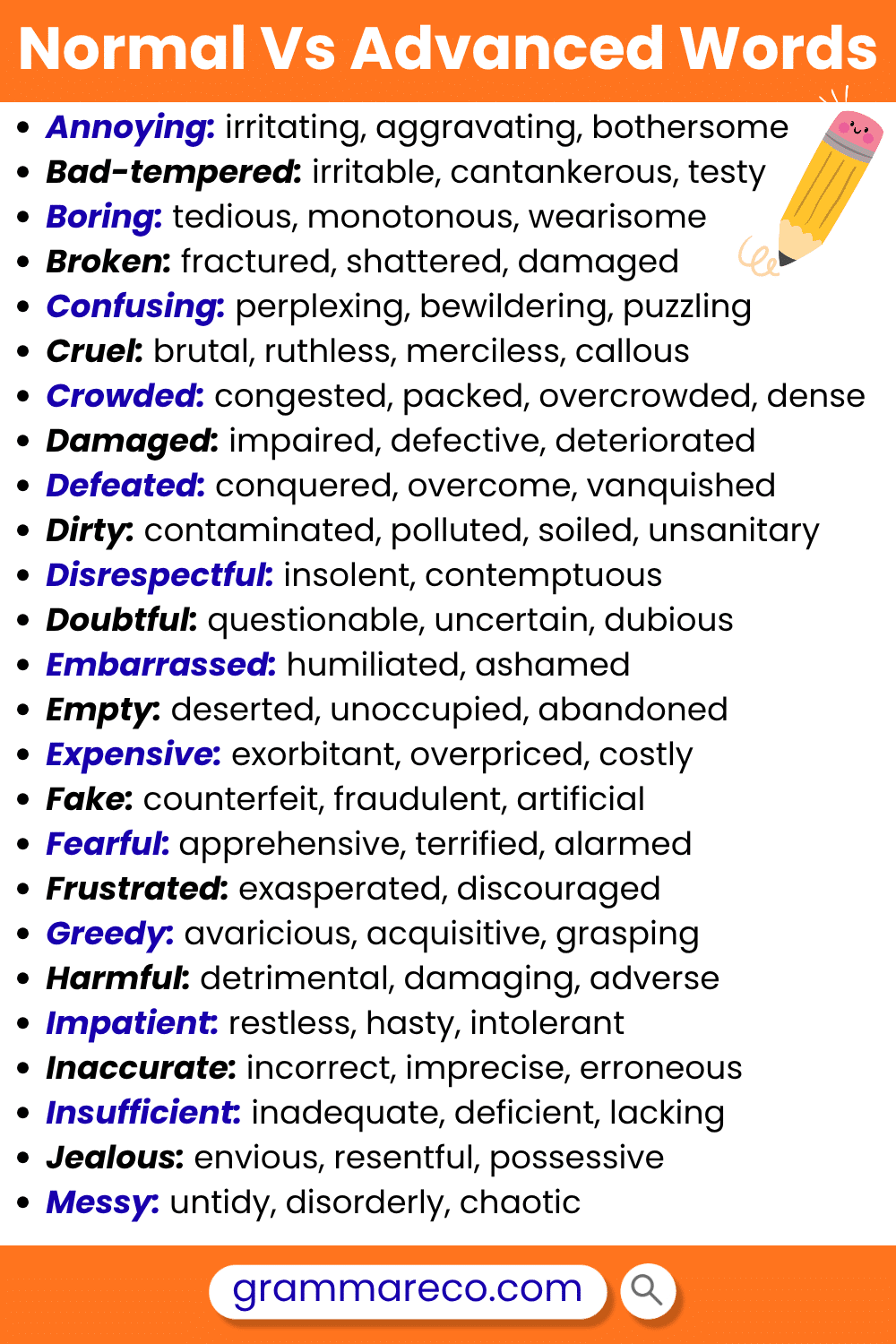
Negative Basic and Advance Words in English
Negative normal vs advanced vocabulary words can describe unpleasant qualities, problems, failures, or harmful conditions.
- Annoying: irritating, aggravating, bothersome, vexatious
- Bad-tempered: irritable, cantankerous, testy, grouchy
- Boring: tedious, monotonous, wearisome, tiresome
- Broken: fractured, shattered, damaged, impaired
- Confusing: perplexing, bewildering, puzzling, ambiguous
- Cruel: brutal, ruthless, merciless, callous
- Crowded: congested, packed, overcrowded, dense
- Damaged: impaired, defective, deteriorated, compromised
- Defeated: conquered, overcome, vanquished, subdued
- Dirty: contaminated, polluted, soiled, unsanitary
- Disrespectful: insolent, contemptuous, impertinent, insulting
- Doubtful: questionable, uncertain, dubious, debatable
- Embarrassed: humiliated, ashamed, mortified, self-conscious
- Empty: deserted, unoccupied, abandoned, barren
- Expensive: exorbitant, overpriced, costly, extravagant
- Fake: counterfeit, fraudulent, artificial, imitation
- Fearful: apprehensive, terrified, alarmed, panicked
- Frustrated: exasperated, discouraged, thwarted, disheartened
- Greedy: avaricious, acquisitive, grasping, covetous
- Harmful: detrimental, damaging, adverse, injurious
- Impatient: restless, hasty, intolerant, agitated
- Inaccurate: incorrect, imprecise, erroneous, faulty
- Insufficient: inadequate, deficient, lacking, meager
- Jealous: envious, resentful, possessive, suspicious
- Messy: untidy, disorderly, chaotic, cluttered
- Old-fashioned: outdated, antiquated, obsolete, archaic
- Painful: agonizing, distressing, excruciating, torturous
- Poor-quality: inferior, substandard, defective, mediocre
- Risky: hazardous, precarious, perilous, uncertain
- Scared: terrified, frightened, alarmed, petrified
- Selfish: egotistical, self-centered, inconsiderate
- Shy: timid, bashful, reserved, withdrawn
- Sick: ill, diseased, unwell, ailing
- Stubborn: obstinate, inflexible, headstrong, adamant
- Unclear: ambiguous, vague, obscure, indefinite
- Unfair: biased, prejudiced, inequitable, unjust
- Unfriendly: hostile, antagonistic, inhospitable, aloof
- Unhappy: miserable, sorrowful, discontented, dejected
- Weakness: frailty, vulnerability, feebleness, deficiency
- Worried: anxious, concerned, apprehensive, uneasy
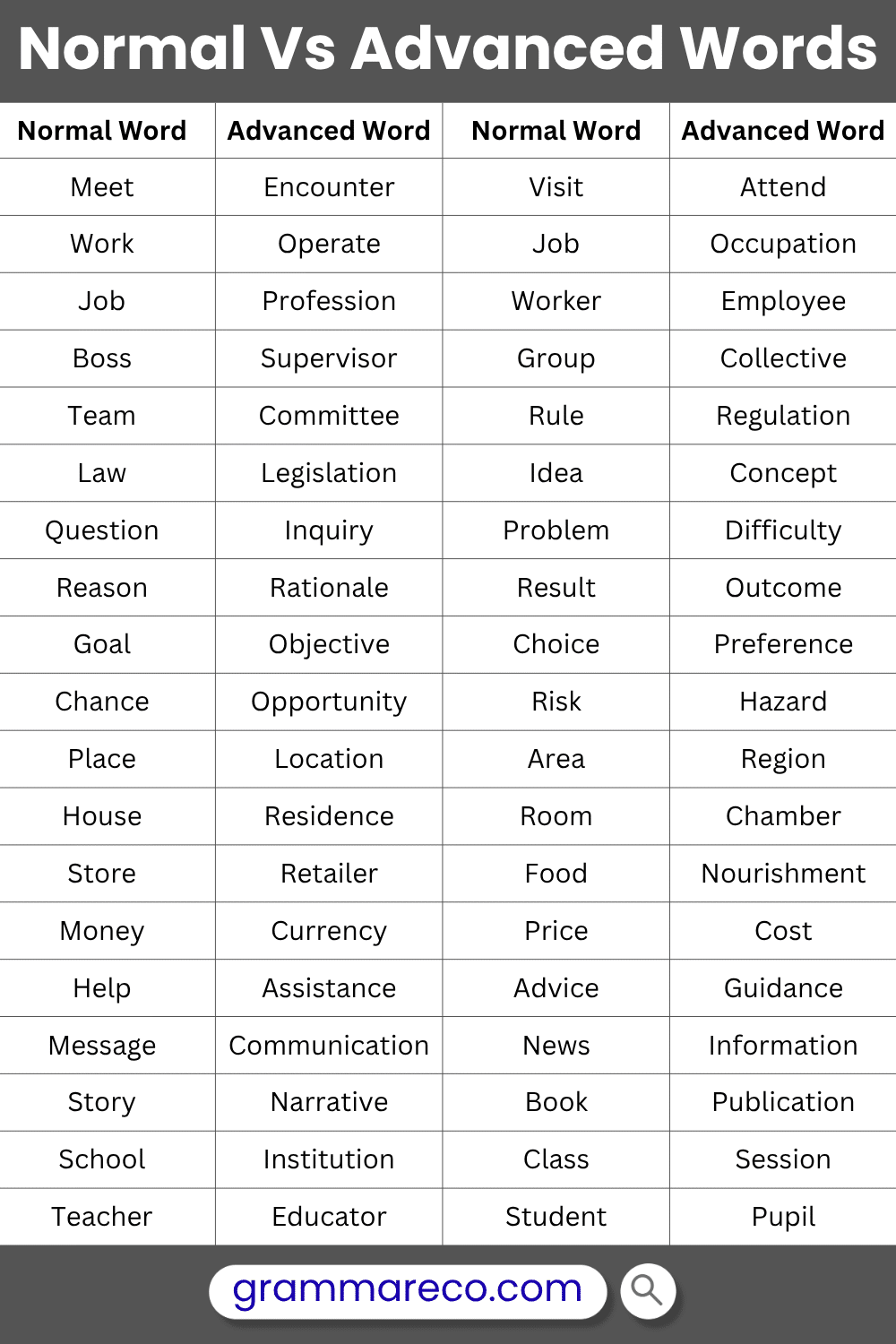
Daily Used Normal and Advanced English Vocabulary Words
| Normal Word | Advanced Word | Normal Word | Advanced Word |
|---|---|---|---|
| Meet | Encounter | Visit | Attend |
| Work | Operate | Job | Occupation |
| Job | Profession | Worker | Employee |
| Boss | Supervisor | Group | Collective |
| Team | Committee | Rule | Regulation |
| Law | Legislation | Idea | Concept |
| Question | Inquiry | Problem | Difficulty |
| Reason | Rationale | Result | Outcome |
| Goal | Objective | Choice | Preference |
| Chance | Opportunity | Risk | Hazard |
| Place | Location | Area | Region |
| House | Residence | Room | Chamber |
| Store | Retailer | Food | Nourishment |
| Money | Currency | Price | Cost |
| Help | Assistance | Advice | Guidance |
| Message | Communication | News | Information |
| Story | Narrative | Book | Publication |
| School | Institution | Class | Session |
| Teacher | Educator | Student | Pupil |
| Test | Assessment | Grade | Evaluation |
| Question | Interrogation | Answer | Response |
| Rule | Principle | Way | Method |
| Part | Component | Side | Aspect |
| Kind | Category | Type | Classification |
| Size | Dimension | Shape | Form |
| Color | Hue | Sound | Audio |
| Picture | Illustration | Sign | Symbol |
| Name | Designation | Place | Venue |
| Road | Route | Trip | Journey |
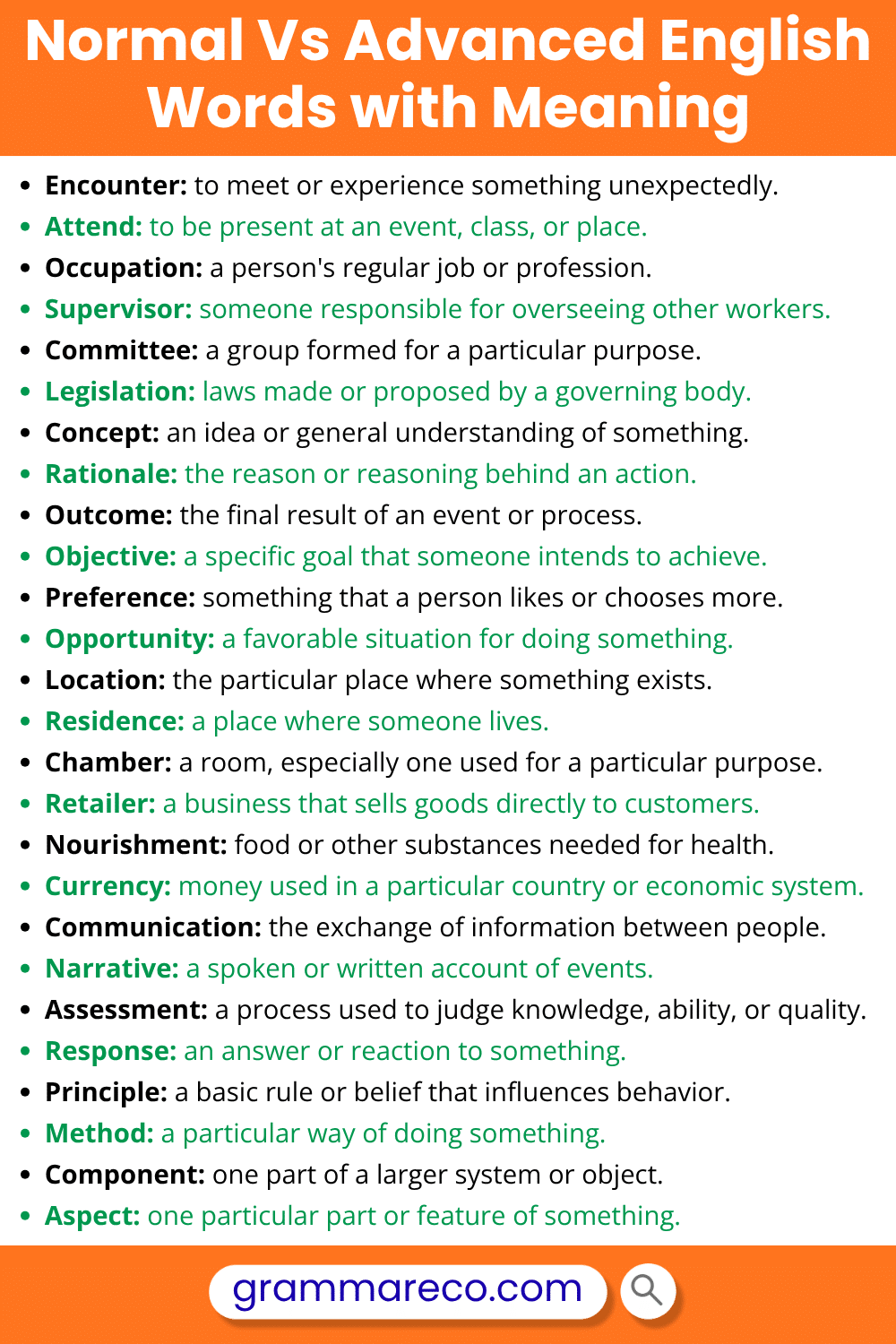
Basic and Advanced English Vocabulary Words With Meaning
- Encounter: to meet or experience something unexpectedly.
- Attend: to be present at an event, class, or place.
- Occupation: a person’s regular job or profession.
- Supervisor: someone responsible for overseeing other workers.
- Committee: a group formed for a particular purpose.
- Legislation: laws made or proposed by a governing body.
- Concept: an idea or general understanding of something.
- Rationale: the reason or reasoning behind an action.
- Outcome: the final result of an event or process.
- Objective: a specific goal that someone intends to achieve.
- Preference: something that a person likes or chooses more.
- Opportunity: a favorable situation for doing something.
- Location: the particular place where something exists.
- Residence: a place where someone lives.
- Chamber: a room, especially one used for a particular purpose.
- Retailer: a business that sells goods directly to customers.
- Nourishment: food or other substances needed for health.
- Currency: money used in a particular country or economic system.
- Communication: the exchange of information between people.
- Narrative: a spoken or written account of events.
- Institution: an established organization such as a school or university.
- Assessment: a process used to judge knowledge, ability, or quality.
- Response: an answer or reaction to something.
- Principle: a basic rule or belief that influences behavior.
- Method: a particular way of doing something.
- Component: one part of a larger system or object.
- Aspect: one particular part or feature of something.
- Classification: the process of arranging things into groups.
- Dimension: a measurable aspect such as length, width, or height.
- Designation: an official name or title given to something.
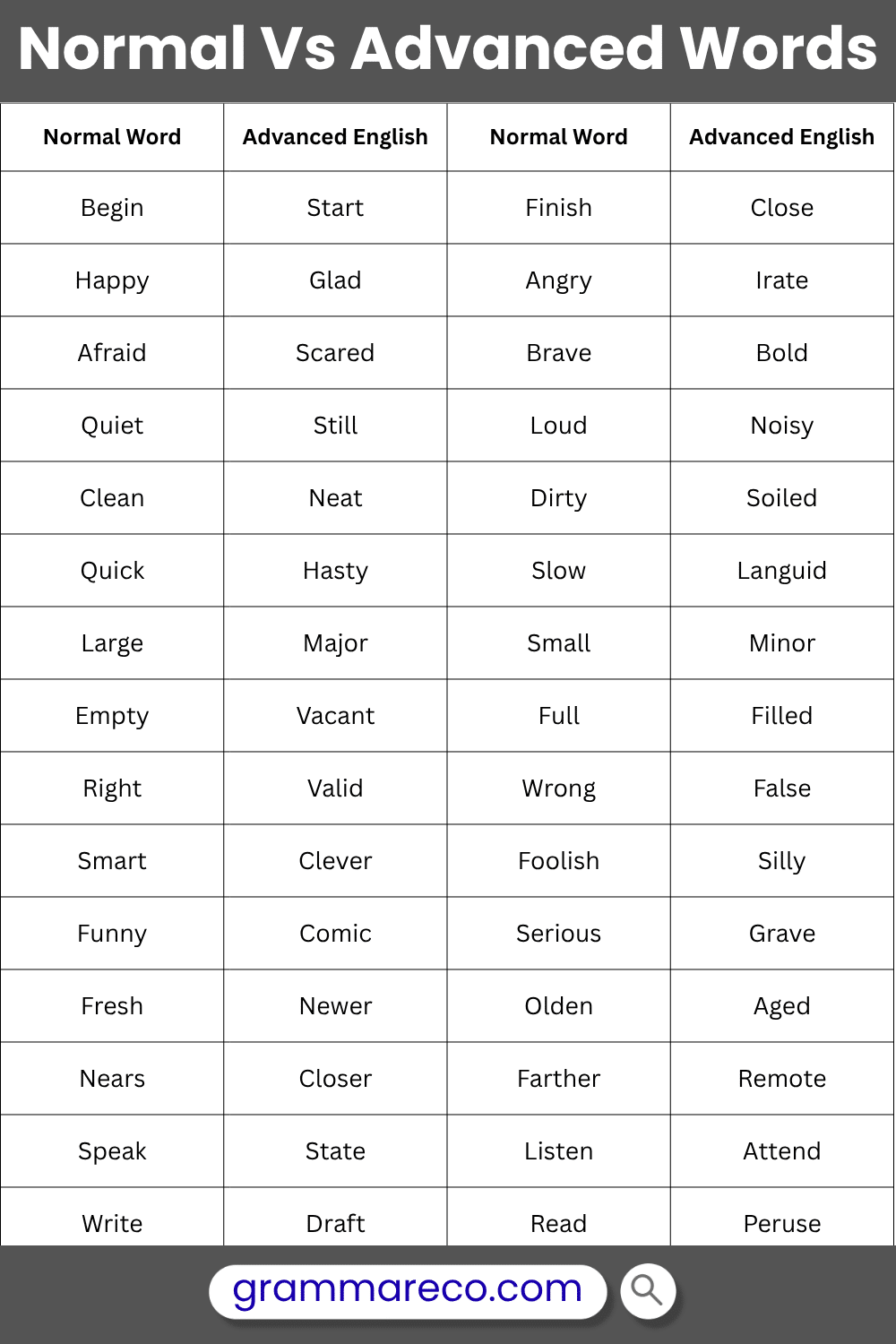
Five Letter Normal Vs Advanced English Words With Pictures
| Normal Word | Advanced English | Normal Word | Advanced English |
|---|---|---|---|
| Begin | Start | Finish | Close |
| Happy | Glad | Angry | Irate |
| Afraid | Scared | Brave | Bold |
| Quiet | Still | Loud | Noisy |
| Clean | Neat | Dirty | Soiled |
| Quick | Hasty | Slow | Languid |
| Large | Major | Small | Minor |
| Empty | Vacant | Full | Filled |
| Right | Valid | Wrong | False |
| Smart | Clever | Foolish | Silly |
| Funny | Comic | Serious | Grave |
| Fresh | Newer | Olden | Aged |
| Nears | Closer | Farther | Remote |
| Speak | State | Listen | Attend |
| Write | Draft | Read | Peruse |
| Learn | Study | Teach | Train |
| Watch | Guard | Look | Glance |
| Think | Ponder | Know | Learn |
| Want | Wish | Like | Enjoy |
| Need | Lack | Give | Grant |
| Take | Seize | Hold | Grasp |
| Bring | Carry | Send | |
| Move | Shift | Turn | Rotate |
| Break | Crack | Build | Raise |
| Fixes | Mends | Cuts | Trims |
| Saves | Stores | Spends | Uses |
| Pays | Funds | Costs | Prices |
| Calls | Rings | Talks | Speaks |
| Helps | Aids | Cares | Tends |
Difficult Basic Vs Advanced English Vocabulary Words
| Normal Word | Advanced Word | Normal Word | Advanced Word |
|---|---|---|---|
| Think about | Deliberate | Look at closely | Scrutinize |
| Explain fully | Expound | Understand | Comprehend |
| Make clear | Elucidate | Predict | Anticipate |
| Stop completely | Discontinue | Keep safe | Safeguard |
| Give evidence | Substantiate | Prove wrong | Refute |
| Change greatly | Revolutionize | Combine | Integrate |
| Separate | Differentiate | Compare | Contrast |
| Reduce strongly | Minimize | Increase strongly | Maximize |
| Begin formally | Inaugurate | End formally | Culminate |
| Protect | Defend | Attack | Assault |
| Delay intentionally | Procrastinate | Hurry | Expedite |
| Make better | Ameliorate | Make worse | Aggravate |
| Use wisely | Exploit | Misuse | Abuse |
| Copy | Replicate | Create | Generate |
| Replace | Supersede | Follow | Succeed |
| Ask formally | Petition | Refuse | Decline |
| Agree | Concur | Disagree | Dissent |
| Join | Participate | Leave permanently | Resign |
| Give up | Surrender | Continue | Persist |
| Spread | Disseminate | Collect together | Consolidate |
| Remove completely | Abolish | Create formally | Establish |
| Make smaller | Compress | Make larger | Expand |
| Hide | Conceal | Reveal | Disclose |
| Begin suddenly | Emerge | Disappear | Vanish |
| Happen again | Recur | Happen first | Originate |
| Need strongly | Demand | Offer formally | Proffer |
| Make possible | Enable | Prevent | Prohibit |
| Deal with | Address | Ignore | Neglect |
| Keep going | Persevere | Give up | Abandon |
| Make a decision | Resolve | Delay a decision | Hesitate |
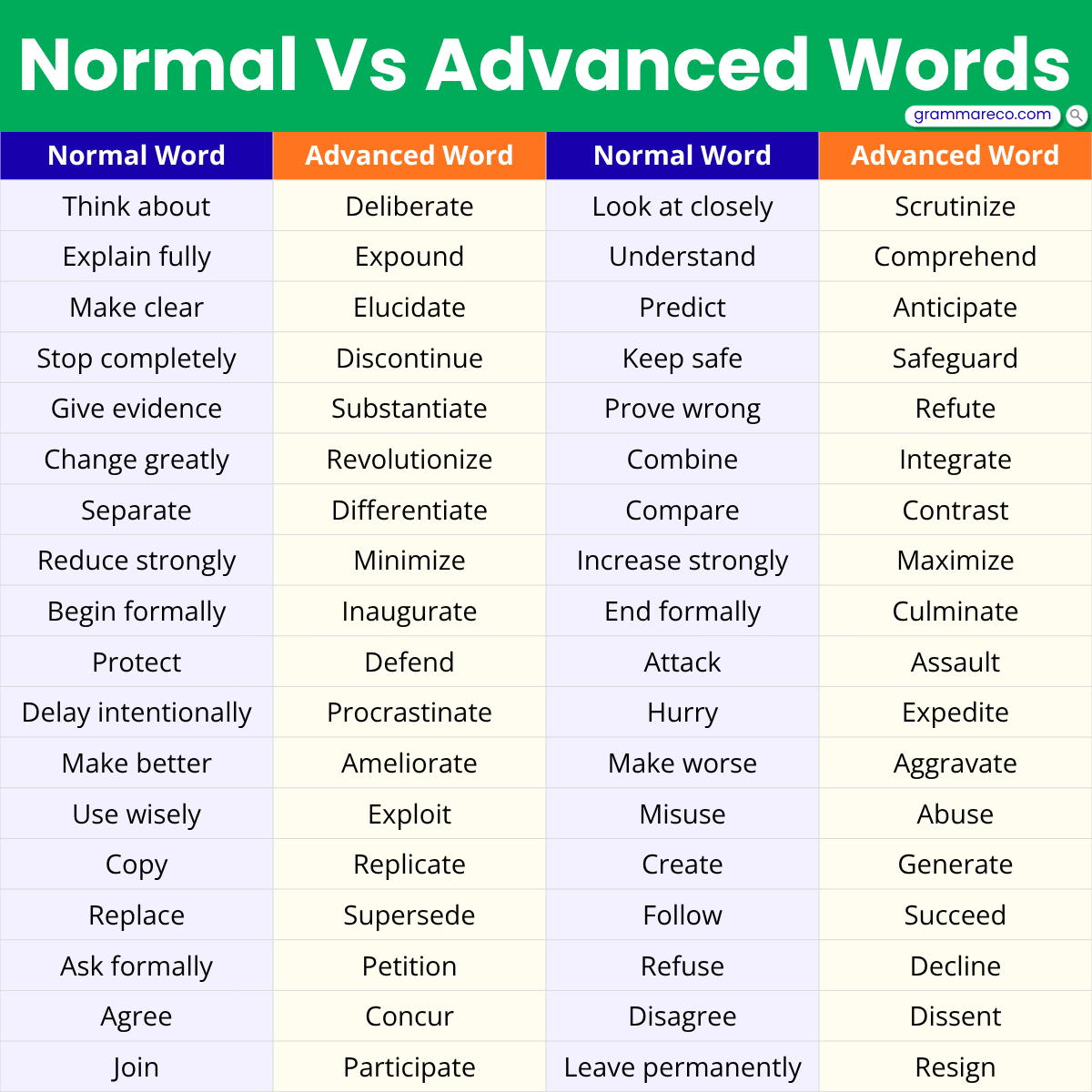
Basic Vs Advanced English Words PDF With Answers
FAQs About Normal Vs Advanced English Words
Twenty common and advanced English word pairs include ask and inquire, help and assist, buy and purchase, start and commence, end and conclude, and use and utilize.
Four-letter basic and advanced words include ask and seek, help and aid, show and cite, tell and state, and need and lack.
Three-letter common and advanced word pairs include ask and beg, get and buy, see and spy, use and ply, and make and form.
Takeaway for Learners
Normal and advanced English words can express related ideas in different ways. The advanced form may be more formal, precise, academic, or specific, but it should always fit the sentence.
A learner does not need to replace every common word with a difficult one. Understanding both forms makes it easier to recognize vocabulary and select an appropriate expression for each situation.
The best practice is simple: learn the meaning, study the context, and then use the word naturally.
Read more