
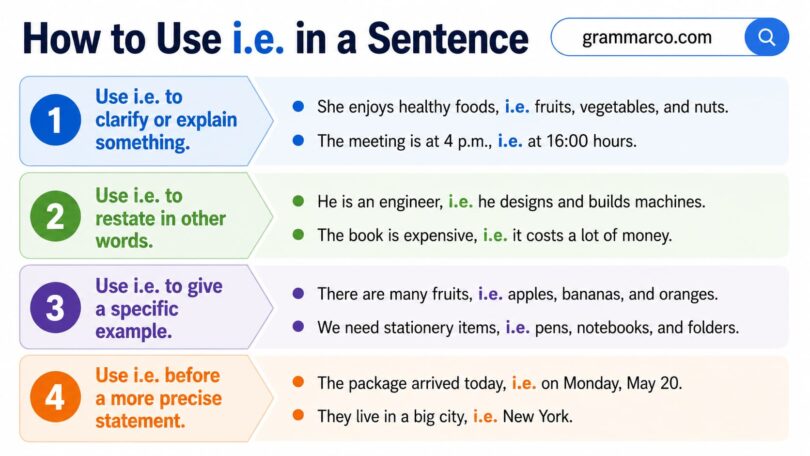
Learning how to use i.e. correctly makes your explanations clearer and more precise. This grammar rule helps readers understand exactly what you mean without confusion. In this article, you’ll learn the meaning, rules, punctuation, and sentence structure of i.e. through simple examples. You’ll also learn common mistakes, correct usage, and grammar patterns with practical examples that are easy to understand.
What Does i.e. Mean in a Sentence?
The abbreviation i.e. comes from the Latin phrase id est, which means “that is” or “in other words.” It introduces a clearer explanation or restates the previous idea in a different way. Use i.e. when you want to explain something more exactly instead of giving examples.
Examples:
- She speaks one language, i.e., English.
- We will meet at noon, i.e., 12:00 p.m.
- He chose the fastest route, i.e., the highway.
- The meeting is virtual, i.e., online only.
- I prefer citrus fruit, i.e., oranges and lemons only.
How to Use i.e. in a Sentence
Use i.e. before a clarification or restatement of an idea. It tells the reader that the next words explain the same meaning more clearly. In American English, place a comma after i.e. before the explanation.
Examples:
- Bring your identification, i.e., your passport.
- The class starts early, i.e., at 8:00 a.m.
- He visited the capital, i.e., Washington, D.C.
- We need a volunteer, i.e., one willing participant.
- The answer is negative, i.e., the request was denied.
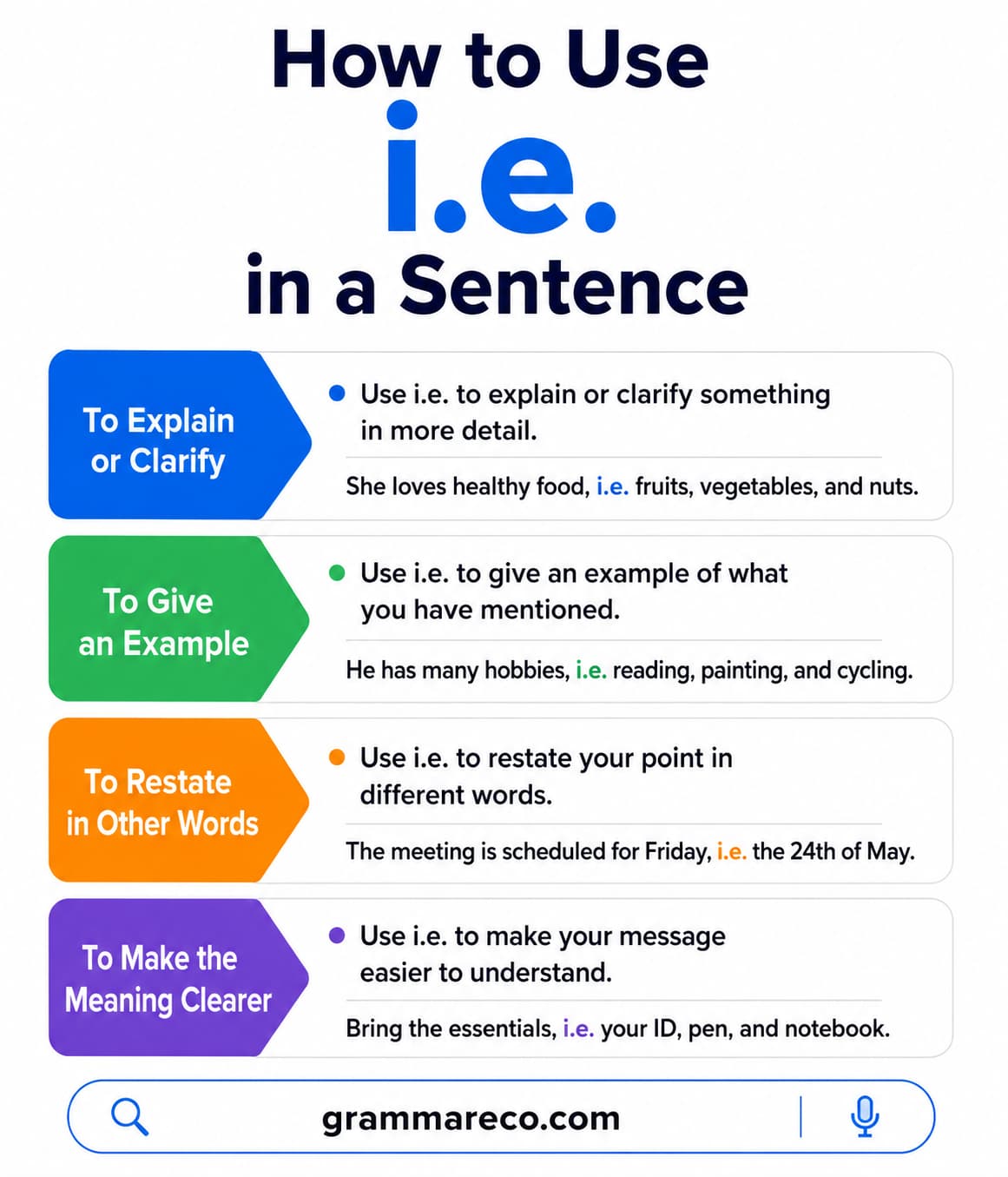
Place i.e. Before an Explanation
Always place i.e. immediately before the words that explain or restate the previous idea. It should introduce a definition, clarification, or more exact meaning rather than a list of examples.
Examples:
- My favorite season is autumn, i.e., the fall months.
- She bought one dessert, i.e., chocolate cake.
- The event is indoors, i.e., inside the community hall.
- He studies biology, i.e., the science of living things.
- They moved overseas, i.e., to another country.
Add a Comma After i.e.
In standard American English, write a comma immediately after i.e. This punctuation separates the abbreviation from the explanation and improves readability.
Examples:
- Please arrive early, i.e., before 9:00 a.m.
- We need one editor, i.e., someone who reviews documents.
- She chose one color, i.e., blue.
- The package is fragile, i.e., handle it carefully.
- He accepted the offer, i.e., he agreed to the terms.
Use i.e. Inside Parentheses
Use i.e. inside parentheses when the explanation is additional information. This keeps the main sentence smooth while adding a helpful clarification.
Examples:
- The museum closes early (i.e., at 4:00 p.m.).
- Everyone should wear formal clothing (i.e., business attire).
- The recipe needs fresh herbs (i.e., not dried ones).
- The software works offline (i.e., without an internet connection).
- The building has central cooling (i.e., one system for every room).
Use i.e. in the Middle of a Sentence
You can use i.e. in the middle of a sentence to clarify a word or phrase you have just mentioned. Place it immediately after the idea you want to explain, followed by a comma.
Examples:
- The committee selected one proposal, i.e., the lowest-cost option, for approval.
- She packed only essentials, i.e., clothes and toiletries, for the trip.
- We visited the oldest district, i.e., the historic town center, yesterday.
- The project needs one final step, i.e., client approval, before launch.
- He enjoys one hobby, i.e., photography, during weekends.
Use i.e. in Formal Writing
i.e. is commonly used in academic, legal, business, and technical writing when a precise explanation is needed. It makes your meaning more exact and avoids misunderstanding. Use it only when you are restating an idea, not listing examples.
Examples:
- The contract applies to one party, i.e., the buyer.
- The report covers one region, i.e., the northern district.
- Students must submit one document, i.e., the completed application form.
- The experiment used one variable, i.e., temperature, throughout the study.
- The policy affects one department, i.e., the finance team.
Avoid Using i.e. at the Start of a Sentence
Avoid placing i.e. at the beginning of a sentence. It should follow the idea it explains. If you need to start a new sentence, write the explanation directly instead of beginning with i.e.
| Correct | Incorrect |
|---|---|
| The store opens early, i.e., at 8:00 a.m. | i.e., the store opens at 8:00 a.m. |
| He selected one option, i.e., the premium plan. | i.e., he selected the premium plan. |
| The meeting is online, i.e., everyone joins remotely. | i.e., everyone joins remotely. |
| We need one signature, i.e., the manager’s. | i.e., the manager’s signature is needed. |
i.e. Sentence Examples
- She owns one pet, i.e., a cat.
- We met in the capital, i.e., London.
- The office closes early, i.e., at 5:00 p.m.
- He studies one language, i.e., Spanish.
- The answer is simple, i.e., yes.
- She ordered one drink, i.e., coffee.
- We need one witness, i.e., an adult.
- The class has one instructor, i.e., Mr. Brown.
- They chose one destination, i.e., Paris.
- Bring one document, i.e., your ID.
- The room needs one repair, i.e., a new window.
- She bought one fruit, i.e., an apple.
- The package contains one item, i.e., a laptop.
- He prefers one season, i.e., spring.
- We have one goal, i.e., finishing on time.
- The building has one entrance, i.e., the front door.
- She follows one diet, i.e., vegetarian.
- He wears one uniform, i.e., the school uniform.
- The event has one purpose, i.e., fundraising.
- We selected one winner, i.e., Sarah.
- The flight has one stop, i.e., Dubai.
- She completed one course, i.e., Biology 101.
- He visited one museum, i.e., the city museum.
- The team needs one captain, i.e., Emma.
- We use one platform, i.e., the company website.
- The recipe needs one spice, i.e., cinnamon.
- He carried one bag, i.e., a backpack.
- The answer requires one change, i.e., correcting the verb.
- She attended one meeting, i.e., the weekly review.
- The road has one exit, i.e., Exit 12.
When Not to Use i.e.
Use i.e. only when you want to restate or explain the same idea more clearly. Do not use it to introduce examples or replace phrases that already mean “for example.” Choosing the correct expression makes your writing more accurate and easier to read.
Instead of e.g.
Do not use i.e. when you want to give only a few examples. In that case, use e.g., which means “for example.” Remember the difference:
- i.e. = that is / in other words
- e.g. = for example
| Correct | Incorrect |
|---|---|
| I enjoy citrus fruits, e.g., oranges and lemons. | I enjoy citrus fruits, i.e., oranges and lemons. |
| Bring warm clothing, e.g., a jacket and gloves. | Bring warm clothing, i.e., a jacket and gloves. |
| She plays many sports, e.g., tennis and badminton. | She plays many sports, i.e., tennis and badminton. |
| We sell office supplies, e.g., pens and notebooks. | We sell office supplies, i.e., pens and notebooks. |
Instead of Such As
Do not replace such as with i.e. when introducing examples. Such as presents one or more examples, while i.e. gives an exact explanation or restatement.
| Correct | Incorrect |
|---|---|
| Tropical fruits, such as mangoes and pineapples, grow in warm climates. | Tropical fruits, i.e., mangoes and pineapples, grow in warm climates. |
| Outdoor games, such as soccer and baseball, are popular. | Outdoor games, i.e., soccer and baseball, are popular. |
| School supplies, such as rulers and pencils, are essential. | School supplies, i.e., rulers and pencils, are essential. |
| Programming languages, such as Python and Java, are widely used. | Programming languages, i.e., Python and Java, are widely used. |
i.e. vs e.g. in a Sentence Comparison
Although i.e. and e.g. look similar, they have different meanings. Use i.e. to explain exactly what you mean. Use e.g. to give one or more examples.
| Feature | i.e. | e.g. |
|---|---|---|
| Meaning | That is / In other words | For example |
| Purpose | Restates or clarifies an idea | Gives examples |
| Introduces | An exact explanation | Sample items |
| Can replace | “That is” | “For example” |
| Common use | Formal writing, academic writing, business writing | Lists, examples, explanations |
| Example | She owns one vehicle, i.e., a truck. | She owns several vehicles, e.g., a truck and a van. |
Quick Tips for Using i.e. Correctly
Before using i.e., ask yourself whether you’re explaining the same idea or giving examples.
- Use i.e. to mean “that is” or “in other words.”
- Place i.e. before the explanation.
- Add a comma after i.e. in American English.
- Use i.e. to clarify, not to list examples.
- Don’t replace e.g. with i.e.
- Don’t replace such as with i.e.
- Avoid starting a sentence with i.e.
- Use i.e. in formal, academic, and business writing when precision matters.
- Keep the explanation short and directly related to the previous idea.
- Read the sentence again to make sure i.e. introduces a restatement, not an example.
FAQs about How to Use i.e. in a Sentence
i.e. means “that is” or “in other words.” It introduces a clearer explanation or restates the previous idea more precisely.
Place i.e. immediately before an explanation, then add a comma after it. Use it only to clarify or restate the same idea.
i.e. explains the exact meaning of something. e.g. introduces one or more examples of a broader idea.
Yes. i.e. is widely accepted in academic, legal, business, and technical writing when you need to provide a precise explanation.
No. It’s better to avoid starting a sentence with i.e. Place it after the idea you want to explain instead.
Read more