
Noun examples in sentences help learners understand how nouns, people, places, objects, animals, and ideas work within sentences. A noun may name something physical or an idea that cannot be touched. Learning its role becomes easier when the word appears naturally within a sentence. You’ll learn common noun forms and how they function in different sentence patterns. These noun examples sentences also include familiar contexts for school and everyday communication.
What Are Nouns and Noun Examples?
A noun is a word that names a person, place, animal, object, or idea. Nouns can work as subjects, objects, or possessive forms within sentences. Nouns appear in many forms, so context matters when identifying them. A single sentence can also contain more than one noun.
Person Nouns
Person nouns name people, such as a teacher, doctor, child, or friend.
- The teacher explained the lesson clearly.
- My brother plays football every evening.
- The doctor helped the sick patient.
Place Nouns
Place nouns name locations, such as a school, park, city, or library.
- We visited the library after school.
- The children are playing in the park.
- She lives in a beautiful city.
Things Nouns
Thing nouns name physical objects that we can see or touch, such as a book, chair, or phone.
- I placed the book on the table.
- The chair is near the window.
- He bought a new phone yesterday.
Idea Nouns
Idea nouns name feelings, qualities, thoughts, or concepts that cannot usually be touched, such as love, honesty, or freedom.
- Honesty is an important quality.
- Her kindness made everyone happy.
- Freedom is valued by many people.
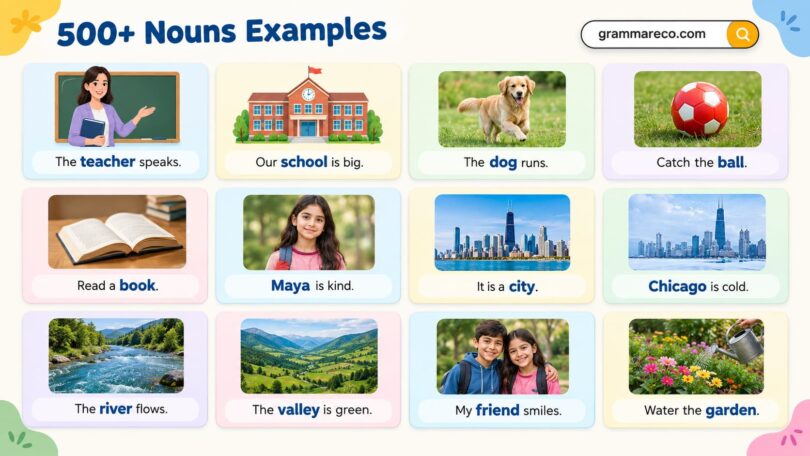
Some Examples of Nouns with Sentences and Pictures
| Noun | Sentence |
|---|---|
| Teacher | The teacher explained the lesson. |
| School | Our school starts at eight o’clock. |
| Dog | The dog chased the ball. |
| Book | Maya opened her book. |
| City | Chicago is a busy city. |
| River | The river flows through the valley. |
| Friend | My friend called me yesterday. |
| Garden | Dad watered the garden. |
| Pencil | I sharpened my pencil. |
| Student | The student answered correctly. |
| Apple | Liam ate an apple after lunch. |
| Bicycle | Her bicycle needs a new tire. |
| Library | We studied at the library. |
| Mountain | The mountain looked beautiful at sunset. |
| Doctor | The doctor spoke with the patient. |
| Music | The music filled the room. |
| Happiness | Her happiness was easy to notice. |
| Team | Our team practiced after school. |
| Water | Please drink some water. |
| Family | My family visited us on Sunday. |
| Park | The children played in the park. |
| Phone | My phone rang during lunch. |
| Teacher | The teacher collected our homework. |
| Restaurant | We ate at a small restaurant. |
| Bird | A bird landed on the fence. |
| Courage | His courage impressed everyone. |
| Computer | The computer needs an update. |
| Sister | My sister loves reading. |
| Beach | We walked along the beach. |
| Basketball | Jordan carried the basketball outside. |
Examples of Types of Nouns With Sentences
Nouns can be grouped according to what they name and how they work. Common categories include proper, abstract, concrete, collective, compound, countable, uncountable, possessive, and plural nouns.
Each noun type has a different purpose in sentence structure. The sections below use short sentences to make each category easier to recognize.
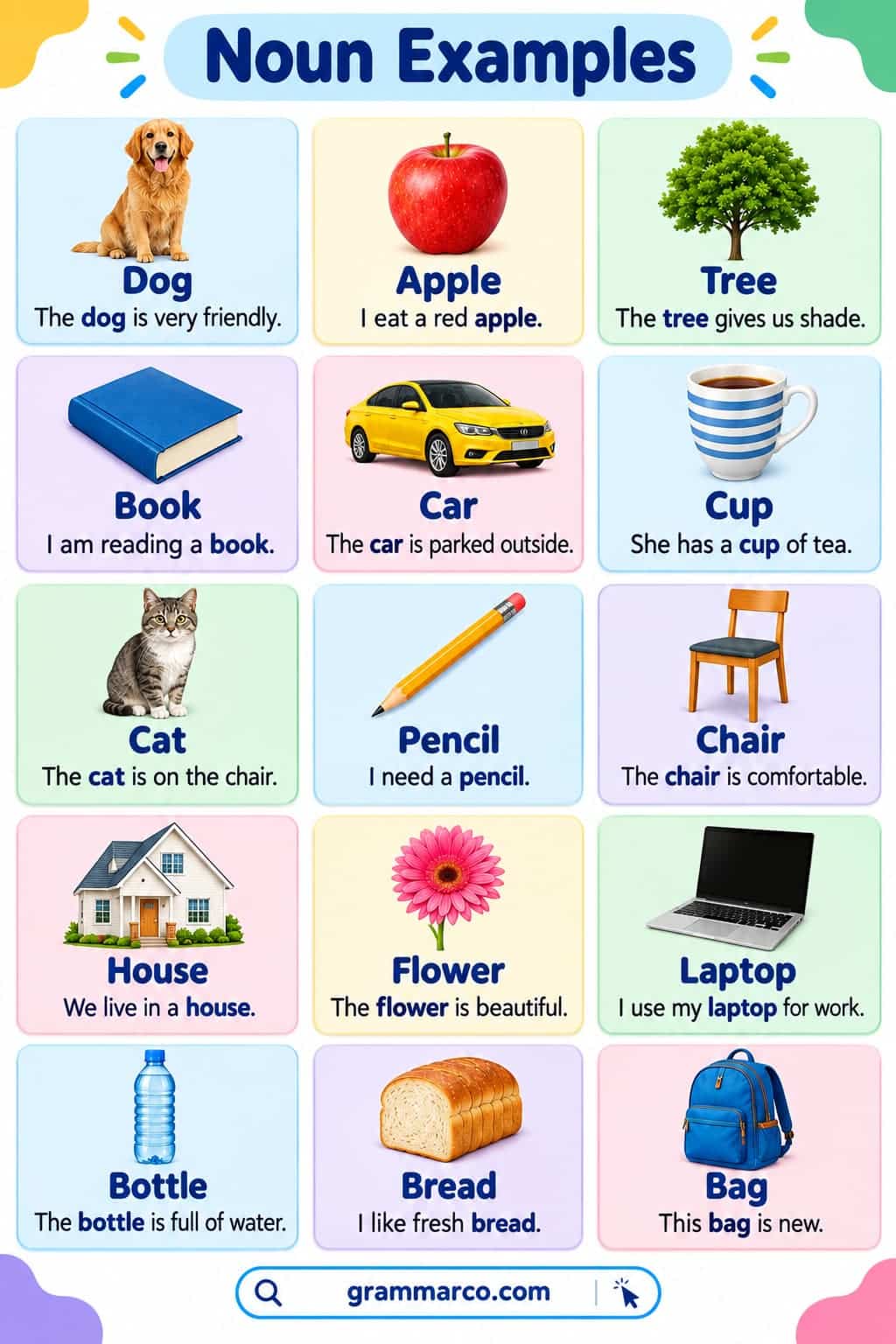
Common Noun Examples Sentences With Pictures
A common noun names a general person, place, animal, object, or thing rather than one specific name. Common nouns usually begin with lowercase letters unless they start a sentence.
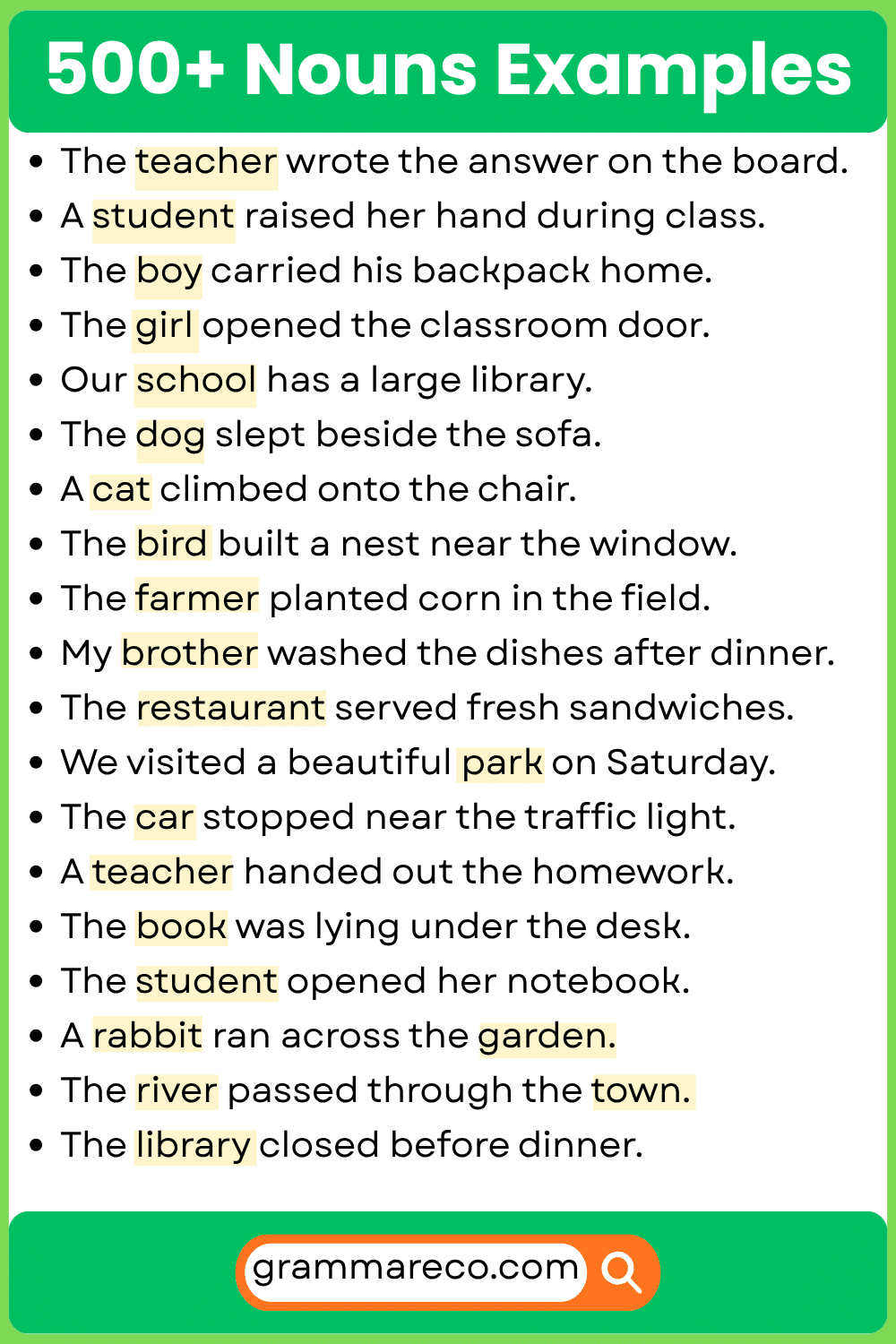
- The teacher wrote the answer on the board.
- A student raised her hand during class.
- The boy carried his backpack home.
- The girl opened the classroom door.
- Our school has a large library.
- The dog slept beside the sofa.
- A cat climbed onto the chair.
- The bird built a nest near the window.
- The farmer planted corn in the field.
- The doctor checked the patient’s temperature.
- My brother washed the dishes after dinner.
- The restaurant served fresh sandwiches.
- We visited a beautiful park on Saturday.
- The car stopped near the traffic light.
- A teacher handed out the homework.
- The book was lying under the desk.
- The student opened her notebook.
- A rabbit ran across the garden.
- The river passed through the town.
- The library closed before dinner.
Notice that words such as teacher, school, dog, and library name general things. They do not identify one particular person or place.
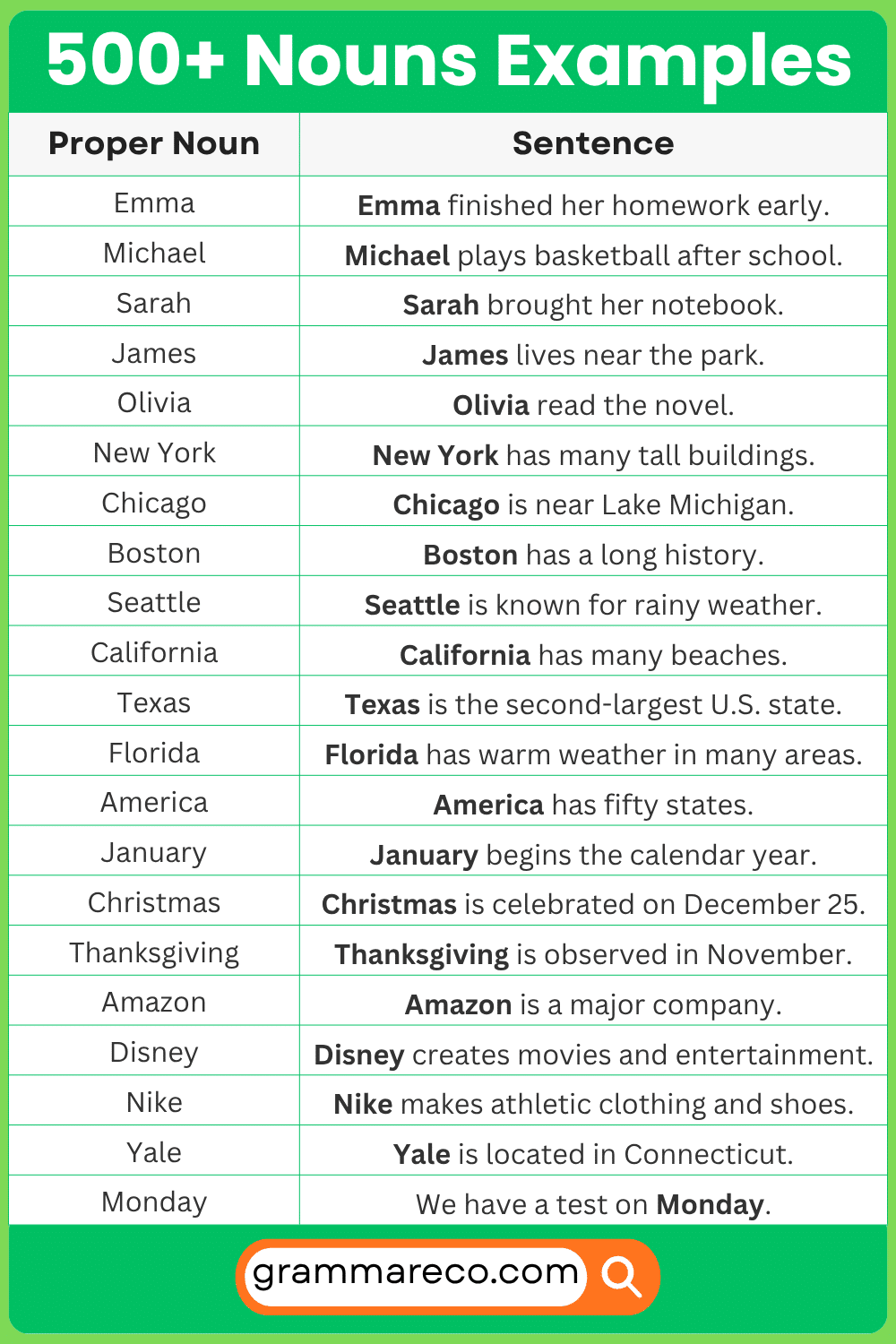
Proper Nouns With Sentences Examples in English
A proper noun names a particular person, place, organization, or other specific entity. Proper nouns begin with capital letters, even when they appear in the middle of a sentence.
| Proper Noun | Sentence |
|---|---|
| Emma | Emma finished her homework early. |
| Michael | Michael plays basketball after school. |
| Sarah | Sarah brought her notebook. |
| James | James lives near the park. |
| Olivia | Olivia read the novel. |
| New York | New York has many tall buildings. |
| Chicago | Chicago is near Lake Michigan. |
| Boston | Boston has a long history. |
| Seattle | Seattle is known for rainy weather. |
| California | California has many beaches. |
| Texas | Texas is the second-largest U.S. state. |
| Florida | Florida has warm weather in many areas. |
| America | America has fifty states. |
| Monday | Monday is the first school day for many students. |
| January | January begins the calendar year. |
| Christmas | Christmas is celebrated on December 25. |
| Thanksgiving | Thanksgiving is observed in November. |
| Amazon | Amazon is a major company. |
| Disney | Disney creates movies and entertainment. |
| Nike | Nike makes athletic clothing and shoes. |
| Google operates a popular search engine. | |
| Microsoft | Microsoft develops computer software. |
| Harvard | Harvard is a university in Massachusetts. |
| Yale | Yale is located in Connecticut. |
| Monday | We have a test on Monday. |
| Central Park | Tourists visit Central Park in New York City. |
| Mount Everest | Mount Everest is the highest mountain above sea level. |
| Mississippi River | The Mississippi River flows through several states. |
| Statue of Liberty | The Statue of Liberty stands in New York Harbor. |
| United States | The United States has fifty states. |
Proper nouns and common nouns often work together. For instance, “city” is a common noun, while “Boston” is a proper noun naming one particular city.
Abstract Nouns Used in Sentences
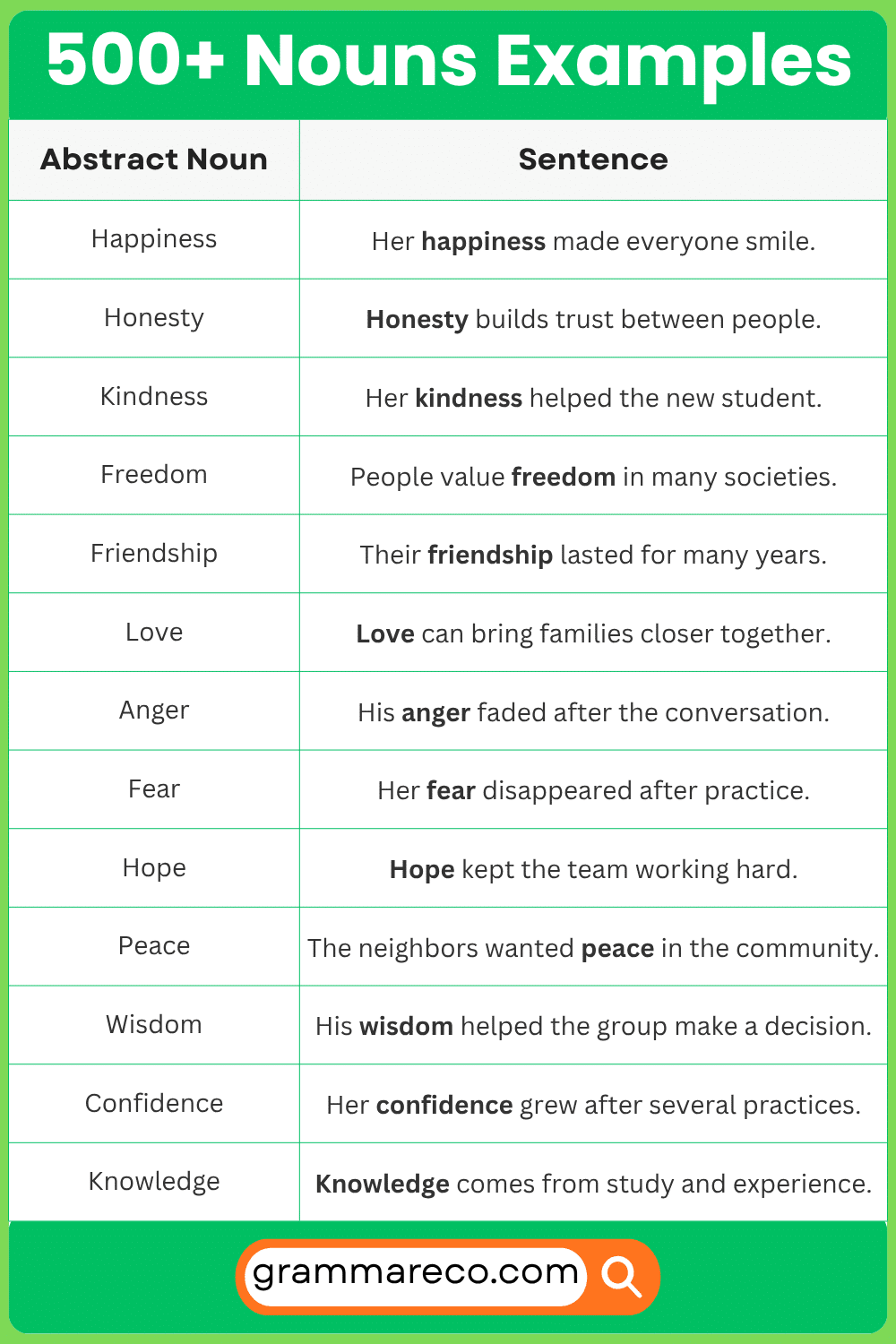
An abstract noun names an idea, feeling, quality, condition, or concept that cannot normally be touched. Words such as courage, honesty, freedom, and happiness are common abstract nouns.
The following abstract noun examples show how ideas and qualities work naturally within sentences.
| Abstract Noun | Sentence |
|---|---|
| Happiness | Her happiness made everyone smile. |
| Courage | His courage helped him face the challenge. |
| Honesty | Honesty builds trust between people. |
| Kindness | Her kindness helped the new student. |
| Freedom | People value freedom in many societies. |
| Friendship | Their friendship lasted for many years. |
| Love | Love can bring families closer together. |
| Anger | His anger faded after the conversation. |
| Fear | Her fear disappeared after practice. |
| Hope | Hope kept the team working hard. |
| Peace | The neighbors wanted peace in the community. |
| Wisdom | His wisdom helped the group make a decision. |
| Patience | Patience is useful when learning something difficult. |
| Confidence | Her confidence grew after several practices. |
| Knowledge | Knowledge comes from study and experience. |
| Respect | Students should show respect toward their teachers. |
| Trust | Trust develops when people keep promises. |
| Success | Their success came after months of practice. |
| Failure | Failure can teach people important lessons. |
| Justice | The community wanted justice for everyone. |
| Creativity | Creativity helped the students design the project. |
| Strength | His inner strength helped him continue. |
| Beauty | The painting had great beauty. |
| Loyalty | Her loyalty impressed her friends. |
| Curiosity | Curiosity led the child to ask questions. |
| Responsibility | Responsibility is important when caring for a pet. |
| Respect | The players showed respect for their opponents. |
| Intelligence | Her intelligence helped solve the problem. |
| Excitement | The students felt excitement before the trip. |
| Education | Education can shape a person’s future. |
Abstract nouns can be difficult to recognize because they do not name physical objects. A useful question is whether the noun represents an idea, feeling, quality, or condition.
Read more: 200 Abstract Noun Examples with Sentences
Concrete Noun Examples Sentences
A concrete noun names something that can be experienced through the senses. People, animals, places, objects, and physical things can all be concrete nouns.
The noun itself may be seen, heard, touched, smelled, or tasted. The following sentences use familiar physical nouns.
- The apple fell from the tree.
- The chair stood beside the desk.
- My backpack is under the table.
- The teacher opened the door.
- A dog barked outside.
- The bell rang at noon.
- The pizza smelled delicious.
- The flower grew beside the fence.
- The book fell from the shelf.
- The car stopped near the house.
- The phone vibrated on the table.
- The sandwich was in my lunchbox.
- The pencil rolled across the floor.
- The computer sits on the desk.
- The window was open.
- The bird flew over the garden.
- The river passed behind the town.
- The house had a red door.
- The guitar sounded beautiful.
- The basketball bounced across the court.
Concrete nouns can include both singular and plural forms. They can also be common nouns or proper nouns depending on what they name.
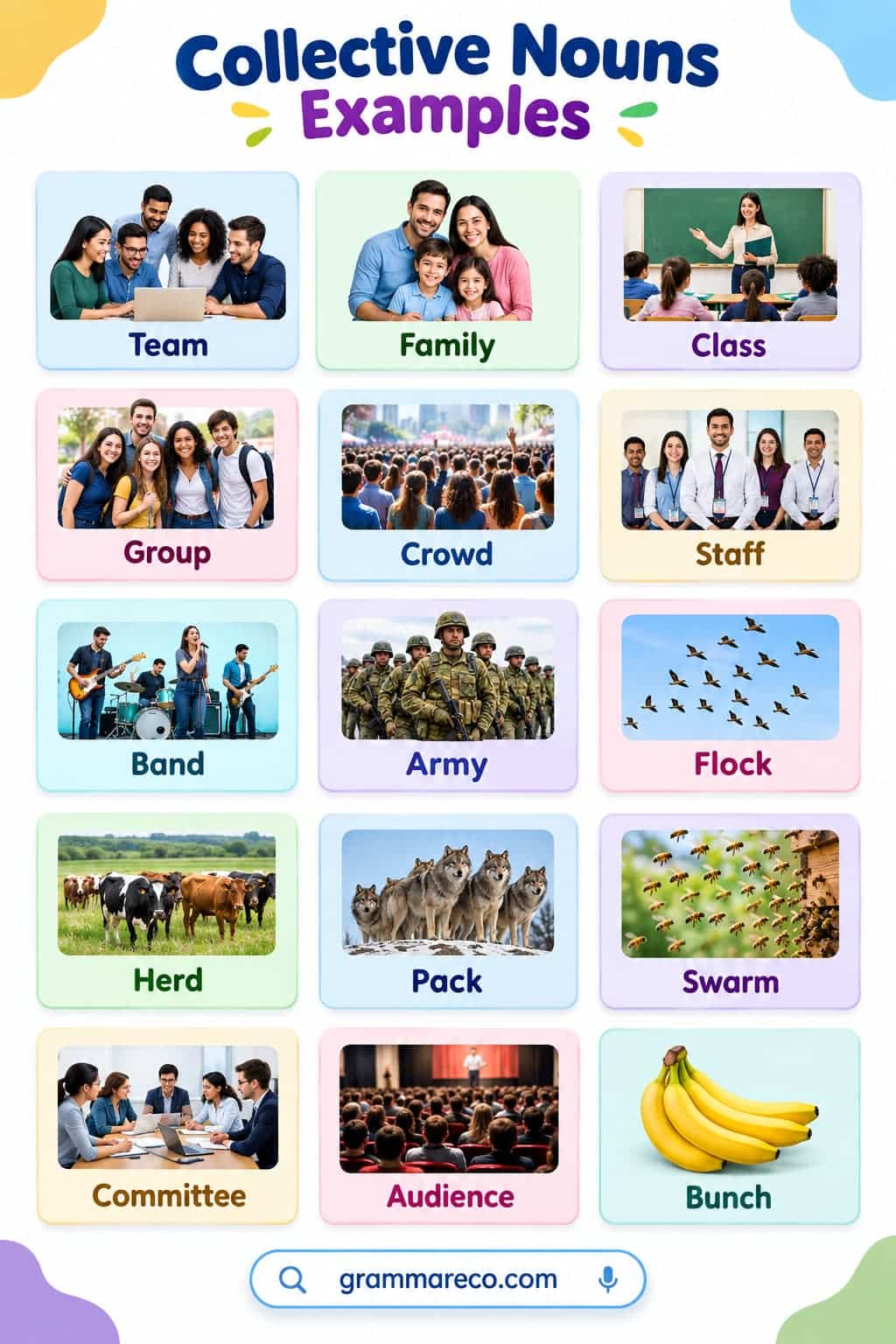
Collective Nouns Examples with Pictures in English
A collective noun names a group of people, animals, or things as one unit. Words such as team, family, class, and flock can refer to groups.
- Team: The team practiced after school.
- Family: My family ate dinner together.
- Class: Our class finished the assignment.
- Group: The group worked on the project.
- Crowd: The crowd cheered loudly.
- Audience: The audience listened quietly.
- Committee: The committee discussed the plan.
- Staff: The staff prepared the room.
- Band: The band played at the festival.
- Choir: The choir practiced before the concert.
- Team: The team won the game.
- Jury: The jury listened to the evidence.
- Class: The class walked into the museum.
- Army: The army moved toward the camp.
- Flock: A flock of birds flew overhead.
- Herd: The herd moved across the field.
- Pack: A pack of wolves crossed the forest.
- Swarm: A swarm of bees flew near the flowers.
- Bunch: She bought a bunch of grapes.
- Fleet: The fleet of ships entered the harbor.
Collective nouns can sometimes take different verb forms depending on the intended meaning and style. In American English, singular treatment is common when the group acts as one unit.
Read more: 500+ Collective Nouns List
Nouns and Compound Nouns Examples With Sentences
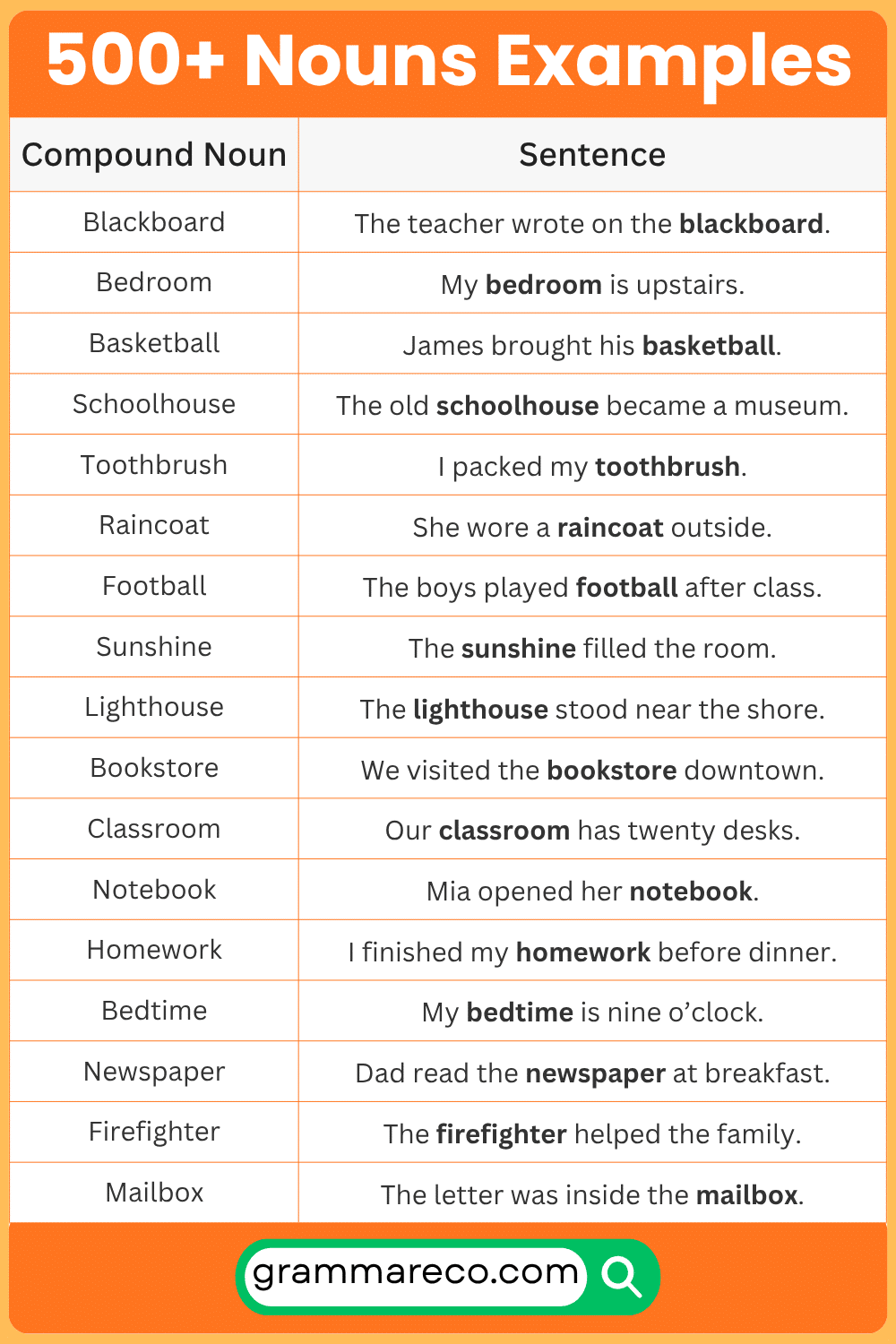
A compound noun forms when two or more words work together as one noun. Compound nouns may be written as one word, separate words, or hyphenated words.
| Noun | Compound Noun | Sentence |
|---|---|---|
| Board | Blackboard | The teacher wrote on the blackboard. |
| Room | Bedroom | My bedroom is upstairs. |
| Ball | Basketball | James brought his basketball. |
| School | Schoolhouse | The old schoolhouse became a museum. |
| Tooth | Toothbrush | I packed my toothbrush. |
| Rain | Raincoat | She wore a raincoat outside. |
| Foot | Football | The boys played football after class. |
| Sun | Sunshine | The sunshine filled the room. |
| House | Lighthouse | The lighthouse stood near the shore. |
| Book | Bookstore | We visited the bookstore downtown. |
| Class | Classroom | Our classroom has twenty desks. |
| Note | Notebook | Mia opened her notebook. |
| Home | Homework | I finished my homework before dinner. |
| Bed | Bedtime | My bedtime is nine o’clock. |
| News | Newspaper | Dad read the newspaper at breakfast. |
| Fire | Firefighter | The firefighter helped the family. |
| Mailbox | The letter was inside the mailbox. | |
| Cup | Cupcake | Sarah baked a cupcake. |
| Hair | Hairbrush | My hairbrush is in the bathroom. |
| Door | Doorknob | The doorknob was loose. |
| Sea | Seashore | We walked along the seashore. |
| Air | Airport | We arrived at the airport early. |
| Basket | Basketball | The basketball rolled away. |
| Snow | Snowman | The children built a snowman. |
| Head | Headache | He had a headache after the game. |
| Water | Waterfall | The waterfall was surrounded by trees. |
| Class | Classmate | My classmate helped me. |
| Day | Daylight | We walked home in the daylight. |
| Moon | Moonlight | The moonlight entered the window. |
| Life | Lifeguard | The lifeguard watched the swimmers. |
Compound nouns can change meaning when their parts are joined. For example, a “classmate” is not simply any person in a class. It specifically means a person who is in the same class.
Countable vs Uncountable Nouns Examples
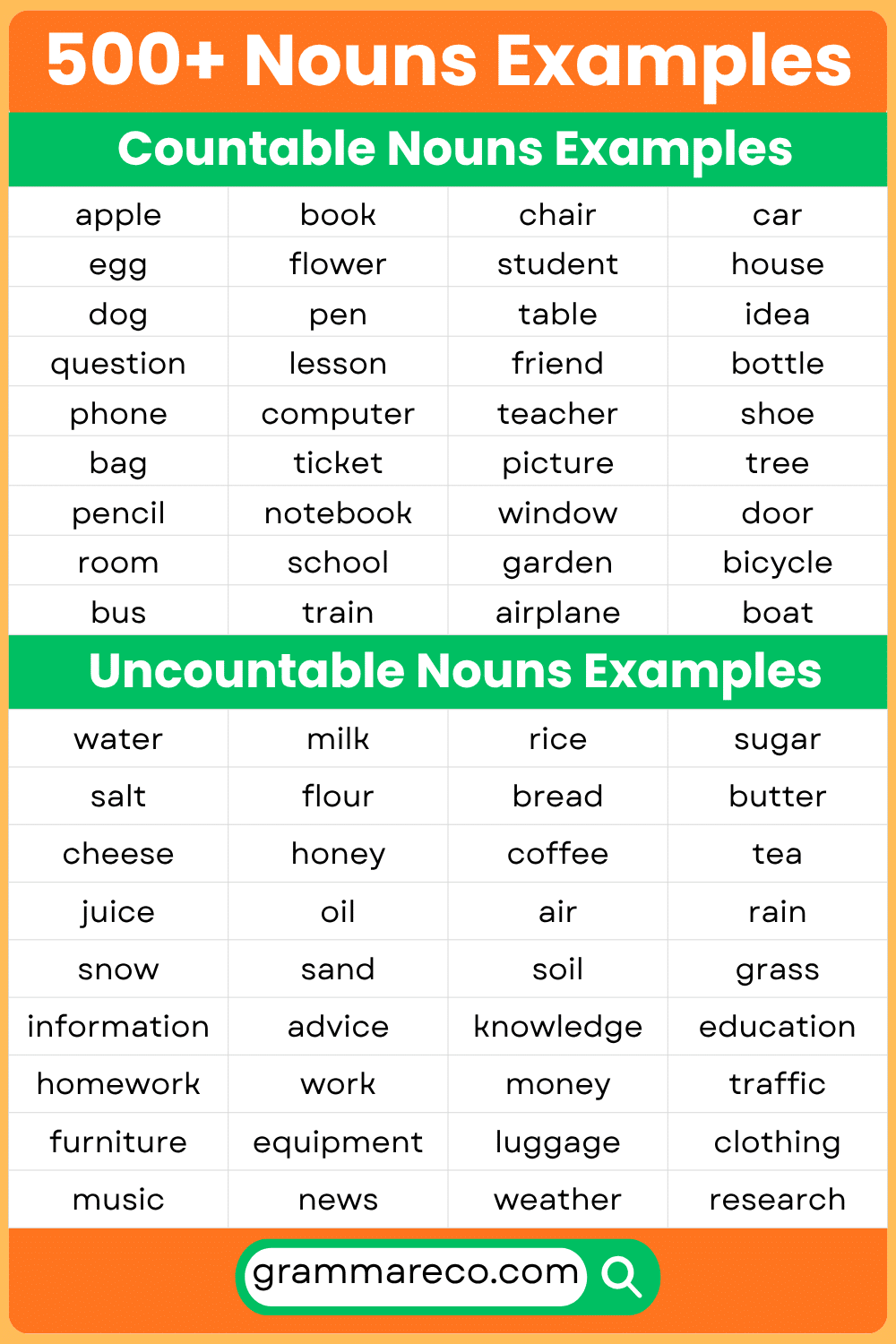
Countable nouns can be counted individually and usually have singular and plural forms. Uncountable nouns refer to substances, materials, or ideas that are not normally counted separately.
| Countable Nouns | Uncountable Nouns |
|---|---|
| apple | water |
| book | milk |
| chair | sugar |
| table | salt |
| pen | rice |
| pencil | flour |
| bottle | bread |
| cup | butter |
| plate | cheese |
| egg | honey |
| banana | oil |
| orange | juice |
| potato | coffee |
| tomato | tea |
| carrot | soup |
| onion | meat |
| sandwich | food |
| cake | fruit |
| cookie | information |
| biscuit | advice |
| student | knowledge |
| teacher | education |
| doctor | research |
| nurse | homework |
| engineer | work |
| farmer | money |
| artist | wealth |
| singer | furniture |
| actor | equipment |
| child | luggage |
| baby | baggage |
| boy | traffic |
| girl | transportation |
| man | weather |
| woman | rain |
| friend | snow |
| neighbor | sunshine |
| customer | air |
| visitor | oxygen |
| tourist | pollution |
| passenger | smoke |
| driver | dust |
| bicycle | sand |
| car | soil |
| bus | grass |
| train | information |
| airplane | news |
| ship | music |
| boat | art |
| house | literature |
| apartment | poetry |
| building | happiness |
| room | love |
| bedroom | anger |
| window | patience |
| door | courage |
| wall | honesty |
| garden | kindness |
| tree | beauty |
| flower | peace |
| plant | freedom |
| leaf | safety |
| branch | health |
| seed | energy |
| fruit | electricity |
| vegetable | heat |
| animal | light |
| dog | darkness |
| cat | fire |
| horse | water |
| cow | rain |
| sheep | snow |
| goat | ice |
| chicken | steam |
| bird | blood |
| fish | milk |
| insect | cream |
| butterfly | yogurt |
| student | butter |
| lesson | cheese |
| question | meat |
| answer | beef |
| idea | chicken |
| story | pork |
| letter | seafood |
| message | clothing |
| clothing | |
| phone | jewelry |
| computer | machinery |
| laptop | technology |
| camera | software |
| television | hardware |
| machine | internet |
| tool | electricity |
| key | fuel |
| bag | petrol |
| box | gasoline |
| bottle | coal |
| jar | gold |
| basket | silver |
| toy | iron |
| game | steel |
| ball | copper |
| book | wood |
| magazine | paper |
| newspaper | cardboard |
| dictionary | plastic |
| map | glass |
| picture | cotton |
| photograph | wool |
| ticket | silk |
| passport | leather |
| document | clothing |
| contract | rubbish |
| bill | garbage |
| coin | waste |
| dollar | dirt |
| shirt | mud |
| dress | dust |
| shoe | rain |
| hat | wind |
| coat | fog |
| jacket | sunshine |
| sock | thunder |
| umbrella | lightning |
| bed | noise |
| sofa | music |
| desk | laughter |
| computer | sleep |
| keyboard | rest |
| screen | exercise |
| printer | training |
| bicycle | experience |
| motorcycle | progress |
| truck | success |
| tractor | failure |
| factory | advice |
| company | permission |
| business | help |
| job | support |
| career | assistance |
| meeting | information |
| appointment | evidence |
| plan | proof |
| decision | news |
| mistake | gossip |
| problem | conversation |
| solution | communication |
| suggestion | speech |
| invitation | language |
| gift | vocabulary |
| present | grammar |
| package | English |
| parcel | mathematics |
| letter | science |
| card | history |
| photograph | politics |
| painting | economics |
| song | biology |
| poem | chemistry |
| movie | physics |
| story | geography |
| book | psychology |
| magazine | philosophy |
Possessive Noun Examples in Sentences
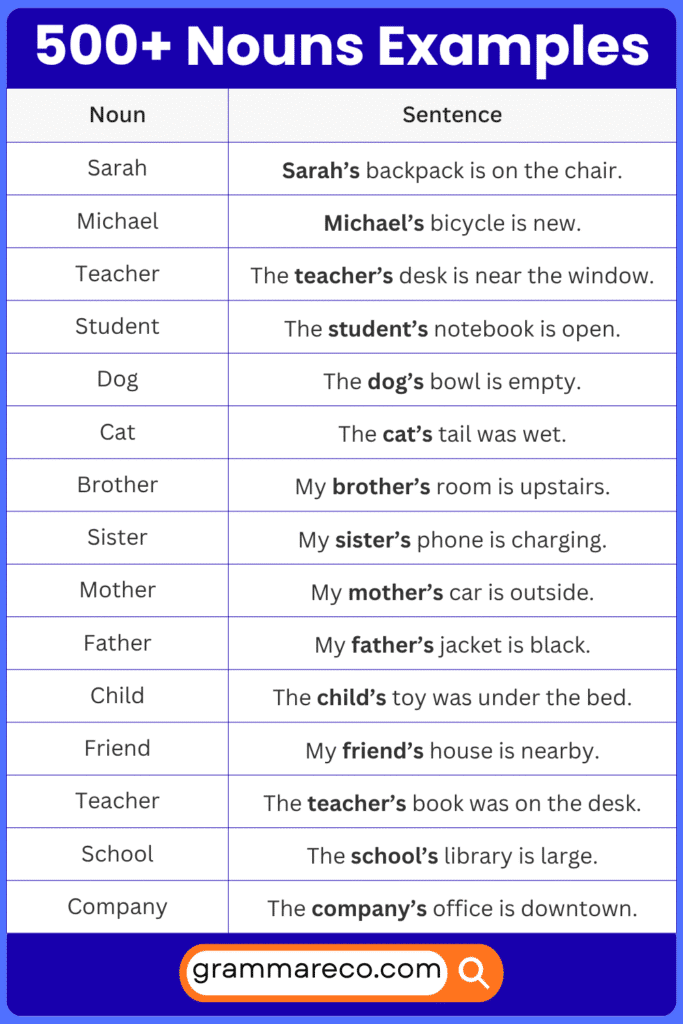
A possessive noun shows ownership, belonging, or a relationship between one noun and another. Singular possessive nouns commonly use an apostrophe and s, while plural nouns ending in s usually use an apostrophe.
| Noun | Sentence |
|---|---|
| Sarah | Sarah’s backpack is on the chair. |
| Michael | Michael’s bicycle is new. |
| Teacher | The teacher’s desk is near the window. |
| Student | The student’s notebook is open. |
| Dog | The dog’s bowl is empty. |
| Cat | The cat’s tail was wet. |
| Brother | My brother’s room is upstairs. |
| Sister | My sister’s phone is charging. |
| Mother | My mother’s car is outside. |
| Father | My father’s jacket is black. |
| Child | The child’s toy was under the bed. |
| Friend | My friend’s house is nearby. |
| Teacher | The teacher’s book was on the desk. |
| School | The school’s library is large. |
| Company | The company’s office is downtown. |
| City | The city’s streets were crowded. |
| Team | The team’s coach spoke to the players. |
| Bird | The bird’s nest was in the tree. |
| Horse | The horse’s saddle was brown. |
| Doctor | The doctor’s office was quiet. |
| Students | The students’ desks were arranged in rows. |
| Teachers | The teachers’ lounge was closed. |
| Players | The players’ uniforms were clean. |
| Parents | The parents’ meeting began at six. |
| Dogs | The dogs’ bowls were outside. |
| Girls | The girls’ backpacks were near the door. |
| Boys | The boys’ shoes were muddy. |
| Workers | The workers’ tools were stored safely. |
| Children | The children’s books were on the shelf. |
| Women | The women’s team practiced on Tuesday. |
The apostrophe helps show who owns or is connected to something. Pay attention to whether the noun is singular, plural, or an irregular plural.
Plural Nouns Examples
A plural noun refers to more than one person, place, animal, object, or idea. Many plural nouns are formed by adding s or es, but some change their spelling completely.
- The books are on the table.
- Three students entered the classroom.
- The dogs ran across the yard.
- We washed the dishes after dinner.
- Several boxes were stacked near the door.
- The classes began at eight o’clock.
- Two buses stopped outside the school.
- The babies slept quietly.
- The cities have many tall buildings.
- The stories were interesting.
- Several children played in the park.
- The men waited outside.
- The women entered the room.
- Two mice ran across the floor.
- The feet were covered with sand.
- Several teeth were checked by the dentist.
- The people waited in line.
- The children brought their lunches.
- The geese flew over the lake.
- The feet of the table were uneven.
Some plural forms must be learned individually because they do not follow the usual s or es pattern. Words such as children, mice, teeth, feet, and people are common irregular plurals.
Noun Words and Examples with Pictures – PDF
FAQs About Noun Examples Sentences
Ask what person, place, animal, thing, group, or idea the sentence names. Then check whether that word acts as a noun in its context.
Yes. Some nouns can be countable or uncountable depending on their meaning and context. For example, chicken can name an animal or food.
A common noun gives a general name, such as city, while a proper noun gives a specific name, such as Chicago. Proper nouns are capitalized.
Yes. Common noun examples include teacher, student, school, book, apple, dog, city, garden, river, and friend. These words name people, places, animals, things, or ideas.
Plural nouns name more than one person, place, animal, thing, or idea. Examples include books, teachers, children, cities, dogs, apples, houses, flowers, and friends. Most plural nouns are formed by adding -s or -es.
Possessive nouns show ownership or a relationship. Examples include John’s book, Sarah’s bag, the dog’s tail, the teacher’s desk, and the children’s toys. The apostrophe helps show who or what owns something.
Takeaway
Nouns name people, places, animals, objects, ideas, groups, and other things. They can appear as common, proper, abstract, concrete, collective, compound, countable, uncountable, possessive, or plural nouns.
The easiest way to identify a noun is to ask what person, place, animal, object, group, or idea the word names. Then look at how that noun functions within the sentence.
Read more