
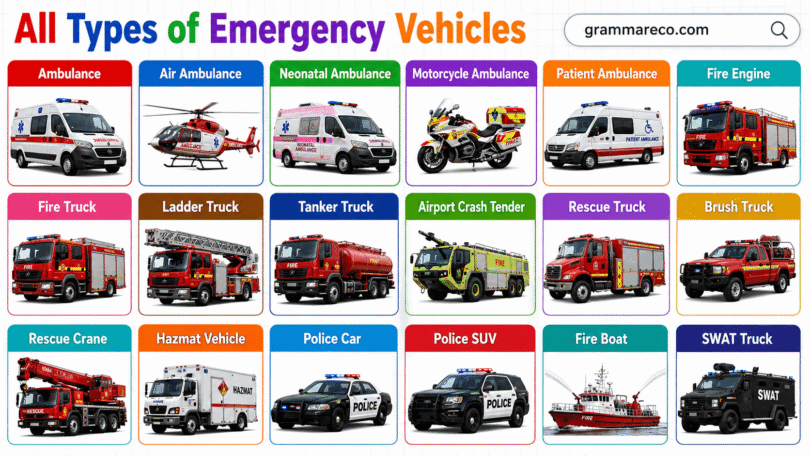
Emergency vehicles are specialized transport units used during medical emergencies, fires, accidents, disasters, and law enforcement operations. Common types of emergency vehicles include ambulances, fire trucks, police cars, rescue helicopters, and disaster response vehicles equipped with sirens, flashing lights, and rescue equipment.
Learning different types of emergency vehicles helps readers understand public safety services, rescue operations, and transportation terms used in schools, hospitals, airports, highways, and cities.
This article explains emergency vehicle names, uses, equipment, and pictures in an organized and beginner friendly way.
What Are Emergency Vehicles and their Use?
Emergency vehicles are specially designed transportation units used during dangerous or urgent situations. Police departments, firefighters, paramedics, military rescue teams, and coast guards depend on these vehicles for fast response and public safety.
These vehicles often carry medical tools, rescue equipment, communication radios, ladders, protective gear, or water tanks. Some travel on roads, while others move through snow, water, mountains, forests, or disaster zones.
Common uses of emergency vehicles include:
- Transporting injured patients
- Stopping fires in buildings or forests
- Responding to crimes and accidents
- Conducting flood and storm rescues
- Carrying emergency medical teams
- Handling airport emergencies
- Supporting military evacuation missions
- Performing search and rescue operations
Ever heard an ambulance siren late at night? That quick sound usually signals an urgent medical response nearby.
Emergency Vehicles Names in English
Emergency vehicles come in many forms depending on their job and environment. Below is a complete list of emergency vehicle names commonly used around the world.
- Ambulance
- Air Ambulance
- Neonatal Ambulance
- Motorcycle Ambulance
- Patient Transport Ambulance
- Fire Engine
- Fire Truck
- Ladder Truck
- Tanker Truck
- Airport Crash Tender
- Rescue Truck
- Brush Truck
- Wildland Fire Engine
- Hazmat Vehicle
- Police Car
- Police SUV
- Highway Patrol Vehicle
- SWAT Truck
- Riot Control Vehicle
- Police Motorcycle
- Mobile Command Vehicle
- K9 Unit Vehicle
- Sheriff Vehicle
- Rescue Helicopter
- Medical Helicopter
- Coast Guard Boat
- Rescue Boat
- Fire Boat
- Lifeboat
- Search and Rescue ATV
- Snow Rescue Vehicle
- Mountain Rescue Vehicle
- Disaster Response Truck
- Urban Search and Rescue Vehicle
- Bomb Disposal Vehicle
- Military Ambulance
- Armored Rescue Vehicle
- Emergency Response Van
- Mobile Clinic Vehicle
- Emergency Utility Truck
- Emergency Communication Vehicle
- Tactical Rescue Vehicle
- Flood Rescue Truck
- Ice Rescue Vehicle
- Emergency Bulldozer
- Rescue Crane
- Emergency Bus
- Emergency Evacuation Vehicle
- Drone Support Vehicle
- Emergency Fuel Truck
- Airport Rescue Vehicle
- Rapid Response Vehicle
- Medical Supply Vehicle
- Civil Defense Vehicle
- Emergency Recovery Truck
All Types of Emergency Vehicles and Pictures
Emergency vehicles are grouped by their rescue duties, transport systems, and response environments. Some handle medical emergencies, while others focus on fires, disasters, law enforcement, or water rescues. Types of emergency vehicles make identification easier because many vehicles look surprisingly similar at first glance.
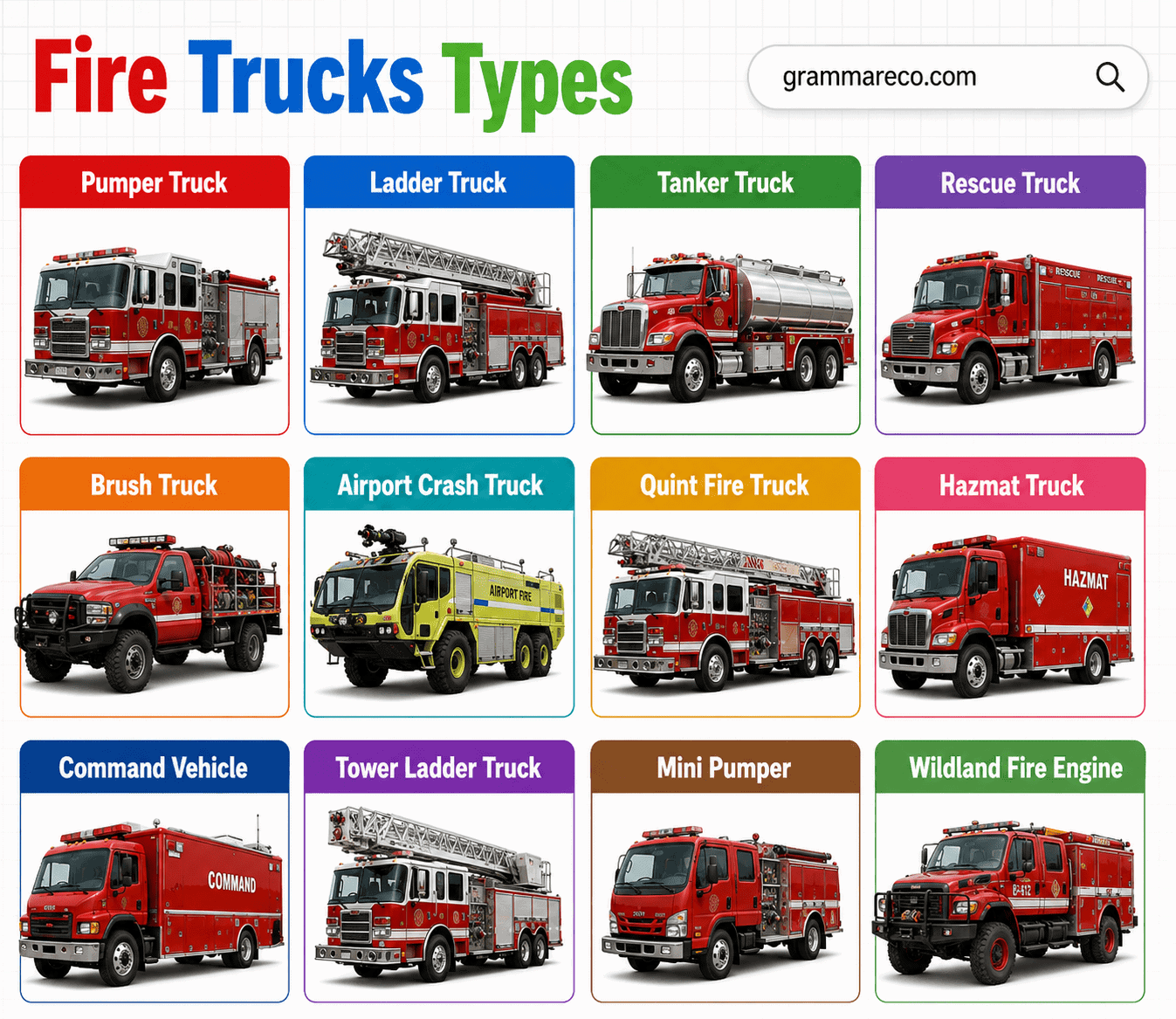
Types of Fire Trucks
Fire trucks are specialized emergency response vehicles built for fast firefighting, rescue missions, and disaster control. They operate in cities, forests, airports, and industrial zones where fire risks change quickly. Each unit carries water systems, rescue tools, ladders, and breathing equipment for different emergency conditions.
Fire Engine
Fire Engine is the core firefighting unit used by most city fire departments. It includes water pumps, hoses, and a trained crew for immediate fire suppression. It responds to house fires, vehicle accidents, and building emergencies where fast action is required.
Ladder Truck
Ladder Truck is built for high-rise rescue operations in tall buildings. Its extendable hydraulic ladder reaches upper floors during apartment or skyscraper fires. Firefighters use it for evacuation, rooftop access, and aerial support during complex fire scenes.
Tanker Truck
Tanker Truck supplies large volumes of water to areas without hydrants. It is essential in rural zones, farms, and highway regions where water sources are limited. During major fires, it continuously refills other fire engines.
Brush Truck
Brush Truck is a lightweight off-road firefighting vehicle designed for wild terrain. It moves through forests, grasslands, and hills where larger trucks cannot enter. It is widely used during wildfire outbreaks and fast-spreading vegetation fires.
Airport Crash Tender
Airport Crash Tender is a high-speed emergency unit used at airports during aircraft fires. It carries foam-based extinguishing systems designed for fuel fires on runways. It reaches crash sites within seconds for rapid aviation rescue response.
Wildland Fire Engine
Wildland Fire Engine is engineered for forest and mountain fire operations. It has strong suspension, protective frames, and off-road tires for rough landscapes. It is commonly deployed in wildfire-prone regions during dry seasons.
Rescue Truck
Rescue Truck supports technical rescue operations during accidents and structural collapses. It carries hydraulic cutters, ropes, generators, and lifting tools. Firefighters use it to free trapped victims from vehicles or collapsed buildings.
Hazmat Vehicle
Hazmat Vehicle responds to hazardous material incidents such as chemical spills or gas leaks. It includes sealed protection systems and monitoring tools for safety. Specialized teams use it in industrial accidents and transport-related chemical emergencies.
Fire Boat
Fire Boat operates in ports, rivers, and coastal zones for marine fire control. It sprays high-pressure water streams on ships, docks, and waterfront structures. It is a key unit in harbor emergency response systems.
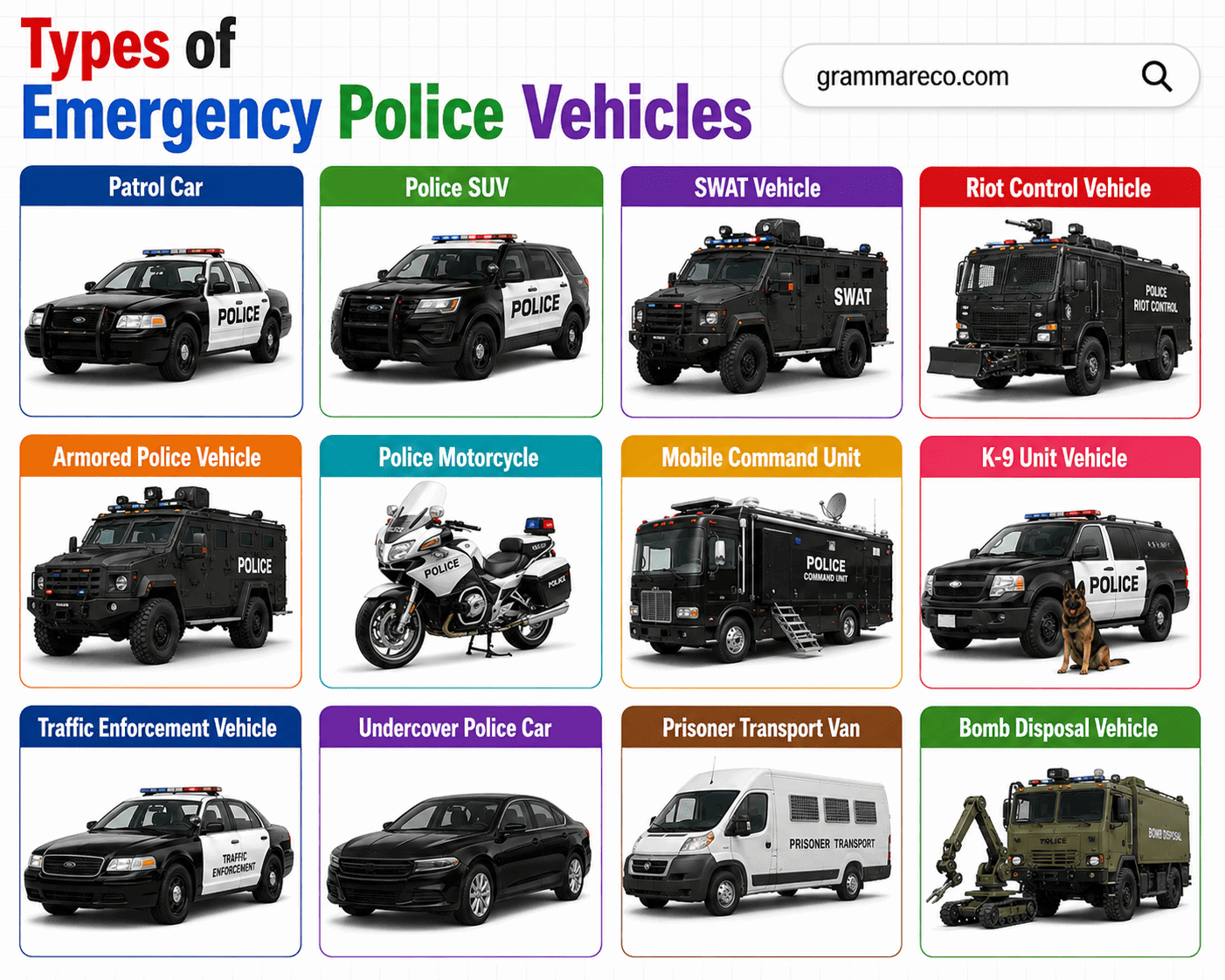
Types of Emergency Police Vehicles
Police vehicles are designed for law enforcement, traffic control, tactical response, and public safety operations. They combine speed, communication systems, and protective features to handle both routine patrols and high-risk incidents.
Police Sedan
Police Sedan is a standard patrol vehicle used in urban policing. It handles traffic violations, neighborhood patrols, and quick emergency response. It is the most common police unit in city environments.
Police SUV
Police SUV provides extra space for officers and tactical equipment. It is used in rural patrols, emergency backup, and high-risk operations. Its durability makes it suitable for rough terrain and unpredictable situations.
Highway Patrol Vehicle
Highway Patrol Vehicle is designed for fast response on expressways and long-distance roads. It manages accidents, speeding enforcement, and highway safety operations. It plays a key role in traffic regulation systems.
Police Motorcycle
Police Motorcycle moves quickly through congested traffic zones. It handles escorts, emergency response, and event security control. Its mobility makes it ideal for urban environments with heavy traffic.
SWAT Truck
SWAT Truck is an armored tactical vehicle used in extreme danger situations. It transports special response teams during hostage rescues or armed threats. It provides strong protection in high-risk environments.
Riot Control Vehicle
Riot Control Vehicle is designed for crowd management and public disturbance control. It includes protective armor and safety barriers for officers. It is deployed during protests and large public gatherings.
Mobile Command Vehicle
Mobile Command Vehicle functions as a mobile operations center during major incidents. It includes communication systems, monitoring screens, and coordination tools. Built to manage disaster and crime scenes efficiently.
K9 Unit Vehicle
K9 Unit Vehicle transports trained police dogs for tracking and detection missions. It is used in search operations, narcotics control, and suspect tracking. It supports specialized police investigations.
Sheriff Patrol Vehicle
Sheriff Patrol Vehicle operates in county and rural law enforcement areas. It handles patrol duties, prisoner transport, and emergency response. It is commonly used outside major city zones.
Disaster Rescue Vehicles with Names
Disaster response vehicles are used during floods, earthquakes, storms, and large-scale emergencies. They carry rescue teams, survival tools, and heavy equipment to reach affected zones quickly and safely.
Urban Search and Rescue Vehicle
Urban Search and Rescue Vehicle is designed for collapsed buildings and disaster zones. It carries sensors, cameras, and cutting tools to locate trapped victims. It is essential during earthquake rescue operations.
Flood Rescue Truck
Flood Rescue Truck operates in deep water during flooding emergencies. It helps evacuate civilians and transport rescue teams safely. Widely used during hurricanes and heavy rainfall disasters.
Snow Rescue Vehicle
Snow Rescue Vehicle is built for icy roads and blizzard conditions. It rescues stranded individuals in mountainous or frozen regions. It plays a critical role in winter emergency response.
Mountain Rescue Vehicle
Mountain Rescue Vehicle is used in steep and rocky terrain rescues. It carries medical and survival equipment for injured hikers or climbers. It is essential in high-altitude rescue missions.
Rescue ATV
Rescue ATV is a compact all-terrain vehicle used in forests, beaches, and muddy areas. It reaches locations inaccessible to larger vehicles. It supports rapid search and rescue operations.
Emergency Bulldozer
Emergency Bulldozer clears debris and blocked roads after disasters. It removes collapsed structures, trees, and heavy obstacles. It helps restore access for rescue teams.
Emergency Recovery Truck
Emergency Recovery Truck removes damaged vehicles and heavy wreckage from accident scenes. It restores road flow after collisions and highway incidents. It is essential for traffic recovery operations.
Drone Support Vehicle
Drone Support Vehicle carries drones and control systems for aerial surveillance. It helps locate victims and assess disaster damage quickly. It improves coordination during rescue missions.
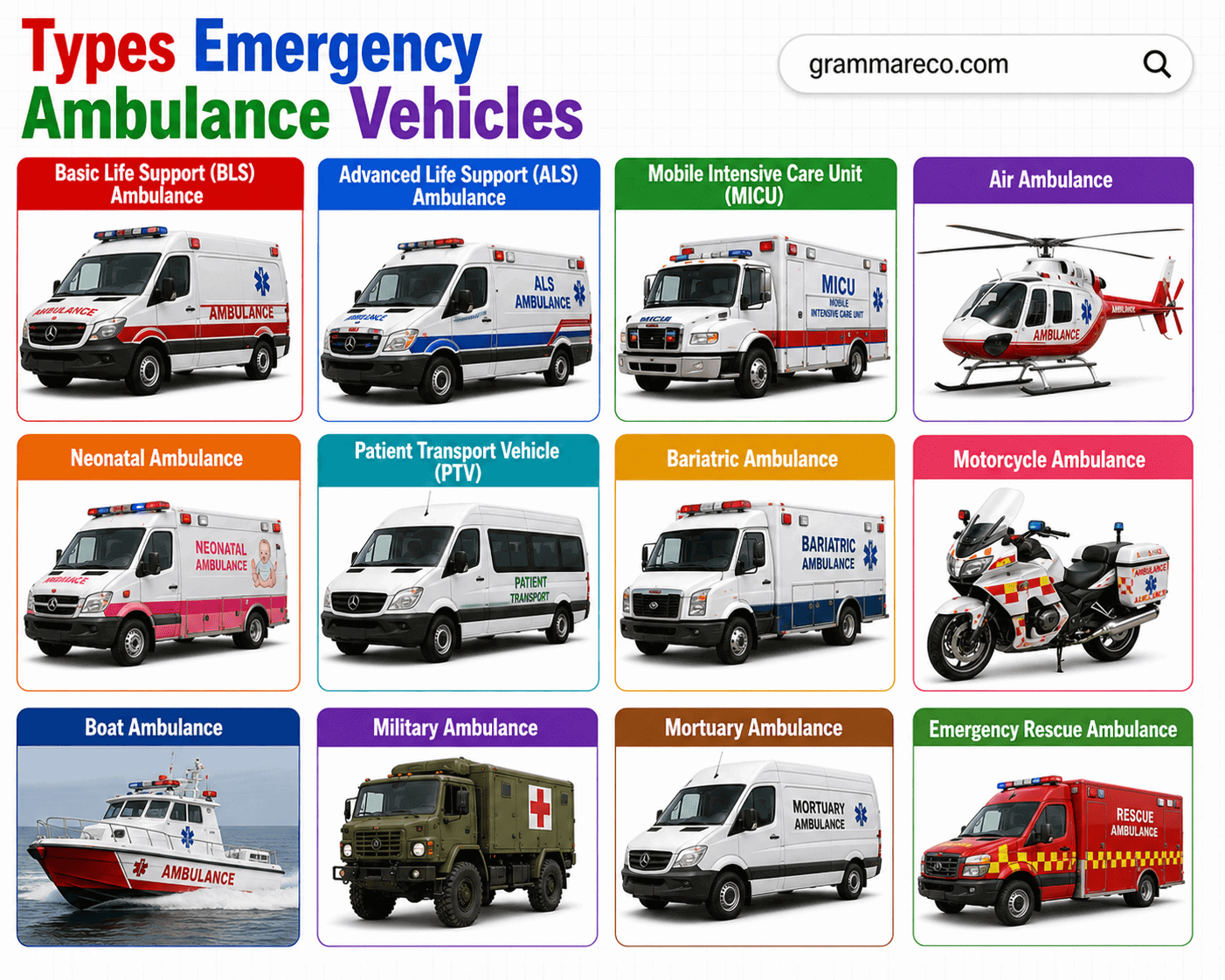
Ambulance Vehicle Types and Uses with Pictures
Ambulance vehicles provide emergency medical care and patient transport during critical situations. They are equipped with life-support systems, oxygen units, and monitoring devices for different medical needs.
Basic Life Support Ambulance
Basic Life Support Ambulance provides first aid and oxygen support during transport. It handles non-critical patients and emergency transfers. It is widely used in everyday medical emergencies.
Advanced Life Support Ambulance
Advanced Life Support Ambulance includes advanced monitoring systems and cardiac care tools. Paramedics provide intensive care during transport. Often used in serious and life-threatening conditions.
Air Ambulance
Air Ambulance uses helicopters or aircraft for rapid long-distance patient transport. It is essential for remote areas and critical trauma cases. It significantly reduces response time.
Neonatal Ambulance
Neonatal Ambulance is designed for newborns requiring specialized medical care. It includes incubators and oxygen systems. Used for infant emergency transport.
Motorcycle Ambulance
Motorcycle Ambulance reaches patients quickly through traffic congestion. It provides immediate first response care in urban areas. It improves emergency reaction time.
Patient Transport Ambulance
Patient Transport Ambulance moves stable patients between hospitals or care centers. It does not support critical emergencies. It ensures safe medical transfer.
Military Ambulance
Military Ambulance transports injured personnel from conflict or training zones. It carries battlefield medical equipment and support tools. It is used in defense operations.
Mobile Clinic Vehicle
Mobile Clinic Vehicle operates as a traveling healthcare unit. It provides vaccinations, treatment, and basic medical services. It supports rural and underserved communities.
Emergency Vehicle Equipment and Features
Emergency vehicles use advanced warning systems and protective equipment to improve rescue speed and public safety. Many vehicles also include communication radios, navigation systems, cameras, and emergency power supplies.
Sirens Used on Emergency Type of Vehicles
Sirens warn nearby drivers and pedestrians during emergency responses. Different siren sounds help emergency crews communicate urgency levels on busy roads.
Common siren types include:
| Siren Type | Main Use |
|---|---|
| Wail Siren | Warns traffic from long distances during emergency response situations. Common on ambulances and fire trucks. |
| Yelp Siren | Uses short and rapid tones to move through heavy traffic and crowded intersections quickly. |
| Hi-Lo Siren | Alternates between two tones and is often used by ambulances in busy city areas. |
| Phaser Siren | Produces fast-changing electronic sounds that quickly grab driver attention in traffic. |
| Mechanical Siren | Creates a loud rotating warning sound used on older fire engines and civil defense vehicles. |
| Electronic Siren | Modern digital siren system with adjustable emergency tones for different rescue situations. |
| Air Horn Siren | Gives a powerful horn blast to alert nearby drivers at intersections and emergency scenes. |
| Federal Signal Siren | High-powered warning siren commonly used by large fire departments and rescue fleets. |
A phaser siren sounds sharp and rapidly changing, kind of like a fast electronic alarm echoing through traffic.
Flashing Lights on Rescue Vehicles
Emergency lights improve visibility during nighttime operations, storms, highway accidents, and crowded traffic conditions. Different colors often represent different emergency services.
Common emergency light colors include:
- Red Lights for fire departments
- Blue Lights for police vehicles
- White Lights for visibility
- Amber Lights for caution vehicles
- Green Lights for volunteer responders
LED emergency lights are now widely used because they consume less power and remain brighter during poor weather.
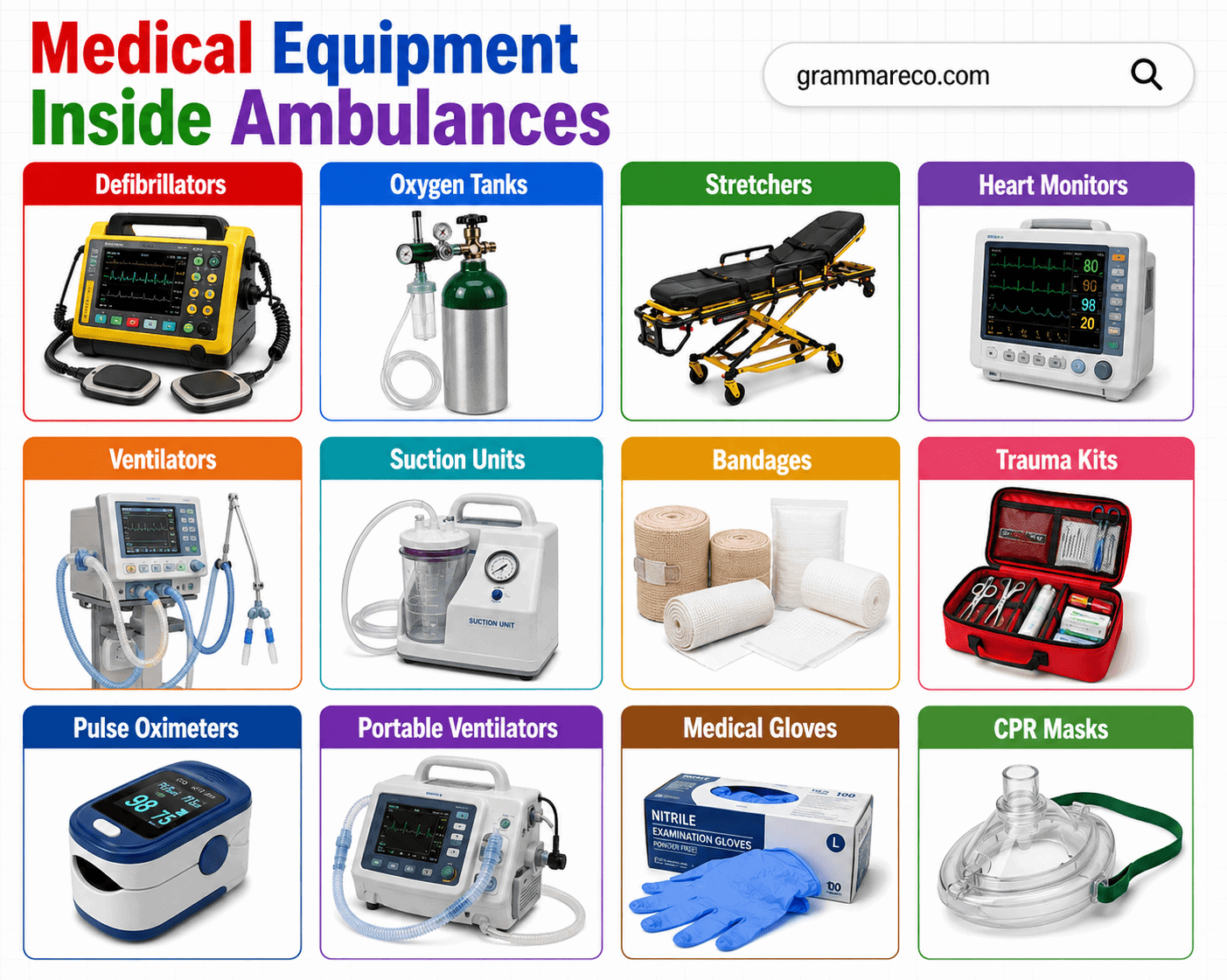
Medical Equipment Inside Ambulances
Ambulances carry emergency medical tools for patient treatment during transportation. Advanced ambulances often look almost like moving hospital rooms inside.
Common ambulance equipment includes:
- Defibrillators
- Oxygen Tanks
- Stretchers
- Heart Monitors
- Ventilators
- Suction Units
- Bandages
- Trauma Kits
- IV Supplies
- Emergency Medicines
- Spine Boards
- Blood Pressure Monitors
- Pulse Oximeters
- Portable Ventilators
- Medical Gloves
- CPR Masks
Why Emergency Vehicles Use Sirens and Lights
Sirens and flashing lights warn traffic about urgent emergency movement. Drivers hearing sirens should safely move aside because emergency response teams may carry injured patients or respond to dangerous situations.
Lights also improve visibility during fog, rain, smoke, snow, and nighttime emergencies. Bright emergency lighting reduces accident risks while helping responders travel faster through busy intersections.
You might already know this one, but ambulances usually combine both loud sirens and bright flashing lights together for maximum road visibility.
Safety Rules Around Emergency Vehicles
People should stay alert whenever emergency vehicles approach roads, intersections, schools, or highways. Small safety actions can prevent serious accidents during emergency responses.
Important safety rules include:
- Move to the roadside when sirens approach
- Never block emergency intersections
- Keep safe distance behind ambulances
- Avoid sudden braking near fire trucks
- Follow police traffic instructions immediately
- Do not chase emergency vehicles
- Watch carefully at night crossings
- Slow down near accident scenes
- Keep roads open during evacuations
- Stop carefully for school emergency vehicles
Ever seen drivers freeze during sirens? Staying calm usually helps traffic move more safely.
FAQs about Emergency Vehicles
Main emergency vehicles include ambulances, police cars, fire trucks, rescue boats, military rescue units, and disaster response vehicles used during urgent situations.
Flashing lights improve visibility during emergencies, especially at night, during storms, or in crowded traffic where responders need safer movement.
Ambulances usually carry oxygen tanks, stretchers, heart monitors, defibrillators, trauma kits, ventilators, and emergency medical supplies for patient treatment.
Airport crash tenders respond to airplane emergencies because they carry foam systems, rescue tools, and high capacity firefighting equipment.
Drivers should safely slow down, move aside carefully, avoid blocking intersections, and allow emergency vehicles enough space to pass quickly.
Conclusion
Emergency vehicles play an important role in protecting people during fires, medical emergencies, natural disasters, and dangerous rescue situations. Fire trucks, ambulances, police vehicles, rescue boats, and disaster response units help emergency teams reach affected areas quickly and safely. Each type of emergency vehicle is designed for a specific task, whether carrying medical equipment, controlling fires, managing traffic, or rescuing trapped victims.
Different rescue roles require different emergency response vehicles because every situation creates unique challenges. A wildfire in dry forests needs brush trucks and wildland fire engines, while flood emergencies depend on rescue boats and high-water rescue trucks. Police units use patrol cars, motorcycles, and tactical vehicles to handle public safety operations across cities and highways.
Modern emergency vehicles now include advanced communication systems, GPS tracking, thermal cameras, drones, hydraulic rescue tools, and life-support medical equipment. These technologies improve response speed and help rescue teams operate more efficiently during large emergencies and disaster situations.
Learning about types of emergency vehicles also improves transportation awareness and public safety understanding. Recognizing sirens, flashing lights, and rescue vehicle functions helps people react properly during emergencies and understand how first responder systems operate in daily life.
Read more