

Many English learners feel confused when choosing is, am, or are while speaking or writing. One small mistake can change the meaning of a sentence and reduce confidence. This blog post explains the uses of is am and are in a simple way to make your English clear and correct.
How to Use Is, Am and Are in Sentences
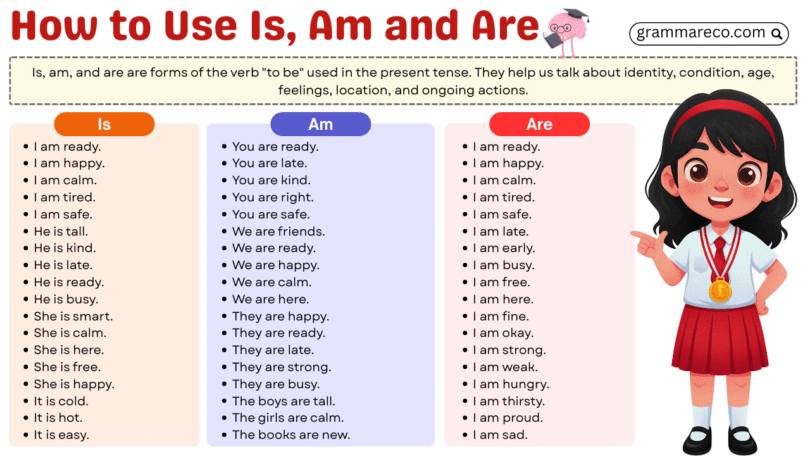
Is, am, and are are forms of the verb “to be” used in the present tense. They help us talk about identity, condition, age, feelings, location, and ongoing actions. Choosing the correct form depends on the subject of the sentence. Learning their correct use builds a strong grammar foundation and improves sentence accuracy.
Is → he, she, it, singular nouns | Am → I | Are → you, we, they, plural nouns
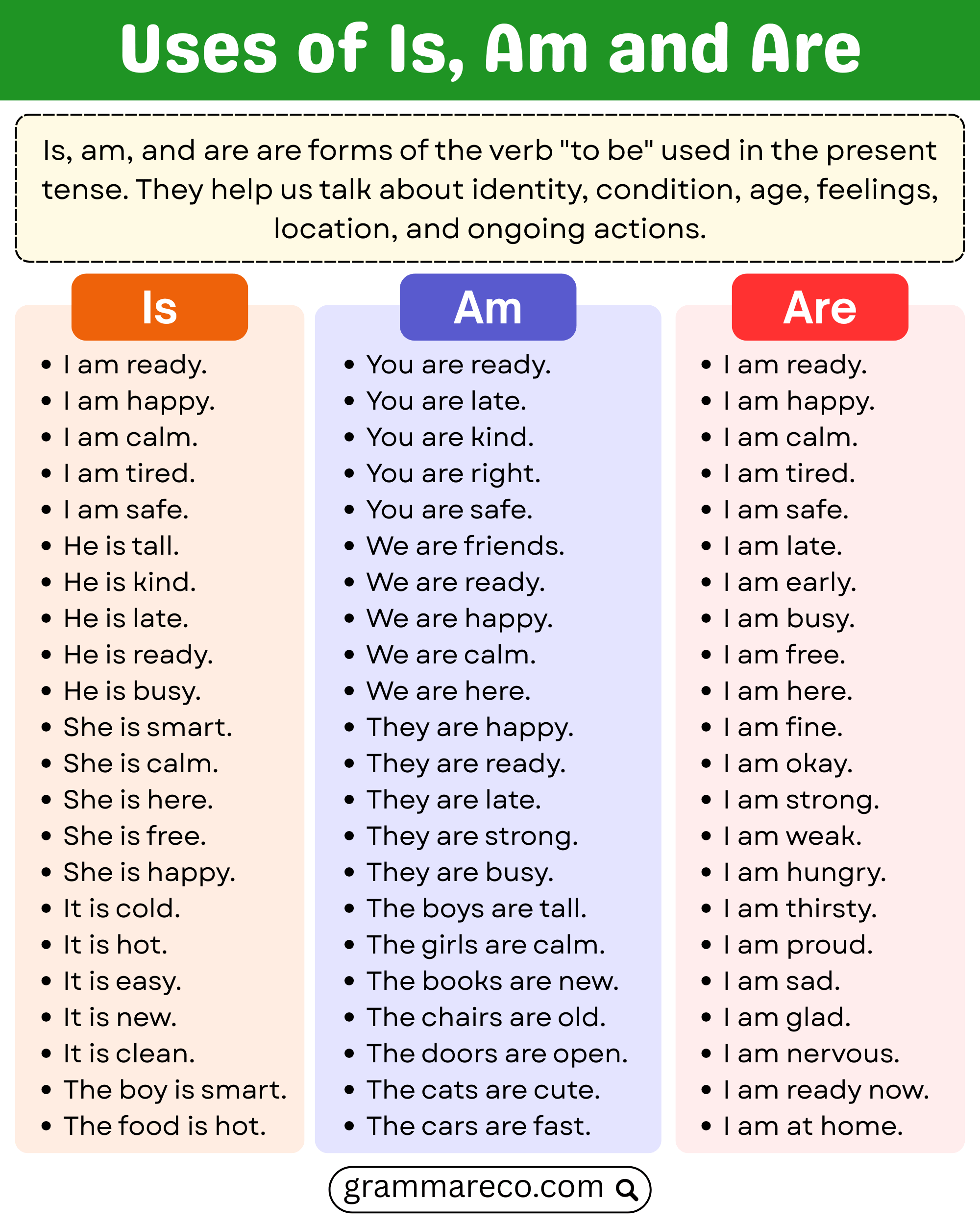
Uses of Is in Different Situations
The verb is is used with singular subjects and third person forms. It helps describe one person, thing, idea, or situation. Teachers often explain is as the most common form used in daily English sentences for facts, states, and present actions.
Rules of using Is for singular nouns
We use is when the subject is one person, one place, or one thing. Singular nouns always take is in the present tense.
- The book is on the table.
- Ayesha is my best friend.
- The school is very clean.
- This chair is broken.
Using is with uncountable nouns
Uncountable nouns represent things we cannot count individually, such as water or information. These nouns are treated as singular.
- The milk is fresh.
- The information is correct.
- The furniture is new.
- The advice is helpful.
Tip: If the noun has no plural form, use is.
How to use is with third person singular (he, she, it)
The pronouns he, she, and it always take is in present tense sentences.
- He is my cousin.
- She is very intelligent.
- It is raining today.
- He is ready for school.
Using is in present continuous tense
In present continuous tense, is is used with singular subjects before the -ing form of the verb.
- Ali is studying English.
- The boy is playing football.
- She is cooking dinner.
- The dog is barking loudly.
Using is in yes/no questions
Is comes at the beginning of yes/no questions with singular subjects.
- Is he your teacher?
- Is the shop open?
- Is she feeling better?
- Is this your bag?
How to Use Am in English with Examples
The verb am is only used with the pronoun I. It shows identity, feeling, condition, or an action happening now. No other subject can be used with am, which makes it easy to remember.
Rules for am with “I” in English
Am is always paired with I in present tense sentences.
- I am a student.
- I am happy today.
- I am ready for the test.
- I am your new neighbor.
Using am in present continuous tense
Am is used with I in present continuous tense.
- I am learning English.
- I am writing a letter.
- I am watching TV.
- I am preparing dinner.
Am in affirmative sentences
Affirmative sentences state positive facts or ideas using am.
- I am confident.
- I am your classmate.
- I am from Pakistan.
- I am interested in English.
Using am in questions
In questions, am comes before I.
- Am I late?
- Am I correct?
- Am I speaking clearly?
- Am I allowed to enter?
Using am in negative sentences
Negative sentences are formed by adding not after am.
- I am not tired.
- I am not ready yet.
- I am not angry.
- I am not available today.
Uses of Are in Different Situation with Examples
The verb are is used with plural subjects and certain pronouns. It helps describe more than one person or thing and is very common in conversations.
Rules for are with plural nouns
Plural nouns always take are in the present tense.
- The students are in class.
- The books are heavy.
- The teachers are helpful.
- The cars are new.
Tip: If the noun ends in s, use are.
Using are with you, we, and they
The pronouns you, we, and they use are.
- You are my friend.
- We are ready.
- They are absent today.
- You are very kind.
Using are for groups and collections
Groups or collective ideas are treated as plural when members act separately.
- The team are wearing new uniforms.
- The staff are working late.
- The players are practicing.
- The children are excited.
Using are in present continuous tense
Are is used before verb-ing with plural subjects.
- They are studying.
- We are waiting outside.
- You are learning fast.
- The girls are dancing.
Tip: Structure: Subject + are + verb-ing.
How to use are in questions
Are comes at the beginning of questions with plural subjects.
- Are you okay?
- Are they coming?
- Are we late?
- Are the shops open?
Using are in negative sentences
Negative sentences are formed by adding not after are.
- They are not ready.
- We are not tired.
- You are not wrong.
- The students are not present.
Fill in the Blanks: Uses of Is, Am, and Are
Fill in the blanks:
- I ___ ready for class.
- She ___ my best friend.
- They ___ playing outside.
- He ___ very kind.
- We ___ late today.
- It ___ cold in the morning.
- You ___ my teacher.
- The boys ___ in the room.
- The bag ___ heavy.
- I ___ happy today.
Answers:
- am
- is
- are
- is
- are
- is
- are
- are
- is
- am
FAQs about Uses of Is Am and Are
Is is used with singular subjects, am with I, and are with plural subjects.
No, am is only used with I.
No, always use you are.
Are is used for more than one subject and with you, we, and they.
They help form correct sentences and improve speaking and writing skills.
To teach the use of is, am, and are, explain that these words are used to talk about the present time. Start with am and use it only with I, such as I am a student. Then teach is for one person or thing, like Ali is happy. After that, teach are for more than one person and with you, for example They are friends and You are ready. Use simple speaking practice so students learn naturally and confidently.
Read more