

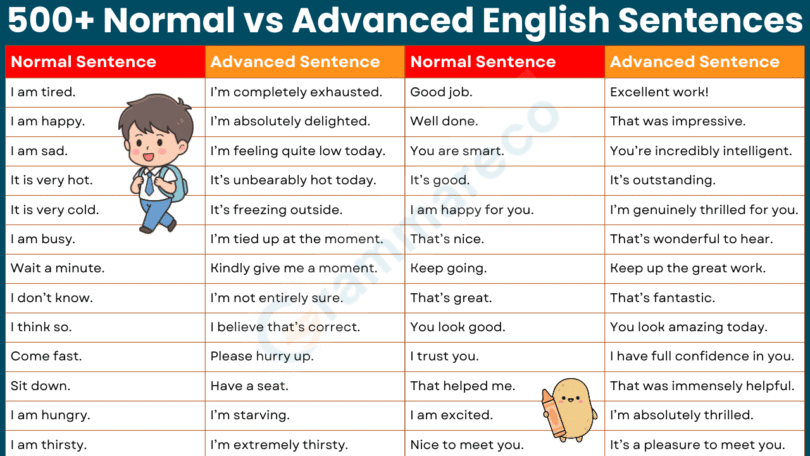

Struggling to sound fluent even after years of studying English? Many learners know grammar but still speak in very simple sentences. Normal Vs Advanced English Sentences help you upgrade everyday speech into confident, natural, and impressive English that sounds more professional and fluent in real conversations.
Daily Used Normal vs Advanced English Sentences
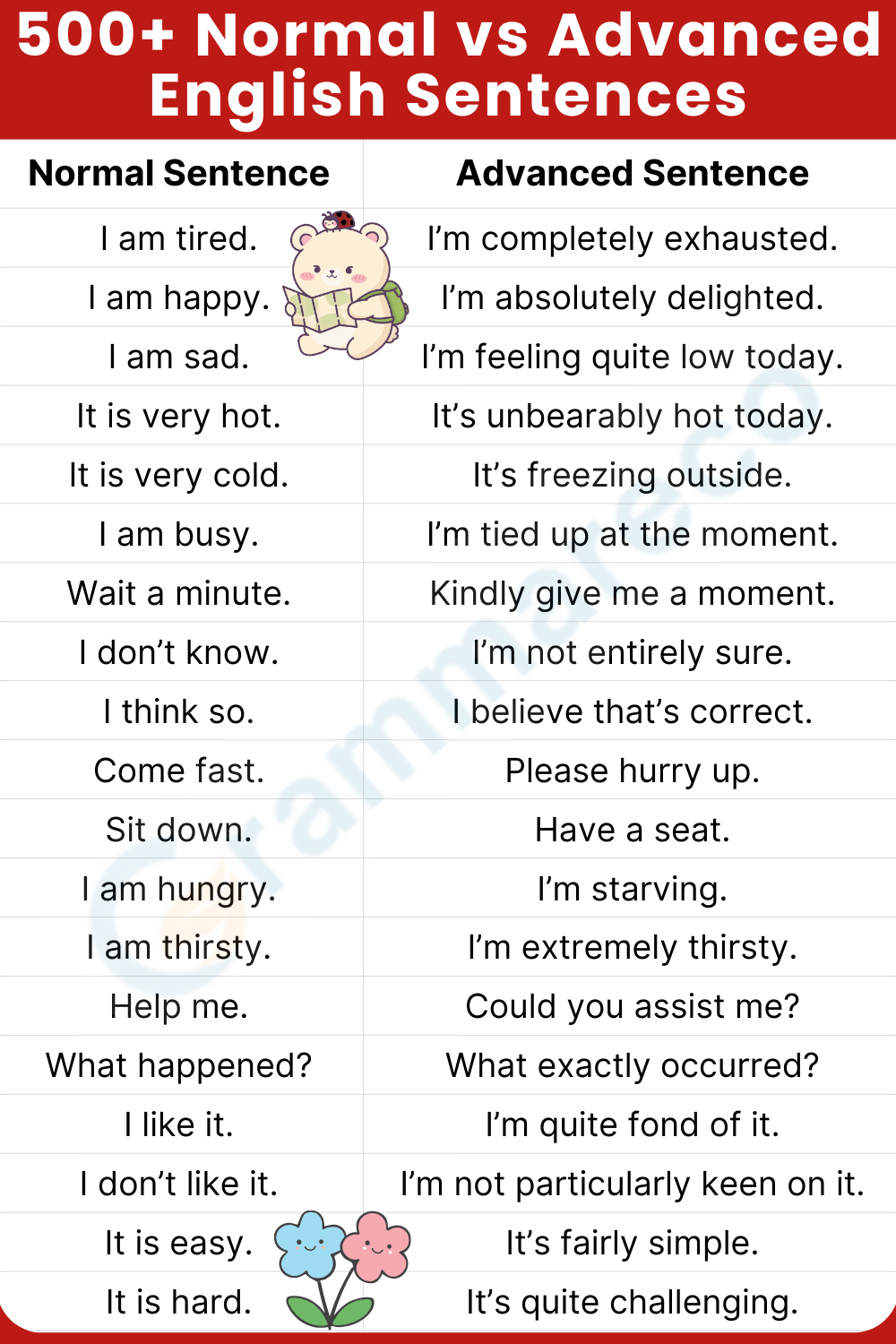
These are everyday speaking examples. The advanced versions use richer vocabulary, better structure, and more natural tone while keeping the meaning simple.
| Normal Sentence | Advanced Sentence |
|---|---|
| I am tired. | I’m completely exhausted. |
| I am happy. | I’m absolutely delighted. |
| I am sad. | I’m feeling quite low today. |
| It is very hot. | It’s unbearably hot today. |
| It is very cold. | It’s freezing outside. |
| I am busy. | I’m tied up at the moment. |
| Wait a minute. | Kindly give me a moment. |
| I don’t know. | I’m not entirely sure. |
| I think so. | I believe that’s correct. |
| Come fast. | Please hurry up. |
| Sit down. | Have a seat. |
| I am hungry. | I’m starving. |
| I am thirsty. | I’m extremely thirsty. |
| Help me. | Could you assist me? |
| What happened? | What exactly occurred? |
| I like it. | I’m quite fond of it. |
| I don’t like it. | I’m not particularly keen on it. |
| It is easy. | It’s fairly simple. |
| It is hard. | It’s quite challenging. |
| I forgot. | It completely slipped my mind. |
| Call me. | Please give me a call. |
| I will try. | I’ll certainly give it a try. |
| I am ready. | I’m all set. |
| I understand. | I completely understand. |
| I am confused. | I’m a bit puzzled. |
| Be careful. | Please exercise caution. |
| Tell me. | Kindly let me know. |
| I agree. | I completely agree with you. |
| I disagree. | I beg to differ. |
| That’s true. | That’s absolutely correct. |
Positive Normal vs Advanced English Sentence with Pictures
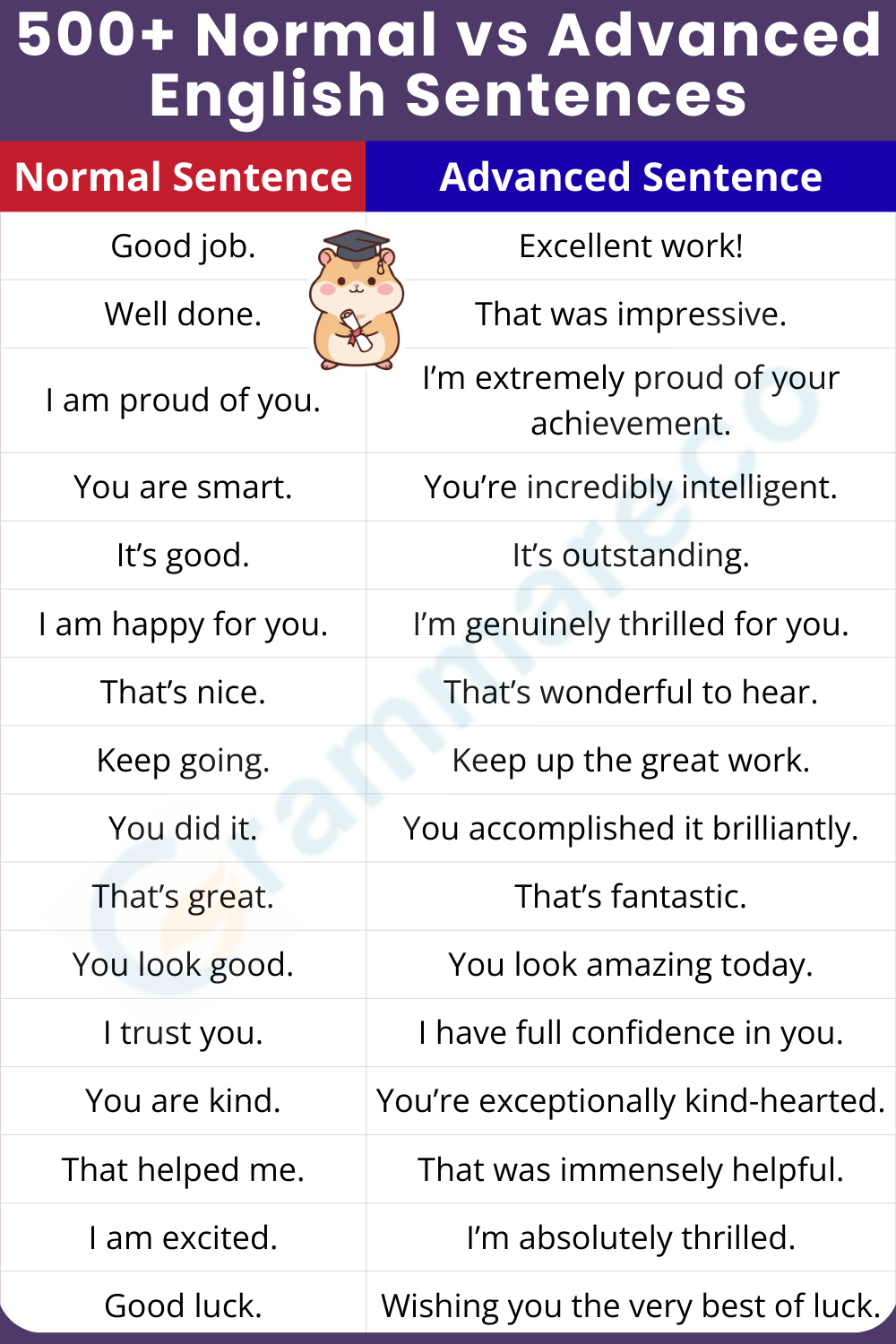
Learn how to express positive feelings, appreciation, and encouragement more confidently. These upgraded sentences sound more natural in professional and social situations.
| Normal Sentence | Advanced Sentence |
|---|---|
| Good job. | Excellent work! |
| Well done. | That was impressive. |
| I am proud of you. | I’m extremely proud of your achievement. |
| You are smart. | You’re incredibly intelligent. |
| It’s good. | It’s outstanding. |
| I am happy for you. | I’m genuinely thrilled for you. |
| That’s nice. | That’s wonderful to hear. |
| Keep going. | Keep up the great work. |
| You did it. | You accomplished it brilliantly. |
| I like your idea. | I truly appreciate your innovative idea. |
| That’s great. | That’s fantastic. |
| You look good. | You look amazing today. |
| I trust you. | I have full confidence in you. |
| You are kind. | You’re exceptionally kind-hearted. |
| That helped me. | That was immensely helpful. |
| I am excited. | I’m absolutely thrilled. |
| Good luck. | Wishing you the very best of luck. |
| Nice to meet you. | It’s a pleasure to meet you. |
| Thank you. | I sincerely appreciate it. |
| You are right. | You’re absolutely right. |
| That’s helpful. | That’s extremely beneficial. |
| I feel good. | I’m feeling fantastic. |
| This is fun. | This is incredibly enjoyable. |
| I am confident. | I feel completely confident. |
| You are talented. | You’re remarkably talented. |
| It worked. | It worked perfectly. |
| I believe in you. | I have unwavering faith in you. |
| That’s useful. | That’s highly useful. |
| You are amazing. | You’re truly exceptional. |
| I’m satisfied. | I’m completely satisfied. |
Negative Normal vs Advance English Sentences
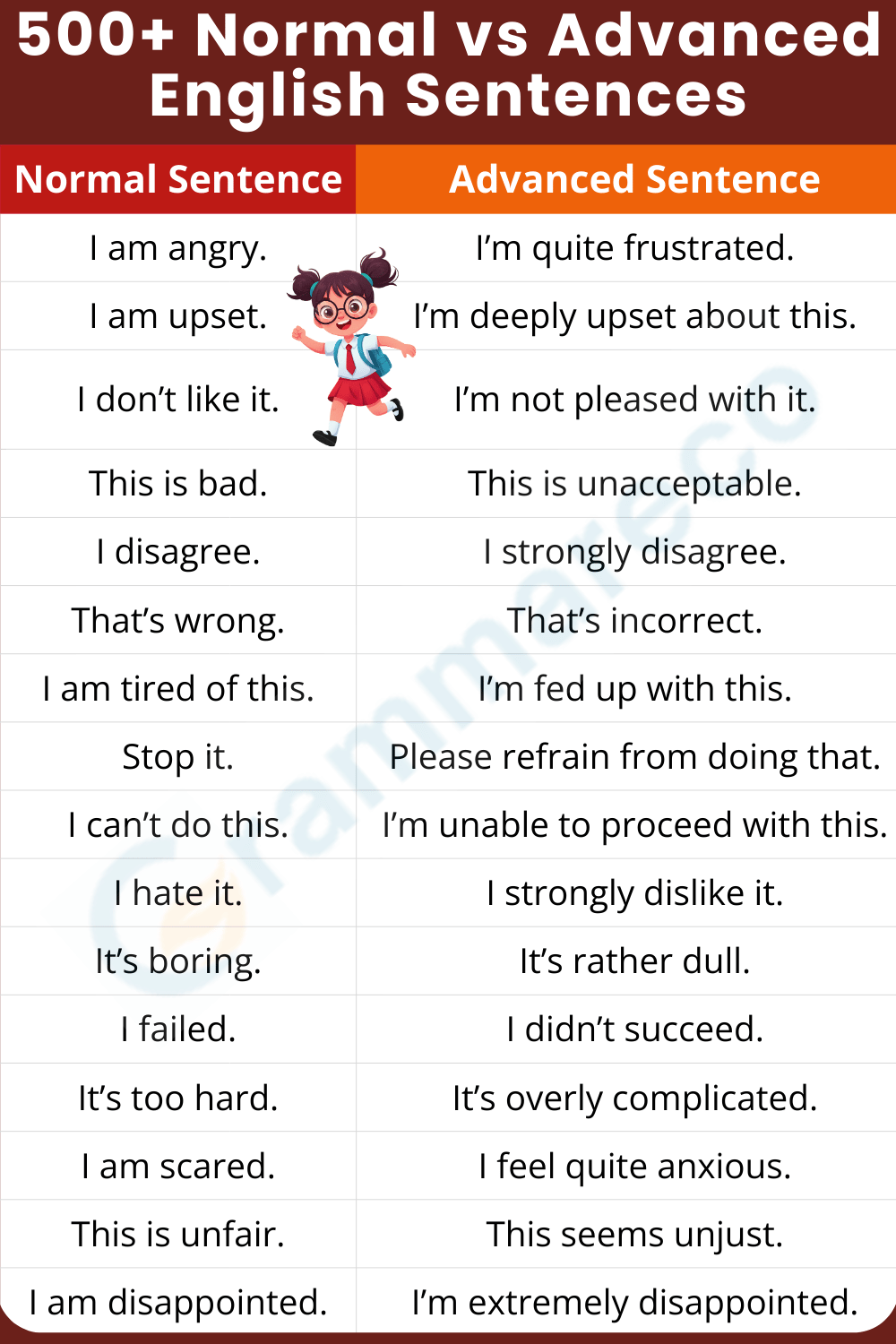
Master the advanced English language sentences and know how to express disagreement, disappointment, or refusal politely and professionally without sounding rude.
| Normal Sentence | Advanced Sentence |
|---|---|
| I am angry. | I’m quite frustrated. |
| I am upset. | I’m deeply upset about this. |
| I don’t like it. | I’m not pleased with it. |
| This is bad. | This is unacceptable. |
| I disagree. | I strongly disagree. |
| That’s wrong. | That’s incorrect. |
| I am tired of this. | I’m fed up with this. |
| Stop it. | Please refrain from doing that. |
| I can’t do this. | I’m unable to proceed with this. |
| I hate it. | I strongly dislike it. |
| It’s boring. | It’s rather dull. |
| I failed. | I didn’t succeed. |
| It’s too hard. | It’s overly complicated. |
| I am scared. | I feel quite anxious. |
| This is unfair. | This seems unjust. |
| I am disappointed. | I’m extremely disappointed. |
| Don’t shout. | Kindly lower your voice. |
| I am worried. | I’m quite concerned. |
| That’s silly. | That’s unreasonable. |
| I am not ready. | I’m not fully prepared. |
| You are wrong. | You may be mistaken. |
| I don’t agree. | I’m afraid I can’t agree. |
| Leave me alone. | I’d appreciate some space. |
| It’s late. | It’s getting rather late. |
| That’s not good. | That’s far from ideal. |
| I forgot. | It slipped my mind. |
| I can’t help. | I’m unable to assist. |
| I am busy. | I’m currently occupied. |
| This is risky. | This appears quite risky. |
| I feel bad. | I feel rather uneasy. |
Normal vs Advanced Sentences in English for Kids
By learning normal vs advanced English helps children speak more confidently by replacing simple textbook sentences with expressive alternatives.
| Normal Sentence | Advanced Sentence |
|---|---|
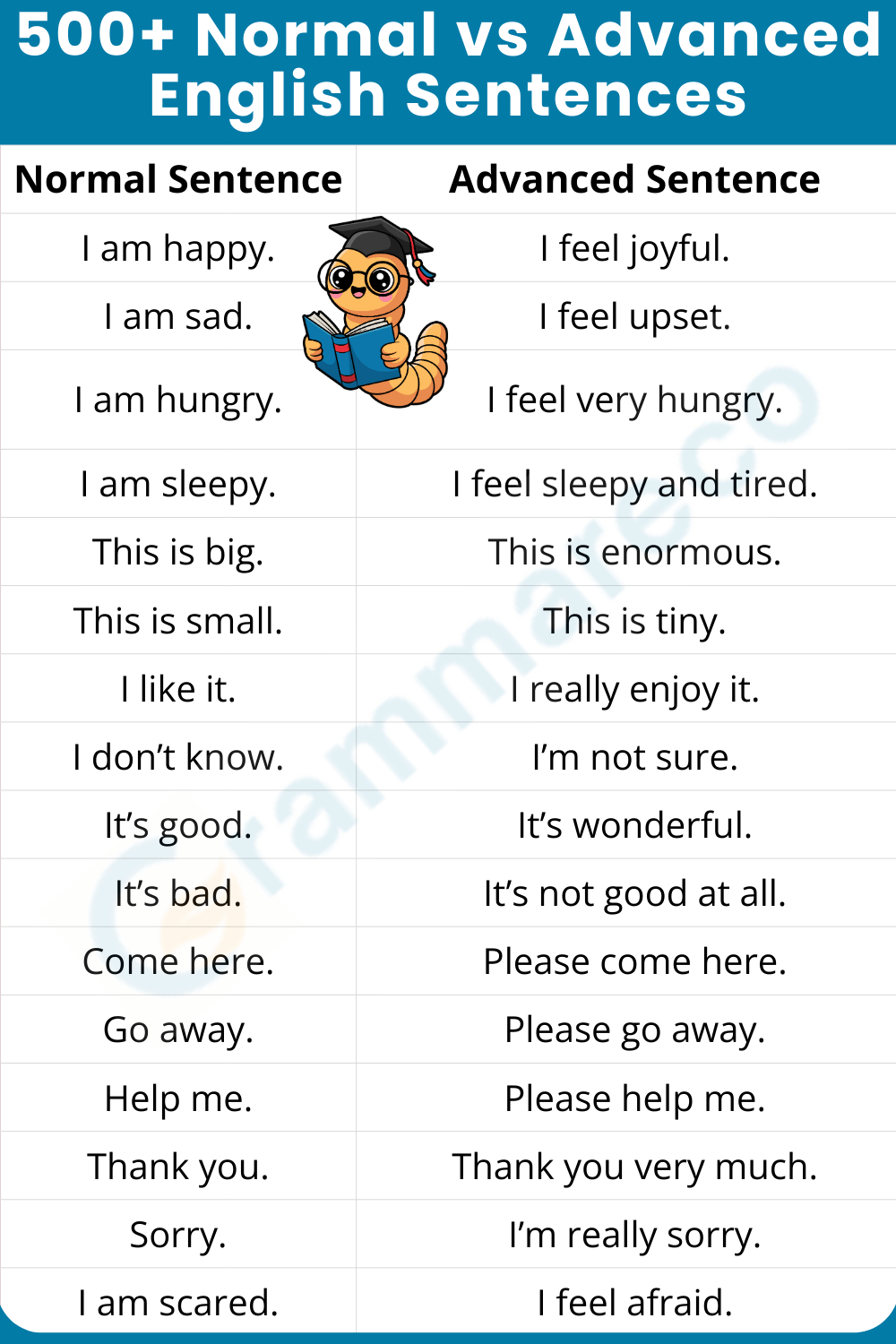
| I am happy. | I feel joyful. |
| I am sad. | I feel upset. |
| I am hungry. | I feel very hungry. |
| I am sleepy. | I feel sleepy and tired. |
| This is big. | This is enormous. |
| This is small. | This is tiny. |
| I like it. | I really enjoy it. |
| I don’t know. | I’m not sure. |
| It’s good. | It’s wonderful. |
| It’s bad. | It’s not good at all. |
| Come here. | Please come here. |
| Go away. | Please go away. |
| Help me. | Please help me. |
| Thank you. | Thank you very much. |
| Sorry. | I’m really sorry. |
| I am scared. | I feel afraid. |
| Let’s go. | Let’s get going. |
| Wait. | Please wait a moment. |
| I won. | I was successful. |
| I lost. | I didn’t win. |
| I am ready. | I’m fully prepared. |
| It’s funny. | It’s hilarious. |
| It’s nice. | It’s lovely. |
| I am strong. | I feel strong and brave. |
| I can do it. | I’m confident I can do it. |
| Look at this. | Take a look at this. |
| Be quiet. | Please be quiet. |
| Sit here. | Please sit here. |
| Stand up. | Please stand up. |
| I finished. | I have completed it. |
50+ Basic Vs Advanced English Sentences
Below are basic vs advanced level English sentences that will boost your fluency in English language to normal to advanced:
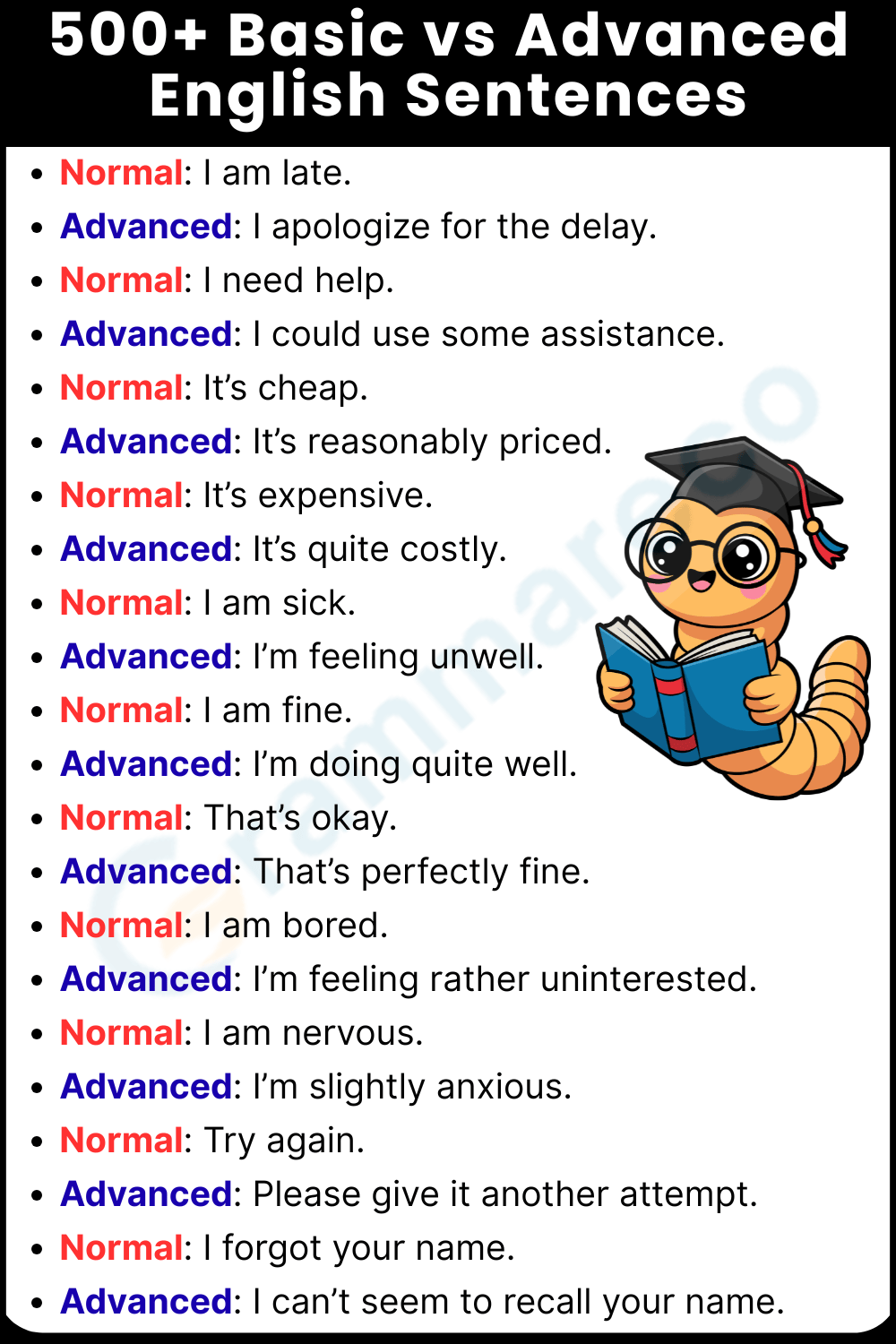
- Normal: I am late.
Advanced: I apologize for the delay. - Normal: I need help.
Advanced: I could use some assistance. - Normal: It’s cheap.
Advanced: It’s reasonably priced. - Normal: It’s expensive.
Advanced: It’s quite costly. - Normal: I am sick.
Advanced: I’m feeling unwell. - Normal: I am fine.
Advanced: I’m doing quite well. - Normal: That’s okay.
Advanced: That’s perfectly fine. - Normal: I am bored.
Advanced: I’m feeling rather uninterested. - Normal: I am nervous.
Advanced: I’m slightly anxious. - Normal: Try again.
Advanced: Please give it another attempt. - Normal: I forgot your name.
Advanced: I can’t seem to recall your name. - Normal: I am sure.
Advanced: I’m absolutely certain. - Normal: I am not sure.
Advanced: I’m somewhat uncertain. - Normal: It’s possible.
Advanced: It’s highly likely. - Normal: It’s impossible.
Advanced: It’s simply not feasible. - Normal: I like reading.
Advanced: I thoroughly enjoy reading. - Normal: I need money.
Advanced: I’m in need of some funds. - Normal: I will go.
Advanced: I shall proceed. - Normal: It’s my mistake.
Advanced: It was entirely my fault. - Normal: I am surprised.
Advanced: I’m genuinely astonished.
Everyday Situation Normal Vs Advanced English Sentences
Daily used normal to advanced English sentences are given below:
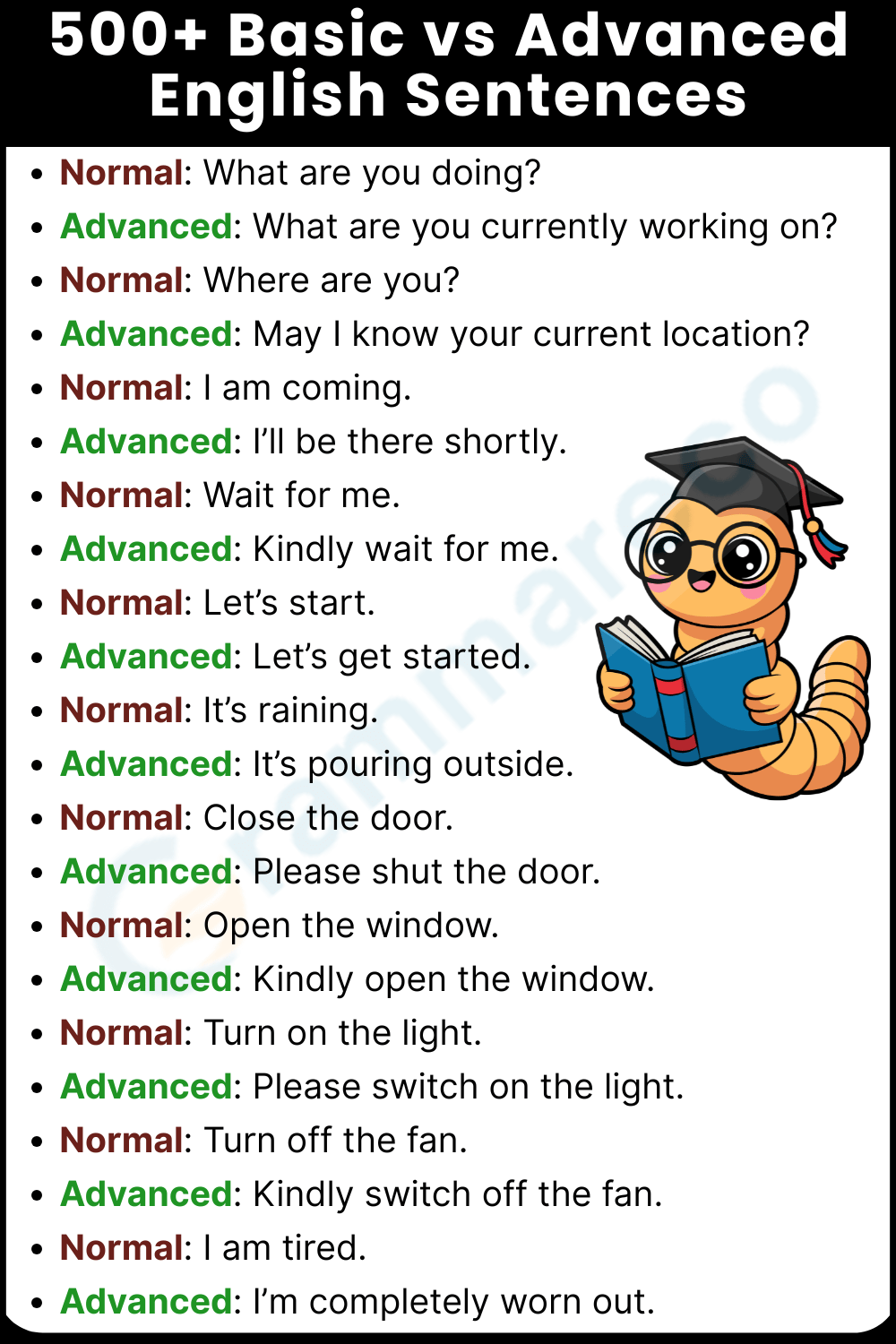
- Normal: What are you doing?
Advanced: What are you currently working on? - Normal: Where are you?
Advanced: May I know your current location? - Normal: I am coming.
Advanced: I’ll be there shortly. - Normal: Wait for me.
Advanced: Kindly wait for me. - Normal: Let’s start.
Advanced: Let’s get started. - Normal: It’s raining.
Advanced: It’s pouring outside. - Normal: Close the door.
Advanced: Please shut the door. - Normal: Open the window.
Advanced: Kindly open the window. - Normal: Turn on the light.
Advanced: Please switch on the light. - Normal: Turn off the fan.
Advanced: Kindly switch off the fan. - Normal: I am tired.
Advanced: I’m completely worn out. - Normal: I will call you.
Advanced: I’ll get in touch with you. - Normal: Send me the file.
Advanced: Please forward the file to me. - Normal: I am waiting.
Advanced: I’m waiting patiently. - Normal: Let’s meet tomorrow.
Advanced: Let’s schedule a meeting for tomorrow. - Normal: I am sorry.
Advanced: I sincerely apologize. - Normal: That’s enough.
Advanced: That will suffice. - Normal: I am thinking.
Advanced: I’m considering it carefully. - Normal: I don’t understand.
Advanced: I’m having difficulty understanding. - Normal: Explain it.
Advanced: Could you please elaborate?
Unique Normal Vs Advanced English Sentences List
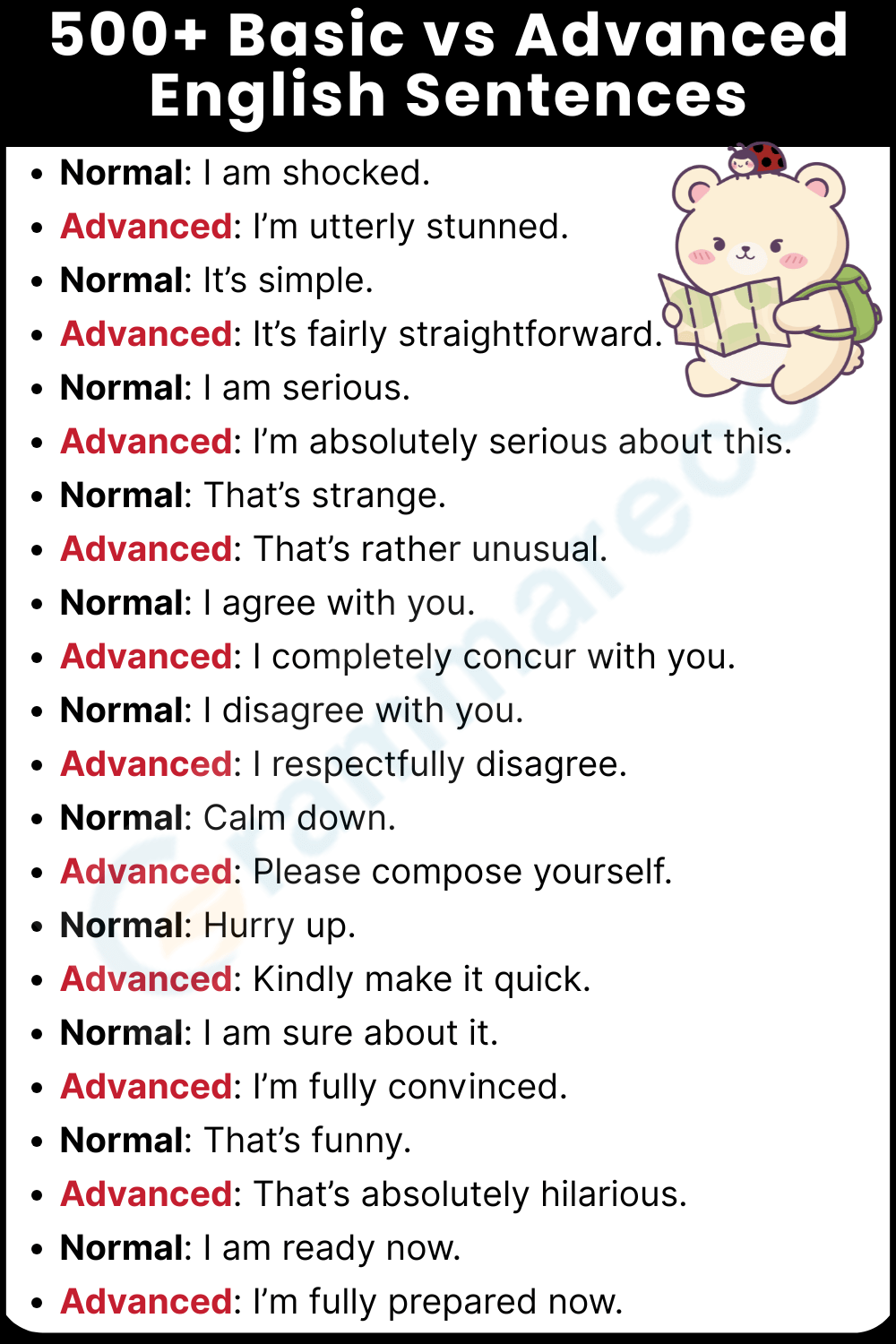
- Normal: I am shocked.
Advanced: I’m utterly stunned. - Normal: It’s simple.
Advanced: It’s fairly straightforward. - Normal: I am serious.
Advanced: I’m absolutely serious about this. - Normal: That’s strange.
Advanced: That’s rather unusual. - Normal: I agree with you.
Advanced: I completely concur with you. - Normal: I disagree with you.
Advanced: I respectfully disagree. - Normal: Calm down.
Advanced: Please compose yourself. - Normal: Hurry up.
Advanced: Kindly make it quick. - Normal: I am sure about it.
Advanced: I’m fully convinced. - Normal: That’s funny.
Advanced: That’s absolutely hilarious. - Normal: I am ready now.
Advanced: I’m fully prepared now. - Normal: I am curious.
Advanced: I’m genuinely curious about it. - Normal: That’s important.
Advanced: That’s extremely significant. - Normal: It’s different.
Advanced: It’s quite distinct. - Normal: I am confused.
Advanced: I’m rather perplexed. - Normal: It’s risky.
Advanced: It carries considerable risk. - Normal: I am busy now.
Advanced: I’m currently engaged. - Normal: It’s my idea.
Advanced: That was my proposal. - Normal: I am careful.
Advanced: I exercise caution. - Normal: I promise.
Advanced: I give you my word.
Simple and Next Level English Practice Examples
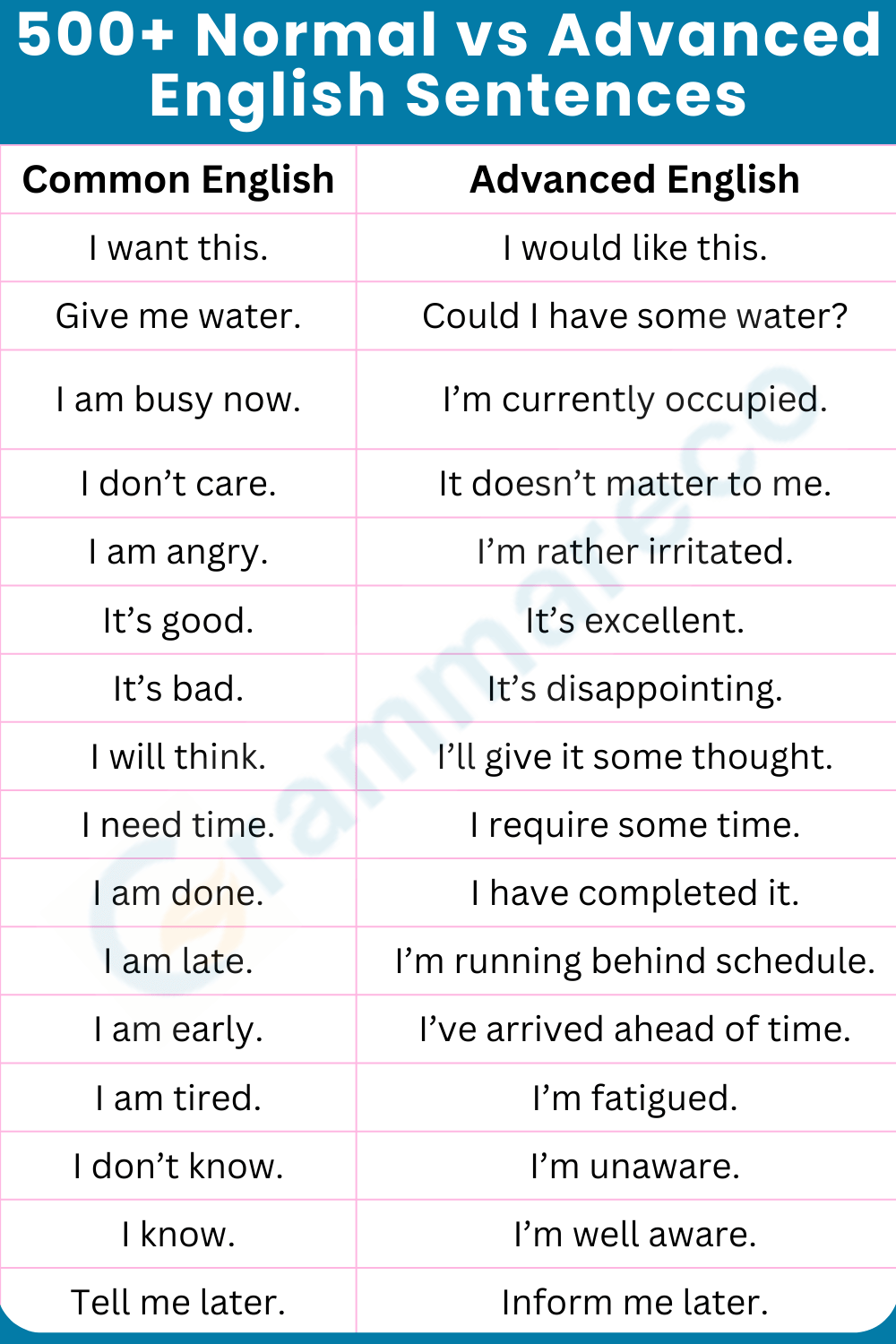
| Common English | Advanced English |
|---|---|
| I want this. | I would like this. |
| Give me water. | Could I have some water? |
| I am busy now. | I’m currently occupied. |
| I don’t care. | It doesn’t matter to me. |
| I am angry. | I’m rather irritated. |
| It’s good. | It’s excellent. |
| It’s bad. | It’s disappointing. |
| I will think. | I’ll give it some thought. |
| I need time. | I require some time. |
| I am done. | I have completed it. |
| I am late. | I’m running behind schedule. |
| I am early. | I’ve arrived ahead of time. |
| I am tired. | I’m fatigued. |
| I don’t know. | I’m unaware. |
| I know. | I’m well aware. |
| Tell me later. | Inform me later. |
| It’s fine. | It’s acceptable. |
| I forgot. | I failed to remember. |
| I am shocked. | I’m astonished. |
| That’s easy. | That’s effortless. |
| I am hungry. | I’m famished. |
| I am scared. | I’m frightened. |
| I am busy. | I’m preoccupied. |
| It’s true. | That’s accurate. |
| I am bored. | I’m uninterested. |
| I am ready. | I’m prepared. |
| I am thinking. | I’m contemplating. |
| I am wrong. | I stand corrected. |
| I am right. | I’m correct. |
| It’s okay. | It’s satisfactory. |
Download PDF
👉 Download Here – 500 Normal vs Advanced English Sentences
FAQs about Normal Vs Advance English Sentences with Answer
Normal sentences use simple vocabulary and direct structure. Advanced sentences use richer vocabulary, varied sentence patterns, and more precise expressions.
They improve fluency, confidence, and professionalism in speaking and writing.
Yes, start with small upgrades like replacing “very good” with “excellent.”
Replace basic words with stronger vocabulary and improve sentence structure. Example: “I am happy” → “I’m absolutely delighted.”
No. Advanced English often uses simple grammar but better vocabulary and natural phrasing.
Yes. They improve band scores in speaking and writing and create a strong impression in job interviews.
Read more


Amazing Work Emily