
Many English learners struggle with using do, does, and did correctly. Confusion arises because these words change based on the subject and tense, leading to mistakes in speaking and writing. This blog post help you to learn uses of do, does and did with examples. Understanding their proper use can improve your English fluency and make your sentences clear and correct.
Effective Uses of Do in English with Examples
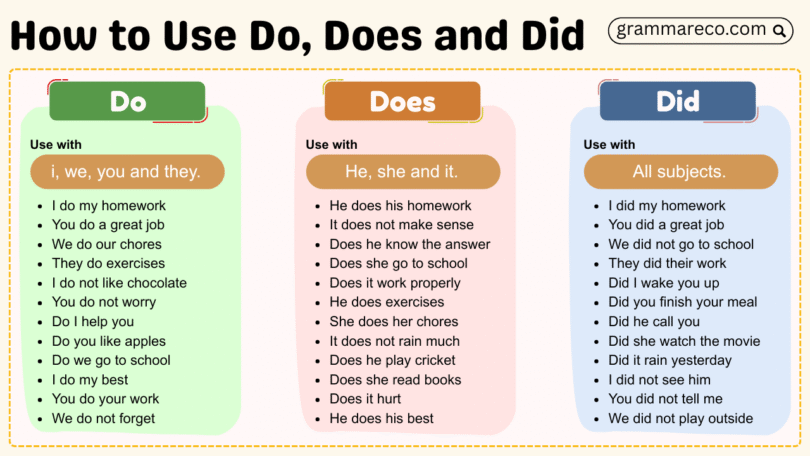
Do is primarily used in the present tense with plural subjects (I, you, we, they). It can act as a main verb meaning “perform” or as an auxiliary verb in questions, negatives, and for emphasis. Learning do correctly strengthens your sentence formation skills.
Examples:
- I do my homework every evening.
- They do their chores before school.
- You do a great job in class.
- We do exercises every morning.
- I do want to join the science club.
Tip: Use do to emphasize action in positive sentences. It adds strength to your statement without changing the meaning.
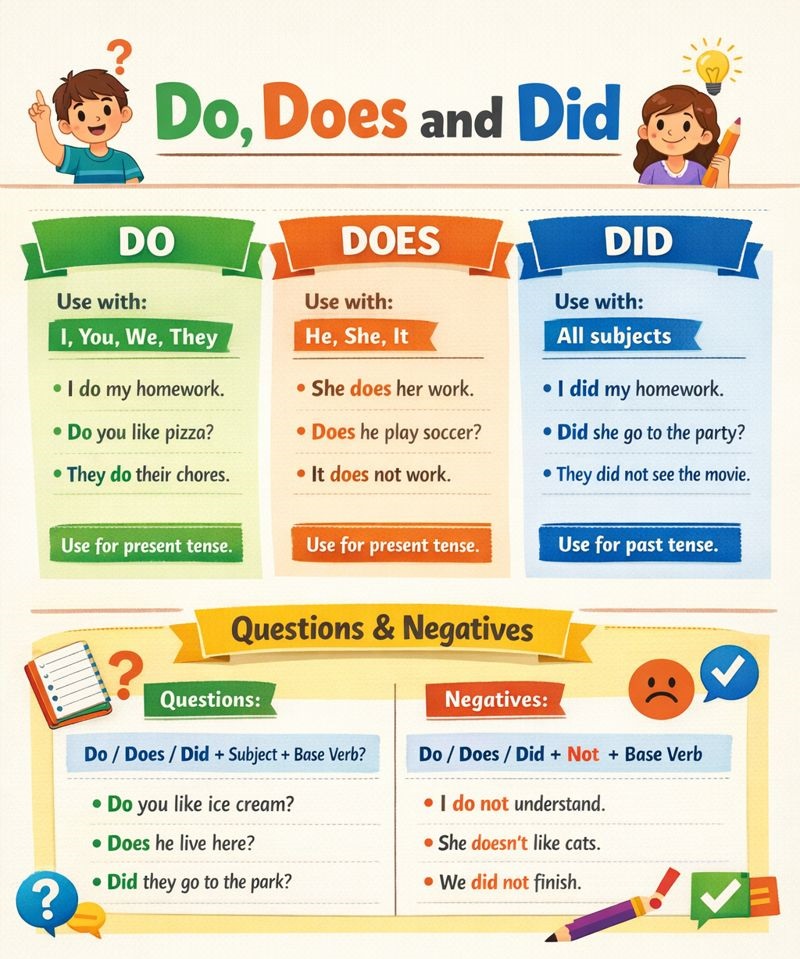
Using do with I, You, We, They
With these subjects, do agrees in the present tense and expresses regular actions or habits.
Examples:
- I do enjoy reading English books.
- You do need more practice in speaking.
- We do celebrate our teacher’s birthday every year.
- They do play football after school.
Using do in Questions
Do is used to form questions in the present tense. It is placed before the subject.
Examples:
- Do you like chocolate?
- Do they play cricket on weekends?
- Do we need to bring our notebooks?
- Do I have to finish this today?
Using do in Negative Sentences
Do is used with “not” to make negative statements in the present tense.
Examples:
- I do not like spinach.
- You do not need to worry.
- They do not attend online classes regularly.
- We do not go to school on Sundays.
Using do for Emphasis
Do can be added to positive sentences to emphasize the action.
Examples:
- I do want to help you.
- She does try her best, and I do admire her effort.
- We do enjoy this game.
- You do look tired today.
Using Does with He, She, and It
Does is the singular form of do for third-person singular subjects (he, she, it). It is used in the present tense in statements, questions, negatives, and for emphasis. Mastering does helps avoid subject-verb mistakes.
Examples:
- He does his homework on time.
- She does the cooking every morning.
- It does seem interesting.
- He does enjoy music a lot.
- She does want to join the debate club.
Tip: Remember, does always goes with he, she, or it. Never use does with I, we, you, or they.
Using does with He, She, It
Used for singular subjects to indicate habitual actions or routines.
Examples:
- He does study hard for exams.
- She does her exercises daily.
- It does make a difference.
- He does care about his friends.
Using does in Questions
Placed before the subject in present tense questions for third-person singular subjects.
Examples:
- Does he like ice cream?
- Does she speak French?
- Does it work properly?
- Does your brother play football?
Using does in Negative Sentences
Used with “not” to negate present tense sentences for he, she, or it.
Examples:
- He does not eat junk food.
- She does not attend online classes regularly.
- It does not belong to me.
- He does not like rainy days.
Using does for Emphasis
Does strengthens positive sentences with singular subjects.
Examples:
- He does try his best.
- She does enjoy reading novels.
- It does look amazing.
- He does want to help you.
Uses of Did in the Past Tense with Examples
Did is the past tense form of do. It is used for all subjects (I, you, we, they, he, she, it) to form past tense statements, questions, negatives, and for emphasis. Learning did is essential for talking about past events.
Examples:
- I did complete my homework yesterday.
- They did visit the museum last week.
- She did enjoy the party.
- He did finish the project on time.
- We did help our neighbors yesterday.
Tip: In past tense, always use did for questions and negatives regardless of the subject.
Using did for Past Tense (All Subjects)
Indicates actions completed in the past.
Examples:
- I did study for the exam.
- You did call your friend yesterday.
- We did play football last evening.
- They did clean the classroom.
Using did in Questions
Used to form past tense questions, always placed before the subject.
Examples:
- Did you watch the movie last night?
- Did he attend the meeting?
- Did they complete the assignment?
- Did she help you with the homework?
Using did in Negative Sentences
Used with “not” to negate past tense sentences.
Examples:
- I did not see him yesterday.
- She did not finish the homework.
- They did not go to the park.
- He did not answer the question.
Using did for Emphasis
Did can emphasize a past action or statement.
Examples:
- I did tell you about it yesterday.
- She did enjoy the show.
- He did complete the task on time.
- We did attend the event.
FAQs about Uses of Do, Does and Did
Do, does, and did are used to make questions, negatives, and emphasize actions. Do is used with I, you, we, and they in the present, like I do my homework. Does is used with he, she, and it in the present, for example, She does her work carefully. Did is used for all subjects in the past, such as They did their project yesterday. These words make English sentences clear and correct.
Do is for present tense with I, you, we, they. Does is for present tense with he, she, it. Did is used for past tense for all subjects.
Yes, do and does can emphasize positive sentences, making them stronger without changing meaning.
Place do or does before the subject. Example: Do you like tea? Does she play piano?
Use did when talking about past actions or events, regardless of the subject.
Read more